Nutanix CEO: VMware Migration Wave Has Years To Run
Broadcom’s VMware changes continue to drive customers and partners towards Nutanix, says CEO Rajiv Ramaswami, who believes the next major opportunity for the channel lies in helping organizations govern AI usage and control spiraling token costs.
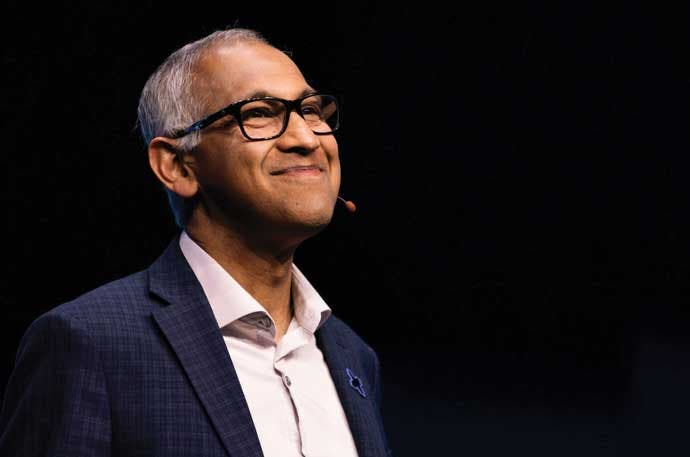
The disruption caused by Broadcom’s acquisition of VMware continues to present a significant opportunity for the channel, according to Nutanix CEO Rajiv Ramaswami, who says the migration wave is still in its early stages and continues to attract both customers and partners to the vendor.
Speaking with CRN UK, Ramaswami said Nutanix is adding between 500 and 1,000 new customers every quarter, with “pretty much almost all of those customers” migrating from VMware.
“We expect that to continue because VMware has a base of a couple hundred thousand customers, so we have plenty of room to continue adding customers and growing our business over the next several years,” he said.
Rather than viewing VMware migrations as a short-term market disruption, Ramaswami believes customers are making long-term infrastructure decisions.
“Customers want to know what they’re migrating to,” he said. “They’re making a 10-year bet, and that bet is on a company that will continue to innovate and deliver what they need over the next decade.”
While Nutanix has won a number of large enterprise customers, Ramaswami said the opportunity extends well beyond the Fortune 500.
“Our architecture enables smaller customers to deploy the solution effectively. Many of these customers don’t have large IT teams, and many of them buy through the channel,” he said.
Services Opportunity Remains Strong
Ramaswami said that creates an ongoing services opportunity for partners.
“Partners drive much of the services engagement needed to help these customers assess and migrate. Nutanix is a product company, not a services company. We encourage partners to build their capabilities on Nutanix, get trained, become certified, and develop services practices around our platform.”
The vendor is also seeing more partners join its ecosystem as VMware customers reevaluate their infrastructure strategies.
“We’ve onboarded a number of new partners over the last year or two,” he said. “We’ve seen more of them come our way, whether they’re resellers or service providers.”
VMware remains one of the most common topics in partner discussions, Ramaswami said, but conversations are increasingly shifting toward AI and Kubernetes.
“AI is one of them, and Kubernetes is the other,” he said. “These are new technologies that partners need to become familiar with and bring to market.”
From VMware To AI Governance
Alongside the ongoing migration opportunity, Nutanix this week announced the general availability of Agent Gateway, part of Nutanix Enterprise AI 2.7. The offering is designed to provide governance, access controls, and visibility across agentic AI deployments.
The product serves as a central control point between AI agents, large language models, and enterprise tools, allowing organizations to monitor token consumption, apply access policies, and manage AI costs across multiple models.
“Tokens are the new unit of currency,” said Ramaswami. “As organizations begin using more AI, they may think they’re doing something simple, but it could be consuming a significant number of tokens behind the scenes—and somebody has to pay for it.”
He said many organizations have limited visibility into which AI tools employees are using and the costs associated with them.
“The first order of business is getting visibility. Some people call it shadow AI because everyone in the organization is doing their own thing with AI,” he said.
An AI gateway provides that visibility, enabling organizations to understand who is consuming AI services, monitor token usage, and implement governance policies, such as restricting access to the most expensive models or setting usage quotas.
Partners Need To Keep Up
Ramaswami believes helping customers navigate those challenges represents one of the biggest opportunities for partners over the next two years.
“I would urge partners to become familiar with the offerings and understand the problems customers are trying to solve,” he said.
He pointed to Nutanix’s own experience as an example. The company has seen AI adoption increase significantly within its software engineering teams, improving productivity while also driving up costs.
“We started out using frontier models, but costs kept rising as usage increased,” he said.
To reduce those expenses, Nutanix invested in dedicated GPU infrastructure to run open-weight AI models internally for most of its software development workloads, while reserving commercial frontier models for more complex tasks.
Ramaswami expects many enterprise customers to follow a similar path as AI deployments mature, balancing public AI services with dedicated infrastructure to optimize costs, improve governance, and address data sovereignty requirements.
Partners, he said, need to understand those options because customer demand is already there.
“This wasn’t even a topic a year ago. Now it is,” he said. “I had probably a dozen customer meetings over the last two days, and this has been front and center in almost every conversation.”
He added that the pace of change means partners cannot afford to stand still.
“This is probably the fastest-moving technology shift of all,” he said. “Partners have to catch up.”
This article originally appeared on CRN sister website CRN UK.