Deloitte CEO On 2026 AI Plans, Removing AI ‘Fear’ And AWS Partnership
‘2026 will be the year where people really realize the value of humans in this AI equation,’ says Deloitte Consulting CEO Jason Salzetti. The firm's CEO talks to CRN about his 2026 AI plans and enterprise goals.

Deloitte Consulting CEO Jason Salzetti wants 2026 to be the year when people move away from the fear of AI and embrace its enormous opportunity, which is already driving huge productivity gains for Deloitte customers.
“2026 will be the year where people really realize the value of humans in this AI equation,” said Salzetti, chairman and CEO of IT services giant Deloitte Consulting.
“Some people have this view that, ‘Hey, we’re just going to drop AI into the enterprise. It’s going to figure everything out, and maybe, displace a bunch of humans,’” Salzetti said.
[Related: AWS re:Invent 2025: The 15 Biggest Products, AI And News Unveiled]
This is not the reality for Deloitte Consulting customers and for businesses worldwide, he said.
“In reality, what we’re actually seeing is that it’s allowing the humans to do the things that they are uniquely capable of, but 10X-ing that because they’re enabled by and supported by the machines,” said Salzetti.
Deloitte Consulting On AI, AWS And 2026 Plans
Deloitte is a $282 billion IT powerhouse.
Deloitte Consulting is the New York City-based company’s consulting services arm that is one of the biggest consulting firms in the world and a top global partner of Amazon Web Services and SAP.
Salzetti has been with Deloitte for more than 30 years, including most recently leading its U.S. Government and Public Services Industry business.
In an interview with CRN, Salzetti talks about what gets Deloitte Consulting excited about AI in 2026, enterprise buying market trends, innovating with AWS and shifting to an outcome-based business model for clients.
“We’re trying to get our clients to shift to more of, ‘How do we share in the value that we create?’ So that’s our value-creation, outcome-based model. That’s a big thing going into 2026. When I’m talking to our senior clients, they’re very interested in that because then it shifts the risk,” he said.
What makes you excited about 2026?
We’re early innings on getting all this agentic AI into production at scale.
The use cases right now tend to be fairly narrow, but what we’re seeing is this middle-out approach.
So you start to solve this problem and then you realize, ‘Well, I’ve actually just exposed that there’s other issues upstream and other issues that are downstream.’
So you start working it out. And as you do that, you start to take on much more of the enterprise’s data. Then as you do that, it compounds in the value proposition. So there’s a lot of exciting things there.
2026 will be the year where people really realize the value of humans in this AI equation.
In almost every client we’re talking to [it] is about human-led, AI powered. As opposed to, some people have this view that, ‘Hey, we’re just going to drop AI into the enterprise. It’s going to figure everything out and maybe displace a bunch of humans.’
In reality, what we’re actually seeing is that it’s allowing the humans to do the things that they are uniquely capable of, but 10X-ing that because they’re enabled by and supported by the machines.
2026 will be the year that really comes to the forefront, and hopefully we move away from some of the fear side of the equation and move toward the excitement side.

What are you seeing with your enterprise clients in terms of AI market trends? Where is Deloitte’s sweet spot?
The places where we’re seeing a ton of success [are] around value orchestration.
Clients are looking at AI and saying, ‘The board in the C-suite has gotten really excited about AI and the promise of AI.’
Then you get down a layer or two in the organization and they’ve spun up a bunch of initiatives and said, ‘OK, which of these are actually going to scale and go into production?’
That’s where our sweet spot is.
Because we’re not just a technology implementer, we’re not just a managed services firm—we have the true end-to-end capabilities. We understand their business. We understand their industry. We have thought leaders that know the direction of travel here. Then we can map that all the way through to implementing and operating their core technology with our partners like AWS.
That’s where we’re seeing a ton of growth—really helping clients make sense of a lot of the things going on in the market.
This value orchestration layer is like, ‘Hey, if you’re going to go spend this money, how do you spend it and get the highest return on your investment?’
Can you give me a successful enterprise AI use case for Deloitte Consulting? What was the challenge and what did AI solve?
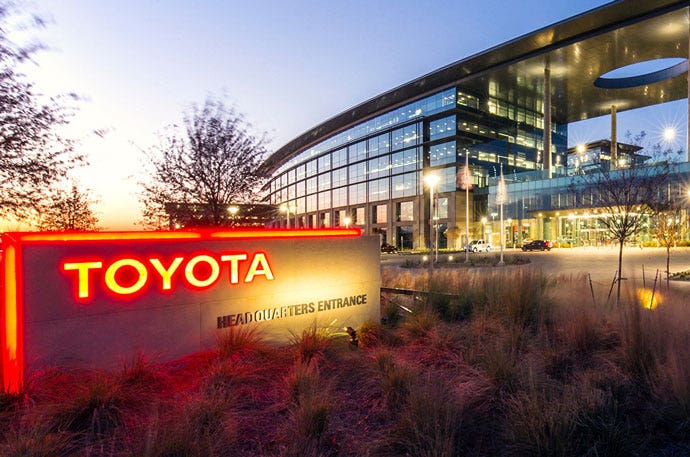
Toyota North America started on a journey two or three years ago to figure out, ‘What are the possibilities of leveraging AI and agents?’
We dug in with them with our AI agents and technology. We really went deep on the supply chain, looking at that supply chain end to end.
We said, ‘They need to have visibility to figure out [when] they’re manufacturing a car where that is in the manufacturing life cycle, etc.—all the way through to how [do] they get it to a dealer and get it sold in the U.S.?’
Then you pull in all the geopolitical issues and challenges that that they’re dealing with and they needed real-time instrumentation, real-time visibility and then predictive modeling around, ‘If I’ve got a car that’s at this stage of manufacturing, how soon can I get it to that dealer to get it sold?’ So when somebody wants that new 4Runner in a certain configuration, they can actually sell it to them.
What that ended up doing was actually driving pretty significant top-line and bottom-line results for them. We helped them develop solutions like parts forecasting and dynamic pricing.
This is something that we did very much jointly with AWS, leveraged a whole suite of their technologies and solutions, everything from Bedrock to core cloud services.
We’re seeing a ton of growth in those solutions because as the technology has matured and it’s gotten easier to use and deploy, that time to value is just decreasing very rapidly.

What’s one area where Deloitte is innovating alongside AWS for joint customers?
One example is on the AWS Marketplace [where] we have particular AI agents built specifically targeted at CFOs.
When you think about what a CFO or a finance organization has to go through—especially for large public companies to get their quarterly earnings releases out and their annual financial statements—there’s hundreds, if not thousands, of spreadsheets, interactions, checkpoints, review processes, checking with their external auditors, checking with different financial analysts, internally and externally, etc.
So we’ve come up with a suite of agents built on Amazon Bedrock AgentCore that can help streamline that process and take a lot of the manual effort out of it.
We’re also doing some forecasting, some predictive modeling, and even predicting what questions external analysts might ask to prep those executives for their earnings calls.
So that’s the type of solution that is deployed in the Marketplace. We’ll have clients that might discover it through that channel versus our direct channel.

What’s one big go-to-market shift you’re planning for 2026? How do you plan to drive more sales and customer stickiness?
To get the market and to bring our clients along this journey of transforming to procuring from us based on outcomes.
So really tying our incentives directly with their incentives.
We have segments of our clients who are already doing that. We’ll say, ‘We can use AI to transform your business. We can increase your margins ‘X’ percentage, and we want to share in that.’
That would be much more of an outcome-driven model.
As opposed to what historically has been more of like an input-based model, for example, ‘It’s going to take this many hours, times this rate, for this resource to do something.’—that’s the input-based model.
We’re trying to get our clients to shift to more of, ‘How do we share in the value that we create?’ So that’s our value-creation, outcome-based model.
That’s a big thing going into 2026. When I’m talking to our senior clients, they’re very interested in that because then it shifts the risk.
It’s more of a shared risk profile, not them just taking on the risk and paying by the hour. So that’s really exciting.