HPE’s Nvidia AI Factory Solution Blitz: What You Need To Know
HPE Tuesday teamed with Nvidia to unleash its next-generation AI Factory solutions, including the second generation of HPE Private Cloud AI, a new air-gapped capability for HPE’s Alletra Storage MP X10000 and agentic AI governance functionality for HPE’s Data Fabric.
HPE AI Vice President of AI Business Development for Hybrid Cloud Robin Braun said the new HPE Nvidia AI Factory solutions being unleashed at the Nvidia GTC conference this week are helping customers overcome significant AI challenges and even high AI failure rates.
In fact, HPE-Nvidia AI Factory is squarely focused on providing a holistic approach to its Nvidia AI Computing portfolio that addresses the “high failure rates of achieving an [AI] outcome that can scale,” said Braun in a press conference detailing the new offerings.
Specifically, Braun said, HPE’s expanded turnkey AI factory solutions are aimed at helping customers bring “more measurable and predictable” solutions to customers, who have been plagued by “fragmented” AI goals and strategies.
“When you start to think about AI scattered across different initial experiments or pilots, this is about how by potentially centralizing those workflows and helping to create reusable assets and infrastructure, you can start to truly gain that scale that is necessary to make it repeatable and sustainable,” Braun said.
A recent HPE-funded research project focused on “Architecting An AI Advantage” found that while 22 percent of organizations have operationalized AI in the last year, fewer than half of them term their overall deployment efforts a success.
In fact, 35 percent to 40 percent of the respondents said their AI deployment use cases garnered “limited success.” What’s more, HPE said nearly 60 percent of organizations have fragmented AI goals and strategies. The survey of 1,775 IT leaders across nine global markets was done by Sapio Research.
HPE said it is focused squarely on making sure that it can operationalize, maintain and life-cycle-manage the new era of private AI solutions with “speed and predictability of deployment” with governance and control, said Braun.
“We are all excited by the promise of what AI can bring, but we need to make sure that it has that transparency, explainability and governance to ensure that the outcomes you are achieving are the right ones within the right guardrails for your business and mission,” Braun said.
At the top of the list of the new solutions is the second generation of HPE’s Private Cloud AI along with a new air-gapped capability for HPE’s Alletra Storage MP X10000 and agentic AI governance functionality for HPE’s Data Fabric.
The new offerings come with AI “no longer really optional” for businesses, said Braun.
“We say with individuals that AI won’t replace you—however, the person using AI very well may [replace you],” she said. “That’s the same thing we talk to customers about. It has become a strategic imperative both for their business and their mission.”
Here is a look at the HPE -Nvidia AI Factory solutions unveiled this week at Nvidia’s popular GTC conference.
The Second Generation Of HPE Private Cloud AI
Topping the list of new offerings is the second generation of HPE’s turnkey Private Cloud AI service co-developed with Nvidia.
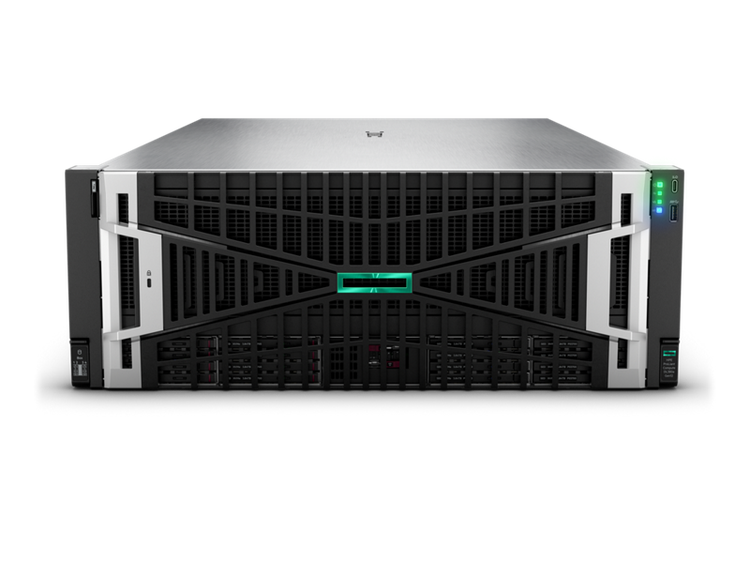
The new HPE Private Cloud AI for the HPE Gen12 ProLiant DL 280a—which features Nvidia RTX Pro 6000 Blackwell Server Edition GPUs—delivers three times better performance than the first-generation offering. It is also upgradeable, opening the door for partners to start customers in a small form factor and then move up.
The new Private Cloud AI can also be integrated into an air-gapped managed, secure private cloud that is attracting “very high” interest from customers, said Braun.
HPE Services, meanwhile, is providing a new offering that leverages Nvidia NeMo frameworks to create “digital avatar assistants” designed to deliver AI-based customer interactions for applications for smart cities, retail, manufacturing, health care, banking, finance and education.
The turnkey HPE Private Cloud AI service—which was designed from the outset to be up and running in three clicks—provides the ability to “deploy in days, not months,” said Braun.
“When you think about the ROI and the value proposition for the customer, being able to be production-ready on day zero, that full-stack integration, that speeds not only the implementation of initial models but also ISVs so they know and can depend on what the stack beneath them is going to be,” she said.
The interest in the air-gapped version of HPE Private Cloud AI has been “very high,” said Braun.
HPE is also releasing a new system adoption accelerator service for HPE Private Cloud Developer Edition that provides users with “comprehensive post-installation” testing that includes sample “prebuilt pipelines and knowledge transfer sessions for data science teams.”

SHI’s HPE Private Cloud AI Smart City Solution For Vail, Colo.
SHI—the $16 billion solution provider powerhouse—is being hailed as an AI star by HPE for its ability to deliver an agentic AI smart city solution built with HPE Private Cloud AI for the jet-set ski town of Vail, Colo.
HPE Vice President of Global Hybrid Solutions Ulrich “Uli” Seibold singled out SHI as a “role model,” acting as the quarterback piloting the breakthrough AI solution from start to finish.
“SHI was the first worldwide partner for this,” said Seibold. “So they built the ecosystem with our Unleash AI partners. They built the consulting capabilities to build a smart city in Vail with traffic control, skiing events, parking tolls, weather conditions, all automated.”
The Vail smart city solution with SHI holding the contract with the town of Vail also included co-development by Nvidia; Blackshark.ai, which makes geospatial AI and early fire detection solutions; Kamiwaza, an automation and real-time decision-making software provider; ProHawk AI, an enhanced compute vision platform; and Vaidio, a real-time video intelligence and behavior analytics application.
Braun, for her part, said the HPE agentic AI smart city solution for Vail “changed the game” by bringing together multiple AI capabilities to deliver a comprehensive solution that unified siloed data and infrastructure to “automate” everyday tasks.
“By being able to create and leverage an agentic AI platform it becomes an easy-to-adopt, scalable model for municipal and government AI adoption that becomes repeatable. It is able to expand across other towns and cities as we move forward.”
Key to the engagement was SHI’s AI prowess with its unique “Imagine, Experiment and Adopt” methodology that is aimed at quickly identifying use cases and delivering tangible return on investment for customers.
In the case of Vail, SHI identified over 20 use cases and refined it to the four most impactful use cases with AI-driven results that include enhancing public safety with earlier wildfire detection and faster emergency response times.
The smart city solution also provided AI-driven 508 compliance to ensure Vail municipal websites are accessible to people with disabilities. That capability alone, SHI said, reduced three years of work into a weekend as a result of the use of AI.
“We really took them from ideation all the way to implementation through our process and orchestrated that across all of those partners in the ecosystem, which as you can imagine is no small feat,” said SHI Vice President of Advanced Growth Technologies Jack Hogan in an interview with CRN. “One of the biggest areas of this now is being able to say we can bring together a full ecosystem of different software providers, a core platform on the HPE Private Cloud for AI that can be managed and operated using the Nvidia GPUs, the Nvidia stack software and Nvidia AI Enterprise and ultimately deliver full solutions that can now be replicated across other towns, cities, states and local governments.”
New Agentic AI Data Governance For HPE’s Unified Data Fabric Software
HPE unveiled new agentic AI data governance capabilities for HPE Data Fabric Software that powers twice the performance on HPE’s Alletra Storage MP X10000 storage platform and also runs in air-gapped environments.
HPE Vice President of Unstructured Data for Hybrid Cloud Gokul Sathiacama said the HPE Data Fabric Software with its unified data layer is bringing together multiple sources of data under a single federated name space. “This enables us to provide governance and compliance and provide vast amounts of heuristics for our customers,” he said.
The agentic AI governance solution brings together the Alletra Storage MP X10000’s data storage capabilities with the HPE Data Fabric Software, which is providing data management. “As we complement these products together, this provides this unified data layer,” he said.
HPE is also announcing that the Alletra Storage MP X10000 can now support a private air- gapped solution. “Customers who have the need to have air-gapped deployments are able to do so in their own data centers as opposed to accessing and managing their systems through our cloud platform,” said Sathiacama.
Finally, HPE in partnership with Nvidia is also providing the ability to do remote direct memory access for object storage, which will provide two times more storage throughput.
“This reduces the latency by up to 80 percent and then reduces the CPU utilization up to 99 percent,” said Sathiacama. “This means more utilization of your compute infrastructure and more processing power for the storage solution.”
HPE Unleashes New ProLiant Servers With Latest And Greatest From Nvidia
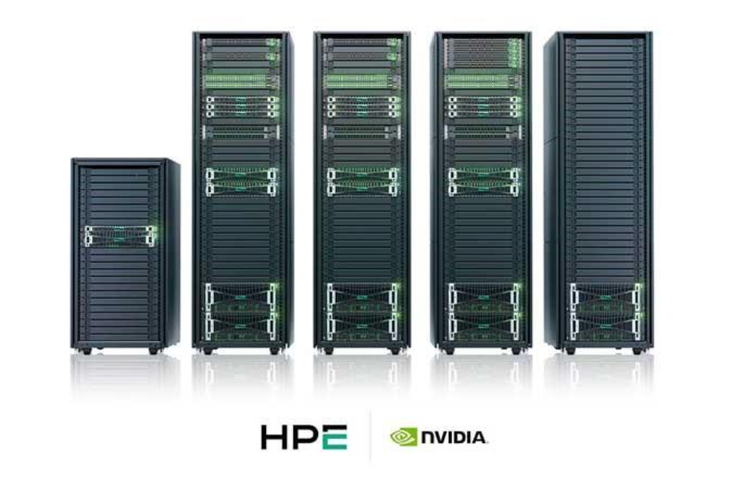
HPE unveiled its next-generation HPE ProLiant servers with the latest and greatest GPUs and technology offerings from Nvidia.
HPE Vice President of High Performance Compute and AI Solutions Chris Davidson said the new systems are designed to power a wide range of solutions from specialized agentic AI agents to large language models that require massive infrastructure.
“We meet them anywhere they are along their AI journey across model developing, training, tuning and inferencing,” he said. “Partnering with Nvidia, we have a range of solutions.”
Among the new offerings is the HPE ProLiant Compute XD685, which now supports eight Nvidia Blackwell Ultra (B300 HGX) GPUs in a 5U, direct-liquid cooled chassis.
HPE said the XD685 is optimized for AI service providers and neoclouds, as well as ambitious enterprises and model builders that need to stand up large, secure and validated AI clusters.
HPE also unveiled the Nvidia GB300 NVL72 by HPE, which is designed for AI models of more than 1 trillion parameters. The Nvidia GB300 NVL72 by HPE is now available to order and expected to ship in December 2025. “This is the second generation of Nvidia’s rack-scale solution which features Nvidia Grace CPUs, it features the Blackwell Ultra GPUs, and a specialty management software stack to make sure you drive efficiencies from that,” said Davidson.
The GB300 NVL72 by HPE utilizes Nvidia NDLink, which effectively creates a single GPU within a rack.
“The big differentiator that HPE brings to the table here is going to be our deployment with [HPE] global services, areas that we have been very successful in, some would say even more successful than our competitors,” he said.
Finally, HPE is unveiling the HPE ProLiant Compute DL380 Gen12 Server with the Nvidia RTX Pro 6000 Blackwell Server Edition GPUs for AI, graphics and VDI workloads. “This is built for boosting AI graphics performance,” said Davidson.
The new HPE DL380 Gen12 is also being offered as a server solution for Microsoft Azure local. “This gives customers the option to deploy a hybrid cloud infrastructure if they like and drive analysis where Azure local services are available,” he said.
HPE-Nvidia Public Sector Drive To Accelerate Sovereign AI, Supercomputing And Quantum Computing
HPE is working hand in hand with Nvidia to drive public sector AI computing leadership.
In fact, Davidson said, HPE is working with Nvidia to bring “cutting-edge technologies and cutting-edge innovation” to the U.S. Department of Energy and National Labs.
“As science and ultimately the workloads are becoming more AI-driven, we are proud to build on that rapport and leadership within the supercomputing space and the innovation to support our federal and public customers,” said Davidson. “Together with Nvidia we are building some of the world’s most powerful AI supercomputers to tackle some of the biggest problems and most complex problems out there,” he said.
HPE recently unveiled a new partnership with the University of Utah to roll out secure sovereign AI factories to drive economic development in the state of Utah.
Braun, for her part, said HPE is turning AI into “tangible citizen outcomes” in the public sector with its smart city solutions.
HPE, she said, is “delivering faster AI value and outcomes, strong compliance and proven results at mission-scale.”