Microsoft Ignite 2025: The Biggest News In AI, Agents, Data
The most captivating news includes Agent 365, Microsoft 365 Copilot vocal commands and Windows 365 agent creation capabilities.
An Agent 365 control plane for artificial intelligence agents, new vocal commands for Microsoft 365 Copilot and a way to create enterprise-grade agents in Windows 365 are some of the biggest announcements in AI, agents and data products at Microsoft Ignite 2025.
The updates by the Redmond, Wash.-based tech giant speak to one of Ignite 2025’s major themes of companies embracing AI technologies early and becoming what Microsoft calls frontier firms, embedding AI across every layer of their business to scale faster, deliver more value and make better decisions.
One way for Microsoft’s ecosystem of 500,000-plus partners to get ahead in the AI era is becoming an AI “customer zero” by internalizing Microsoft AI products and weaving them into operations, building real-world experience and insight with the tools, Nicole Dezen, Microsoft’s chief partner officer and corporate vice president for global channel partner sales, said in a blog post Tuesday.
“By leading as Frontier Firms, these Customer Zero partners enrich employee experiences, reinvent customer engagement, reshape business processes, and bend the curve on innovation with AI, Copilots, and agents across their own organizations,” Dezen said.
[RELATED: Microsoft Windows 11 Receives Agentic AI Updates]
Microsoft Ignite 2025
Other major news to come out of Ignite 2025 related to Microsoft’s portfolio of AI, agentic and data products include:
- Expanded Windows 365 Link availability
- A limited preview for Azure Copilot
- A preview of the Fabric IQ workload for the Fabric data platform
Here are more of the biggest reveals from Microsoft in San Francisco this week.
Frontier Program Updates
Microsoft is rolling out more access to cutting-edge technology for members of its Frontier program for trying out the latest AI agents and Microsoft 365 Copilot features.
In the coming weeks, Frontier members will have the ability to voice-activate Microsoft 365 Copilot by saying “Hey Copilot.”
Frontier members now have access to Agent Mode in PowerPoint, the Sora 2 AI video creator and workforce insights agent for real-time data-driven workforce decisions across roles, tenure and location.
Members also have access to the Agent 365 control plane for agents. A365 offers a single source of truth registry for all agents in an organization and resource access control. A unified dashboard shows connections among agents, people and data. Users can also monitor agent behavior and performance in real time.
A365’s security capabilities aim to protect agents from threats and vulnerabilities. Users can leverage A365 for detecting, investigating and remediating attacks that target agents, according to Microsoft.
A365 can help deploy, organize and govern agents from Microsoft’s own Copilot Studio and Foundry tools, open-source frameworks and third-party vendors including Adobe, ServiceNow, Manus AI and Workday.
In December, Frontier Program members will have access to a sales development agent that can autonomously help build pipeline, nurture leads and personalize outreach through its connection to Salesforce, Dynamics 365 and other CRM tools.
Features coming soon but not given an exact rollout date for Frontier members include multi-tab reasoning in the Microsoft Edge for Business secure enterprise browser.
Microsoft Copilot Upgrades
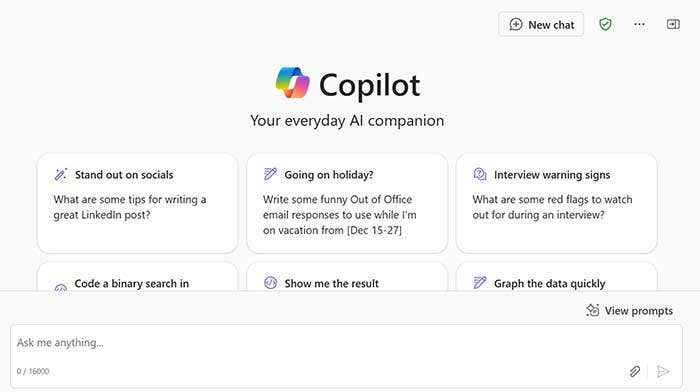
Becoming generally available in December are new voice commands for the Microsoft 365 Copilot application, including the ability to vocally ask phones “What are my top priorities for the day?” and “Catch me up on the meeting I missed” and getting a response.
In public preview is the ability to vocally ask Copilot in Outlook to triage inboxes and calendars. Now generally available are one-tap prompts by phone to summarize and reply to emails and schedule meetings.
Microsoft now has a public preview for Teams Mode for Microsoft 365 Copilot. This mode aims to turn one-to-one Copilot chats into group chats in the Teams collaboration application.
Also in public preview is the ability for Teams users to ask an agent in a channel to work with third-party applications and agents through model context protocol (MCP) servers. Asana and Atlassian Jira users, for example, can leverage the agent for finding blockers and mitigation plans for an upcoming product launch.
Now generally available is a facilitator agent in Teams that can take notes, keep meetings on track and manage actions from the meeting, according to Microsoft.
Windows Cloud PC Updates
Microsoft has launched a private preview for Windows 365 for Agents, which allows for enterprise-grade agent creation and deployment of AI agents in secure, policy-controlled cloud PCs.
W365 for Agents can power Microsoft Copilot Studio in a full Windows environment and Microsoft Researcher in a Linux environment among other scenarios, according to the vendor. W365 offers an option for scalable and always-available compute for AI agents with compliance protections already established in a user’s Microsoft products.
AI agent companies including Manus AI, Fellou, GenSpark, Simular and Tinyfish are all leveraging W365 for Agents for their AI products.
Now generally available for cloud PCs is Windows 365 Cloud Apps and User Experience Sync for Windows 365 Frontline. Users can leverage these capabilities for delivering line-of-business applications without streaming the full desktop.
This should benefit users by reducing overhead while maintaining W365’s security and compliance. User Experience Sync keeps application settings and configurations persistent for each user across sessions.
Coming soon for users accessing Windows in the cloud are regional host pools for removing cross-region dependencies in the connectivity platform.
W365 users will soon have Microsoft Hosted Networks for multi-region cloud PC distribution to reduce single-region dependencies.
A new W365 migration API aims to simplify on-boarding and moving users from Azure Virtual Desktop and other Azure virtual machines to cloud PCs.
Now generally available is Windows 365 Reserve, which gives users temporary cloud PCs if their primary device isn’t working or is lost, stolen or compromised. Reserve cloud PCs come with all necessary apps and policies.
Windows Agents
Microsoft unveiled a host of capabilities in preview for Windows, with plans to roll those capabilities out over time.
New capabilities in preview for Windows 11 and Copilot+ PC users include an improved Windows Search for finding local and cloud files plus the ability for “click to do” to turn any tables on screen into an Excel table.
Users gained previews for the ability to rewrite and compose any text box in any app with offline support on Copilot+ PCs, generate summaries in Outlook through AI, automatically generate alt-text for images in Office documents for accessibility and take words spoken aloud by the user and turn them into text with corrected grammar, punctuation and filler words in real time, according to Microsoft.
Among the capabilities in preview are agent connectors and a dedicated agent workspace in Windows to allow agents to operate securely on devices and in the cloud as part of the operating system experience.
Agent connectors are powered by model context protocol (MCP) and offer a standardized framework for first- and third-party AI agents. Agent workspace gives users a contained, policy-controlled, auditable environment for agents to interact with software with their own identity as if they were human users. The agents can perform tasks on a user’s behalf in parallel without disrupting the user’s primary session.
Microsoft has made the option to put its Ask Copilot feature on the taskbar in Windows available as a public preview.
Users can access by voice or text Microsoft 365 Copilot, agents and search through this taskbar option, according to the vendor. From the taskbar, users can find applications, files and settings. They can also launch, invoke, monitor and manage AI agents. Users can monitor agent progress through hover, badges, notifications and other typical user experience patterns.
Users can also invoke agents directly from Ask Copilot on the taskbar with the tools button or by typing “@” if they don’t want to speak aloud.
Microsoft plans to introduce more first- and third-party agents that users can launch from the taskbar “soon.”
Microsoft launched previews for new Windows artificial intelligence APIs. The Stable Diffusion XL (SDXL) API allows for high-quality image generation. The video super resolution (VSR) API aims to upscale low-resolution streams.
Now in private preview, an app content search API for developers allows for fast in-app search experiences.
Windows ML, now generally available, promises a unified execution layer for streamlining the deployment of custom or proprietary models across a diverse Windows hardware ecosystem. Windows ML ensures models run efficiently on CPUs, GPUs and NPUs without rewriting code for different hardware targets.
Windows 365 Link
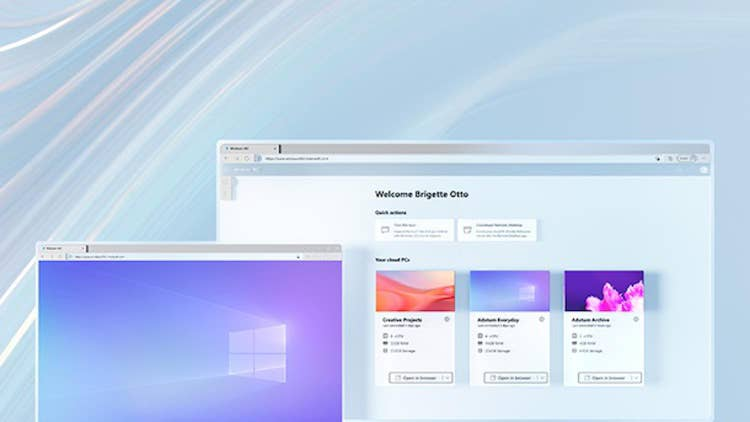
Microsoft will expand Windows 365 Link general availability to Belgium, Finland, Ireland, Italy, Poland, Singapore and Spain starting in February. Next year, Microsoft hopes to have more major commercial PC OEM partnership announcements to further scale its portfolio of W365 cloud PC devices.
Entering preview in the first half of 2026 is an integration with Webex by Cisco to enable high-fidelity meetings on cloud PC devices.
Expected to enter general availability in early 2026 is Link support for pairing Bluetooth devices during Cloud PC device out-of-box experiences, tenant branding to set custom wallpapers, logos and names on cloud PC device sign-in screens and the ability to restore Cloud PC devices using a bare metal recovery image, according to Microsoft.
Azure Copilot Limited Preview
Microsoft is making a limited preview available for Azure Copilot, a new agentic interface that orchestrates specialized agents across the entire cloud management life cycle with built-in governance for enterprise scale.
This Copilot goes beyond the Copilot in Azure conversational AI assistant to give users agents that can perform chain-of-thought reasoning, plan and execute actions on the user’s behalf, according to Microsoft.
The agents can help with modernizing legacy applications, reducing technical debt and accelerating cloud readiness. Users can ask the agents to assess on-premises apps and recommend the best Azure modernization approach. They can even ask an agent to deploy a Python Flask app with a PostgreSQL back end, secure secrets in Key Vault and enable monitoring with Application Insights.
The agents can help with observability, with users asking an agent to investigate alerts with specific alert identifiers. Agents can show users top cost-saving opportunities and generate PowerShell commands to apply them.
Finding workloads that aren’t zone-resilient and suggesting fixes and diagnosing connectivity issues on a VM and recommending next steps are some other use cases for the agents.
More Azure Previews
Logic apps connectors, now in public preview, make more than 1,400 business systems available as model context protocol tools as part of Azure AI Foundry’s expanded tools layer unveiled at Ignite 2025.
SAP, Salesforce, ServiceNow and Workday are among those business systems, according to Microsoft.
Another public preview allows users to make internal APIs or custom MCP tools available using API Management and API Center to make every system of record part of an agent’s workflow.
Other public previews include Microsoft Agent Framework Enhanced Durable Functions supporting multi-agent patterns with built-in orchestration and OpenAI software development kit integration, Azure Container Apps runtime protections and confidential containers and simplified deployment through Docker Compose.
Managed Instance on Azure App Service is another capability in public preview. This capability should allow organizations to bring Windows services, custom runtimes and legacy dependencies into a Platform-as-a-Service environment without code rewrites to speed up migrations. Confidential containers on Azure Red Hat OpenShift are now generally available for secure modernization of regulated or sensitive workloads.
Azure Kubernetes Fleet Manager for Arc-enabled clusters is now in public preview for organizations managing and deploying distributed and AI workloads across hybrid, edge and multi-cluster environments through a single control plane.
A public preview for managed system node pools allows Azure to operate critical Kubernetes components that previously ran in customer environments, simplifying operations and improving reliability, according to Microsoft.
Azure HorizonDB for PostgreSQL, in preview, promises users a fully managed Postgres-compatible database service for modern enterprise workloads. Azure HorizonDB is initially available in the Central U.S., West U.S. 3, U.K. South and Australia East regions.
Azure GA Capabilities
Generally available enhancements to Azure include MCP servers hosting in Azure Functions, policy-driven governance for MCP endpoints and Azure API Center as an enterprise MCP registry.
Logic Apps agent loop, now generally available, allows developers to automate iterative, AI-driven business processes without custom code, according to the vendor.
A generally available enhancement to API Management is AI Gateway—also available in the Foundry Control Plane–—or securing model access, enforcing policies and optimizing token usage. Azure also has a public preview of Google’s Agent2Agent Protocol API support to secure application-to-application integration.
API Management Premium v2 is now generally available for users looking for a high-performance tier for the most demanding workloads for higher capacity, unlimited included calls, lower latency and advanced security features, according to Microsoft.
A new pod readiness service-level agreement is now generally available for making eligible pods ready within five minutes at the 99.9th percentile. And an Azure site reliability engineering agent in general availability promises AI-powered diagnostics and prescriptive insight directly into the platform.
The Azure DocumentDB open-source, MongoDB-compatible document database is also now generally available. The database promises open-source access without sacrificing scale, security or simplicity, according to Microsoft.
Elastic Clusters for Azure Database for PostgreSQL offers developers a way to scale a single database across a cluster of read and write nodes using a SQL command. And Azure Cosmos DB Fleets allow multi-tenant apps to share throughput capacity across multiple database accounts while maintaining full security and performance isolation.
Microsoft Fabric, Data Product Enhancements
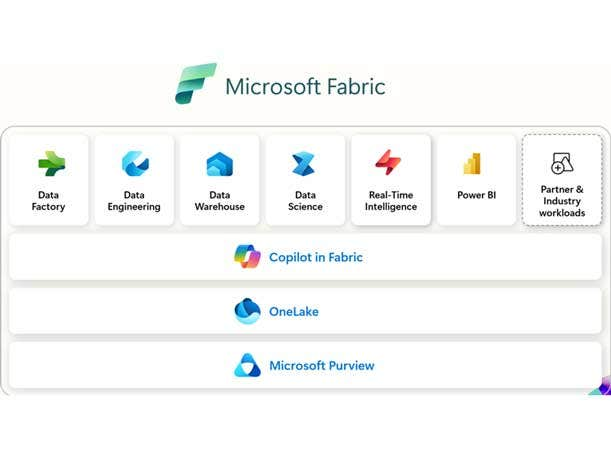
Entering preview for the Microsoft Fabric data platform is Fabric IQ, a workload that unifies data with operational systems under a semantic model of business entities and their relationships.
Fabric IQ doesn’t replace data estates, according to the vendor. Instead, it is meant to be a force multiplier for investments users have already made.
Mirroring for Dataverse and Mirroring for SAP—powered by SAP Datasphere—also entered preview, giving users a way to work with data without extract, transform, load processes.
Previews of shortcuts to SharePoint and OneDrive should also allow users to bring unstructured productivity data into OneLake without copying files or building custom ETL flows when using that data to train agents and provide context.
AI-powered transforms bring semantic understanding directly into the transformation layer, allowing for sentiment analysis, entity extraction, personally identifiable information obfuscation, summarization and other scenarios.
A preview of the dbt job provides a fully integrated, SQL-native environment for managing dbt workflows without external setup for modularity, testing, documentation and continuous integration and continuous delivery in Fabric.
Entering preview in the first quarter of 2026 are expanded surge protection and a new Fabric capacity overage tool. Surge protection allows limit setting on specific workspace activity to protect capacities from unexpected surges from noncritical workspaces. Fabric capacity overage allows administrators to automatically pay for excess consumption and avoid throttling in high-traffic periods.
New generally available functions for Fabric include SQL and Cosmos databases in the platform and mirroring for PostgreSQL, Cosmos DB, SQL Server 2025 and Snowflake. Outbound access protection support for Spark and SQL Analytics Endpoints, customer-managed keys plus warehouse snapshots and large string data types are also generally available.
GitHub Copilot, SQL Server 2025
Microsoft has expanded GitHub Copilot’s application modernization abilities with new support for .NET Framework-to-Core and code-to-cloud upgrades and Java modernization in IntelliJ.
Containerization support is now generally available, while new PostgreSQL and SQL modernization assistants are available in public preview, according to the vendor.
As for SQL Server, Microsoft has made the 2025 edition generally available for users looking to accelerate AI innovation with the data they already have.
Users can leverage advanced semantic search for deeper insight and natural language experiences across enterprise data, according to Microsoft. Developers can switch between AI models without changing code, and they gained native support for vector embedding, text chunking and other essential AI building blocks.
SQL Server 2025 enhances cloud agility with support for database mirroring in Fabric and introduces more modern identity and encryption practices. Users can also now try new features in preview even while SQL Server is generally available with an opt-in mechanism through database-scoped configurations. Microsoft’s goal is to make preview features generally available within about 12 months, according to the vendor.