MuleSoft SVP: Partners ‘Are A Huge Part’ Of Managing AI Agent Sprawl
‘No one has best practices yet, so it’s almost like the partners and we and our customers need to work together as a triumvirate to figure out what the best practices look like,’ says MuleSoft Senior Vice President and General Manager Andrew Comstock.

Salesforce subsidiary MuleSoft is positioning its new artificial intelligence agent integration, connection and governance capabilities as a way solution providers can get ahead of the sprawl and siloing that can happen as organizations start to adopt AI tools and as applications start to add their own agents.
“Partners are a huge part of this,” Andrew Comstock, MuleSoft senior vice president and general manager, told CRN in an interview. “No one has best practices yet, so it’s almost like the partners and we and our customers need to work together as a triumvirate to figure out what the best practices look like.”
The integration platform provider is best positioned as a tool for corralling AI agents, Comstock argued, because of the value it brought to the cloud era around APIs and application integration, connection and governance. The agentic era is a natural extension of those capabilities, he said.
[RELATED: What Salesforce’s Q2 Says About Enterprise Software In The AI Era]
Agentic MuleSoft
Kurt Anderson, managing director and API transformation leader at MuleSoft partner Deloitte Consulting, told CRN in an interview that AI can accelerate the scoping, design, implementation, testing and deployment of moving legacy workloads from legacy providers or to a more favorable licensing structure.
“The workloads that run on MuleSoft and run on competing tech stacks are the heart of many businesses,” Anderson said. “It’s a great place for us to help our customers tend to those very important workloads and do that work in a very quality-centric way.”
Founded in 2006 and acquired by San Francisco-based Salesforce in 2018, MuleSoft’s recent revenue growth acceleration has helped its parent company overcome products in its portfolio that are seeing deceleration, including Marketing Cloud and Commerce Cloud, Salesforce revealed during its latest quarterly earnings report earlier this month.
MuleSoft is likely to get even more attention from its parent as Salesforce closes on its $8 billion deal for cloud data management vendor Informatica.
Comstock wasn’t ready to talk about synergies with Informatica before the deal’s expected closing date in the fourth fiscal quarter or early in fiscal year 2027. But in June, a report by Morgan Stanley said that MuleSoft’s go-to-market can help better distribute Informatica products, with distribution an underinvested part of the acquisition target.
Here’s more of what Comstock had to say about using the integration platform in the agentic AI era and the role of solution providers in preventing sprawl for customers.
What do you want partners to know about MuleSoft Agent Fabric?
Today, the average enterprise has almost 900 apps. And that’s the average. When I present that to a large multinational, they’re like, we have 900 in just HR.
They all want those systems to be smarter. And we saw ‘smarter’ used to be more integrated.
For the first time in 15 years, 10 years, whatever you want to call it, we’re in the next phase, that early phase of that transformation to the agentic enterprise.
That is being powered by AI and agents. And this is prompting us to have this feeling of déjà vu .
We solved the connectedness of apps challenge. We solved the governance of applications. We solved how you manage the connections between systems. And MuleSoft Agent Fabric is taking that two decades of knowledge and skill and experience and bringing it to the genetic landscape to enable agentic enterprises or companies who want to become more agentic.
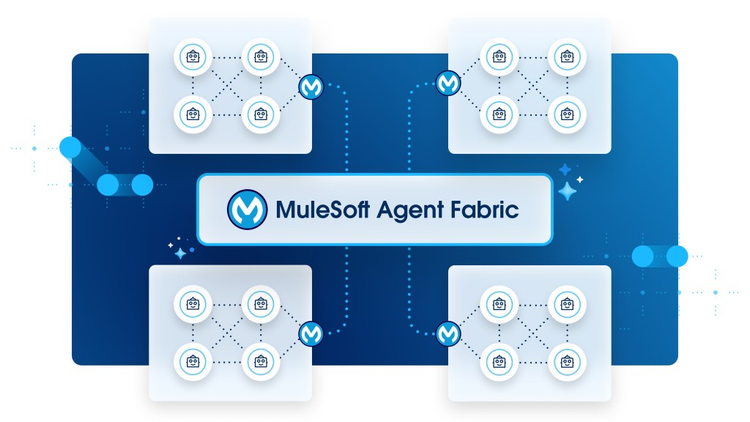
MuleSoft Agent Fabric is enabling customers to control what we think is going to become an explosion of AI agents through orchestration and governance across every agent.
We want to do it across regardless of where it’s built because we see companies leaning into this from a perspective of, ‘Just like we saw with cloud, I’m going to have one primary agent-building platform.’
But we also know, regardless of if you only choose one [agent-building platform], apps themselves are [adding agents]. You see SAP with Joule. Rovo [from] Atlassian, etc., building these agents directly into their applications.
Agent Fabric is really about enabling these customers to control that explosion by governing them and orchestrating them. And it’s doing this by providing a single place to register every agent so you can actually discover and manage them.
You can’t manage what you don’t know about. It equips companies with tools to build intelligent routing services so they can navigate the complexities of multi-agent deployments and drive optimal outcomes. It does it with end-to-end visibility into agent activity so that you can start seeing what agents are actually talking to each other and what agents are running in silos all by themselves.
Every interaction can be consistent, securing policy compliance across [enterprises’] systems and workflows, and also now their agents.
How important is the channel to MuleSoft’s go-to-market in this agentic AI era?
Partners are a huge part of this.
No one has best practices yet, so it’s almost like the partners and we and our customers need to work together as a triumvirate to figure out what the best practices look like.
Partners and vendors like MuleSoft need to be working together so we can start learning, ‘These guys did something. It just didn’t work. But these guys did this variation of it, and it worked great. Let’s get the feedback loops back to the rest of the industry so we can accelerate the development of these processes.’
How does integration work change in the era of AI agents?
We’ve been talking about this idea of self-integrating systems for forever.
But we never had the technology to really do it. But now we are starting to do that.
By the way, there probably will be API-led integration that’s still running in 150 years.
There are still mainframes running and there’s still COBOL code running. But what I see is that some of this stuff will start shifting.
Why would I want to write an integration directly to a REST [representational state transfer] endpoint to create a ticket when instead I could take the input from the customer and just go, ‘This is my problem. Can you create a ticket for me?’ And if that agent is sufficiently trained up, it should be able to do it.
You still need the integration between your website and the ticket system. You still need those capabilities. But you’re not going to have to develop it.
I’m just going to kick it to their agent. They’ve got all the data they need to start helping you do that.
You could also imagine … a new employee goes and files that. So the request is coming through to create the ticket. I don’t know who to assign it to because it’s a new employee. So you could imagine that ticket going to another agent, saying, ‘Who should I assign this to?’
And then that agent is coming from talking to an agent from Workday or an HR system. And how are those interfaces all connected?
Now, where you used to put all of that logic into your integration, now you’re putting it almost behind the scenes on agent-to-agent orchestration questions. That’s what MuleSoft has been built and bred for. That’s why we feel like it's déjà vu.
The architecture is different, but we’ve seen this pattern before. We know we can help customers do this. Also leaning in with Agent Fabric is us taking our capabilities and making sure that everyone knows we have upleveled these into the agentic age. We’ve upleveled these into the agentic enterprise in new ways.
We launched our A2A [Google’s Agent2Agent protocol for AI agent communication] support in our governance layer 79 days after the protocol was announced.
Tools like MuleSoft are unlocks for people to build on top of them, to build comfort and trust on that. And it’s almost like we know that we can help accelerate our customers into this agentic age by giving them trust in these types of technologies.

What’s your advice to MuleSoft partners as best practices get built for the agentic era?
The thing that I’m really excited with some of the partners is how they’re leaning into a mode of not telling customers to build from scratch.
I go back to the cloud playbook where it was, first, we try to enable our technology to work with the cloud. Then we start rehosting our technology on the cloud to make it ready for cloud hosting. And then we do it cloud-native.
One of the jokes of integration is that if the integration works, don’t replace it. Build the next integration you need.
And I see great partners doing the same thing here, where they’re saying, ‘Don’t replace the processes that work with AI. Find the places that don’t work great and build AI there.’
Think about how frustrating something like recruitment can be because it goes to a black box. You take your resume, you send it in, and nothing happens.
Wouldn’t it be great if a system could come back and give you feedback along the way? The answer is ‘yes.’ We can be looking and parsing.
[But] you don’t want someone sitting there and coding every possible scenario.
That’s what agents are great for. You’re seeing this new class of service, a new class of sophistication coming. Just like we did with cloud. That was the big unlock for cloud. I have real-time services. I can tell you what’s in the retail store before you leave. Better service. You’re going to see the same thing with agents.
People who lean into that today are going to be the best. A year from now, we’re going to be talking full new agentic architectures for the agenda enterprise.
How will MuleSoft continue to iterate on the product looking ahead?
This is the starting point of a conversation with our partners and our customers on what ‘best’ looks like.
[The next phase is] building more scanners into other AI systems. It’s adding new extensions of visualizations, setting new policies and governance and control.
Now we’re starting to talk [about] how do they manage costs? How do we build things like LLM gateways to route these requests? And you can look at who requested it? When did they request it? How big is the request? What’s the context for it? And maybe I’ll write it to something cheaper that takes a little bit longer. But it doesn’t matter because that person walked away from their desk.
That type of optimization is the place we’re starting to build on. I’m really excited about that. And that’s something partners are going to help us drive best practices for, not just in design, but cost and implementation.
We’re talking about AI, but is there still a lot of cloud growth opportunity?
There are still digital transformation stories happening. There’s still a lot of work. That’s never going to be truly done.
But another way we think about it is, ‘What also can we leverage on the AI technologies to build better services?’
We’re building new troubleshooting services. Some of that is just giving more data that customers want from our system for logs. But it’s also us leveraging agents on top of that that we’ve built for our customers.
Fabric is our unlock for AI-native architectures and implementations.
[But] we are true to our core and our capabilities, and we want to keep building them out. We’ve been working with customers right now on new API protocol support that they really want.
This is just core use cases … and it’s still a great business for us.
We didn’t build brand-new agent governance and go to every company and say, ‘Go buy agent governance.’ No, for us, that’s API governance. You bought governance from MuleSoft. We can manage and govern your APIs. Well, now we’ve extended that product in place to support new protocols so that, as you’re ready to go, the tooling is ready for you as well. And that’s been our core philosophy.
Partners [should] make sure they’re thinking of themselves as the trusted adviser with a focus on the advice. In cloud, they can be the trusted implementer. ‘We’ve seen every pattern here before. We know what we’re doing.’
This is back to us brainstorming, working together incredibly collaboratively with customers and vendors and companies around the world to try to do this.

What’s the future hold for MuleSoft and the rest of the Salesforce product portfolio?
We’re really excited about Informatica. Deal’s not closed, so I’m not talking too much about that. But I’m really excited about that.
On the partner side, there’s really an interesting dynamic that's playing out.
The story of the enterprise is better when it’s an enterprise story. You want to be able to talk about where the world is really going to go to. As you start talking about things like Agentforce or Data Cloud, both stories are about extending into the enterprise. They’re about making bigger changes. It’s not just about the Salesforce data stack. It’s about the world. That’s what Data Cloud is about. And being able to do things like zero-copy.
MuleSoft is part of that, about bringing more openness to what the Salesforce world is about.
For partners, that makes that story easier for them to talk toward. No one wants vendor lock-in. The more openness you have, the better.
Are you seeing customer concerns around AI governance this early in the cycle?
From the customer side, [governance] is something people are really, genuinely worried about today. It’s not a problem today. But they can all see it.
With agents in particular, and bringing the nondeterminism power that they have, companies are wanting to lean into governance more quickly. We have companies in place going, ‘I’m building governance into my architecture even though I don’t turn it on yet. I don’t want to slow down and stifle innovation and exploration.’
When [employees are] ready to go to production, I don’t want them coming and going, ‘My governance is slowing me down. ‘We put governance in from day one so when I’m ready to turn it on, I can.
That is a much different message and story that we saw with cloud. Cloud was spiking costs, spiking deployments.
Every company on the planet has probably had to send the email of, ‘If you haven’t tagged your instances, I’m going to turn them off on this day.’
But if those tags had been required on day one … they wouldn’t have had to do that. And that’s why we’re thinking about governance early. We want people to be ready for the world that they’re going to be building.
Someone was joking to me, a lot of MCPs [Anthropic’s Model Context Protocol for integrating AI models] today are wrapping APIs.
You’re going to have an MCP governance here that’s totally disconnected from the API it’s wrapping here. Have fun debugging when something goes wrong and what layer went wrong.
We’ve brought those things together to unify those solutions and unify that sophistication to try to reduce exactly those problems.