Nvidia: New Spectrum-XGS Tech Forms ‘AI Super-Factories’ By Linking Multiple Data Centers
Nvidia says the new Spectrum-XGS technology, which consists of network optimization algorithms, can help organizations tackle larger AI workloads by overcoming the compute limits of existing data centers that are limited by their power budgets.
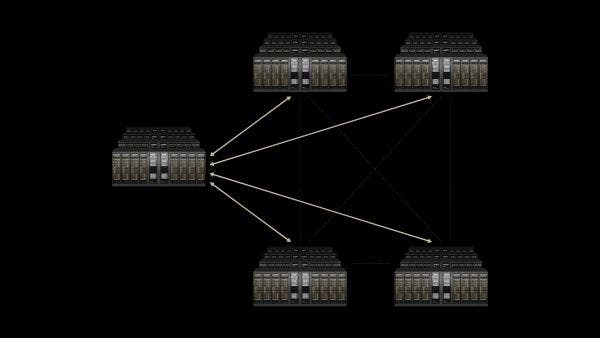
Nvidia said Friday that its newly revealed Spectrum-XGS Ethernet technology uses network optimization algorithms to allow multiple data centers in different locations to operate as a “single AI super-factory.”
Unveiled ahead of the Hot Chips conference in Palo Alto, Calif., next week, Nvidia said the XGS tech introduces a new “scale-across” capability to existing scale-up and scale-out capabilities by speeding up communication between GPU servers to “deliver predictable performance across geographically distributed AI clusters.”
[Related: The 10 Biggest Nvidia News Stories Of 2025 (So Far)]
Jensen Huang, Nvidia’s founder and CEO, called these AI super-factories “essential infrastructure,” saying in a statement that they can consist of data centers located across different cities, countries and continents.
The Santa Clara, Calif.-based company said this new capability is available now as part of its Spectrum-X Ethernet platform, which has been gaining traction over the past few years in AI data centers using Nvidia GPUs.
Among the first customers to use XGS is GPU cloud computing provider CoreWeave. The company’s co-founder and CTO, Peter Salanki, said the new tech will give its customers “access to giga-scale AI that will accelerate breakthroughs across every industry.”
In a briefing with journalists Thursday, Dave Salvator, director of accelerated computing at Nvidia, said XGS can help organizations tackle larger AI workloads by overcoming the compute limits of existing data centers that are limited by their power budgets.
“We’re talking now about multi-data-center scale as an enabler to allow basically more ambitious agentic AI applications to get to the scale that they need, whether that’s for training or inference,” he said.
XGS consists of algorithms that “dynamically adapt the network to the distance between data center facilities,” according to Nvidia.
These algorithms include “advanced, auto-adjusted distance congestion control, precision latency management and end-to-end telemetry,” which nearly doubles the performance of the Nvidia Collective Communications Library, the company said. This, in turn, speeds up communication between GPUs and GPU servers.
Nvidia also said Friday that the newest version of its Dynamo software boosts inference performance of AI models by as much as four times on Blackwell-based systems like the B200. In addition, it revealed a new “speculative decoding” technique that can increase inference performance by 35 percent by using a smaller, faster “draft model” that attempts to predict the next tokens the main AI model will produce.
“What you can see is that we’re delivering a really nice pickup here in terms of overall tokens per second, in terms of speed, while keeping latency very, very low, on the order of about 200 milliseconds, which, from an interactivity perspective, that’s a nice low latency that feels very snappy and interactive,” Salvator said.