Oracle Q1 Earnings: Ellison Says AI Inferencing Fuels Company’s Monster Pipeline
‘People are running out of inferencing capacity,’ Oracle CTO and co-founder Larry Ellison said.
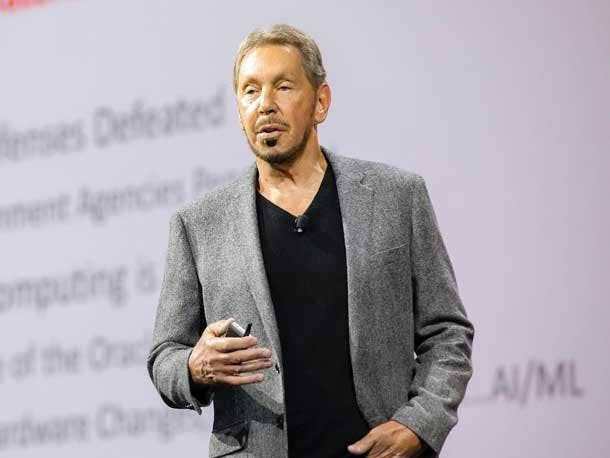
Oracle missed expectations for its latest quarterly performance but blew away analysts with $455 billion in remaining performance obligations and a forecast that it will exceed $500 billion in RPO over the next few months in a signal that there is money to be made in artificial intelligence inferencing–and, perhaps, a shot at enterprise application vendors not yet seeing AI translate into meaningful revenue.
The Austin, Texas-based cloud and database products vendor shared that RPO–the value of contracted services that haven’t yet been delivered to customers–during its earnings call Tuesday covering the first quarter of its 2026 fiscal year. The quarter ended Aug. 31.
Chief Technology Officer and co-founder Larry Ellison pointed to AI inferencing–when an AI model generates data–as a driver for the large amount of revenue his company is expected to take in.
“People are running out of inferencing capacity,” Ellison said on the call. “In the end, all this money we’re spending on (AI model) training is going to have to be translated into products that are sold, which is all inferencing. And the inferencing market, again, is much larger than the training market.”
[RELATED: What Salesforce’s Q2 Says About Enterprise Software In The AI Era]
Oracle Q1
Oracle’s NetSuite division is part of CRN’s 2025 Partner Program Guide.
CEO Safra Catz added that Oracle doesn’t own the building and property, helping keep the cost of that revenue down. Oracle owns and engineers the equipment optimized for Oracle Cloud.
“I know some of our competitors, they like to own buildings,” Catz said. “That’s not really our specialty. Our specialty is the unique technology, the unique networking, the storage, just the whole way we put these systems together.”
Oracle expects about $35 billion in capital expenditures for the fiscal year. “If it is higher, it’s good news, because it means more capacity,” she said.
AI App Generators
Ellison told listeners on Tuesday’s call that Oracle has leveraged AI to build new applications and no longer needs the same number of employees.
“The latest applications that we are building, we’re not building them,” he said. “They’re being generated by AI. And we think we’re far, far ahead of any of the other application companies. … We don’t charge separately for our AI and our applications because our applications are AI. They’re entirely AI. The new ones–the new ones that we’re building–they’re nothing other than a bunch of AI agents that we generate, that are linked together with Workflow (Oracle’s business process automation management system). That’s all they are.”
Oracle has separated itself from AI competitors through its databases that vectorize data, secure the data and link to the popular AI models “to deliver a ChatGPT-like experience on top of your data as well as publicly available data,” Ellison said.
The Oracle co-founder explained that his company has millions of customer databases compared to the tens of thousands application vendors hold. He didn’t explicitly reference any enterprise app vendors, although later in the call he pointed out that Oracle is larger than ServiceNow and Workday.
“We’re better positioned than anybody to take advantage of inferencing,” he said. Oracle still needs employees, “but the number of people we need is substantially less, and we can build slash generate much better applications than we can hand build.”
Oracle’s Cloud Business
Catz said on the call that Oracle’s cloud business continues to grow alongside the AI business, with AI appetite fueling customers’ Oracle database migrations to the cloud.
Fueling that business growth includes Oracle’s dedicated cloud region option, its products across the technology stack and its partnerships with other cloud vendors to provide customers with more choice.
“We have become the de facto cloud for many of our customers,” she said.
Oracle has gotten its cloud offer down to three racks available for $6 million, Ellison said. Competing cloud vendor offers can reach 500 times that amount. Oracle customers have sought a cloud experience without needing to share space with other companies.
Q1 In Detail
The vendor’s total revenue for the quarter was $14.9 billion, up 11 percent year on year ignoring foreign exchange. Wall Street was expecting $15 billion.
Cloud revenue, which Oracle counts as infrastructure-as-a-service plus software-as-a-service was $7.2 billion, up 27 percent ignoring foreign exchange.
IaaS was $3.3 billion, up 54 percent year on year. SaaS was $3.8 billion, up 10 percent year on year. Oracle’s software revenue fell 2 percent ignoring foreign exchange, coming in at $5.7 billion.
The Fusion Cloud enterprise resource planning (ERP) revenue grew 16 percent year on year ignoring foreign exchange to $1 billion. NetSuite Cloud ERP revenue was the same amount at a similar percent growth.
Oracle’s operating income using Generally Accepted Accounting Principles (GAAP) was $4.3 billion. GAAP net income was $2.9 billion. Oracle saw operating cash flow of $21.5 billion over the past 12 months, up 13 percent year on year in U.S. dollars.
The vendor is taking up its expected revenue from Oracle Cloud Infrastructure (OCI) to 77 percent growth year on year to $18 billion for the fiscal year. Oracle expects OCI revenue to then hit $32 billion the following year, then $73 billion the year after, $114 billion and then $144 billion in four years.
Multicloud database revenue from the hyperscalers of Amazon, Google and Microsoft was 16 times the amount from a year ago, according to Oracle. Oracle’s stock was up 26 percent after the market closed Tuesday, trading at about $305 a share.