Salesforce Q2 Earnings: CEO Benioff Says It’s ‘Nonsense’ That AI Will Spell The End Of SaaS
‘This is not a company in crisis. This is a company that is accelerating and doing things in new ways,’ Salesforce co-founder and CEO Marc Benioff said on the company’s quarterly earnings call.
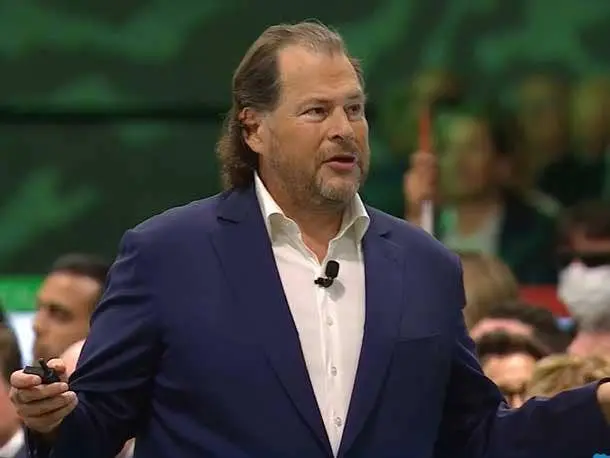
Salesforce co-founder and CEO Marc Benioff called theories that artificial intelligence spells the end of Software as a Service and enterprise applications “nonsense” and a “strange narrative,” instead viewing AI as extending and transforming software’s capabilities and turning organizations into “agentic enterprises”—an area where Salesforce is leading the market, he said.
“This is not a company in crisis,” Benioff told listeners on the company’s quarterly earnings call Wednesday. “This is a company that is accelerating and doing things in new ways.”
The San Francisco-based AI and enterprise application vendor reported results for the second quarter of its 2026 fiscal year. The quarter ended July 31.
[RELATED: What Snowflake’s Q2 Earnings Say About Data In The AI Era]
Salesforce Second-Quarter Earnings
Instead of AI ending the market for enterprise apps and software, Benioff and executives on the call described new areas where Salesforce plans to take share thanks to AI innovation.
Benioff doubled down on comments he made on a recent podcast episode that Salesforce will enter the IT service management market dominated by players such as ServiceNow—inverting comments ServiceNow executives have made this year about capturing share in Salesforce’s flagship CRM market.
Comments the Salesforce CEO made that are likely of interest to members of its ecosystem of 12,000 channel partners include growth the vendor has seen in smaller businesses and organizations, with Benioff telling listeners that he has encouraged larger Salesforce systems integrator partners “to move their business down downstream to serve these companies that have single-digit-thousand” employees.
Agentic Enterprises
Salesforce has been in the AI field for more than a decade through its Einstein platform, Benioff said on the call. This new era of large language models (LLMs) extends the capabilities of applications rather than makes them obsolete—a potential future suggested by Microsoft Chairman and CEO Satya Nadella, a rival of Salesforce’s in the AI and enterprise app space through offers such as Dynamics 365.
“I just look at how I’m running my own business and the business of our customers,” Benioff said. “I don’t understand what the replacement is.”
Instead, the LLM era is creating agentic enterprises with reduced overhead and greater revenue opportunities compared with traditional companies—with Salesforce itself leading the charge as an agentic enterprise, Benioff said.
“To hear some of this nonsense that’s out there in social media or in other places—and people say the craziest things—but it’s not grounded in any customer truth,” he said.
AI agents are helping Salesforce employees return more calls. In the past nine months, agents have answered support questions through help.salesforce.com without customer satisfaction scores going down. Benioff gave a resolution rate of about 77 percent.
Over the last nine months, 1.5 million support conversations happened with agents, and 1.5 million conversations happened with humans, he said. Agents haven’t totally replaced humans in customer support because LLM accuracy only reaches the 90 percent range, Benioff said.
Salesforce has reduced its support head count to about 5,000 employees, letting go of 4,000 employees. AI agents can now handle lower-tier support cases and increase the productivity of remaining human support workers.
When asked on the call about why other companies aren’t reporting those levels of head-count reduction through AI, Benioff said the issue could be timing, the number of AI tools on the market overpromising what they can deliver and fear around dramatic changes.
Agentic enterprises are “a radical technology transformation” with “humans and agents working together” and “a radically different organizational transformation involving what the structure of your company looks like,” Benioff said.
“It's a complex transformation, not just from the software side, but also from the human management [side],” he said.
Salesforce’s value in the AI era also comes from a robust data fabric across metadata and customer systems of record, reaching around 300 petabytes of information managed for customers.
“We have a very crystal-clear vision about what the future of enterprise software looks like and how we’re going to be able to help customers achieve a level of success,” Benioff said.
Salesforce Challenges ServiceNow In ITSM
Salesforce is building an agentic IT service management (ITSM) product that leverages its Slack communication and collaboration app, Benioff said. Salesforce is moving all of its offers into a “Slack-first” approach so that customers can “start Sales Cloud and start Service Cloud, and all of our products, even our new ITSM product, from Slack first.”
Although Benioff didn’t discuss ServiceNow on the earnings call, during his appearance Friday on “The Logan Bartlett Show” he called ServiceNow “a great company” but pointed out that ServiceNow automates about 9,000 companies compared with about 1 million companies using Slack.
Benioff did say that ITSM is “a whole different kind of architecture,” but added that the company will showcase the new product at its annual Dreamforce conference in San Francisco in October.
“A lot of our existing customers have been asking for this,” Benioff said on the call, saying that the platform will work in Slack and allow IT teams to work with AI agents to solve problems.
“It’s going to be an incredible growth driver for the company, but it’s just really another example of how every platform is going to become agentic,” he said. “We’re really excited that we’re getting there first.”
Salesforce President and CRO Miguel Milano said that alongside new revenue opportunities from ITSM, the company sees ways to grow through recently released and upcoming products including an Agentforce voice offer, Agentforce for Public Sector, Life Sciences Cloud and Partner Cloud.
To handle selling all the new products, Salesforce grew its number of account executives by 20 percent by the end of the second fiscal quarter, Milano said.
Salesforce’s pipeline into the second half of the year is “growing in the high teens,” Milano said. For bigger deals, the company is “approaching 20 percent growth.”
Salesforce M&A Strategy
Benioff said to look forward to more acquisitions by Salesforce, even as it dedicated billions of dollars to a stock buyback and a dividend.
“If we see great entrepreneurs or great technology or something that we’ve never seen before that just blows our mind, we’re going to buy it,” Benioff said. “When you have $15 billion of cash flow in a single year, like this year … we plan to use it in a smart way.”
In the lead-up to Wednesday’s call, Salesforce completed the purchase of AI-powered sales prospecting platform Bluebirds with plans to integrate the company into its Sales Cloud and Agentforce offers and completed the purchase of Waii, which translates plain-language questions into complex, production-ready SQL queries. Salesforce plans to integrate Waii into Data Cloud.
The acquisition of Regrello, an AI-native complex business process automation vendor, should close in the third quarter, bringing more agentic capabilities to Agentforce and Slack, according to Salesforce.
Benioff revealed that Salesforce became interested in Regrello in part because of its work automating 20,000 users in Dell Technologies’ supply chain and because of relationships with the company’s leadership.
The vendor moved forward its planned closing date for buying Informatica to the fourth fiscal quarter or early in fiscal year 2027. Benioff justified the pending purchase because data organization is the way to better AI results.
Salesforce will maintain “extraordinary cash flow” to make sure it can handle all the expenses, with Benioff slipping in a shot at technology companies—without naming any particular vendors—that have sacrificed cash flow to meet AI demands.
“A lot of software companies and others have just thrown their cash flow away to go build data centers—or do, I don’t even know what, with their money,” Benioff said.
Monetizing AI
Robin Washington, Salesforce’s president and chief operating and financial officer, told listeners on the call that products like Data Cloud and Agentforce are showing up in measures such as net-new average order value and account executive capacity.
Salesforce is also evolving its pricing and go-to-market strategy for the agentic era while continuing to report cloud revenue on a quarterly basis, she said.
“We’re really confident in our strategy to monetize AI,” Washington said. “We’re focused on capturing the value for our customers. And I’d say we’re really optimizing for usage of our platform. We believe this will unlock deeper value across all of our core products over time.”
Commenting on trends in other industries and customer segments, Benioff indicated that government procurement is improving and adapting to the cost-cutting efforts spearheaded by the U.S. Department of Government Efficiency formerly headed by billionaire Elon Musk. Benioff called the federal government a multibillion-dollar customer with more opportunity to expand in the Department of Defense.
“We all know that the government has been going through something that none of us have ever seen before in the last six months, and we all understand the DOGE revolution, and we’re all watching that closely,” Benioff said. “That is something that … now the government is coming out of and [it] is starting to acquire.”
Second Quarter In Depth
Salesforce reported $10.2 billion in revenue for the quarter, up 10 percent year over year ignoring foreign exchange.
Subscription and support revenue was $9.7 billion, up 11 percent year on year ignoring foreign exchange. The vendor’s current remaining performance obligation—deferred revenue and backlog the company plans to deliver over the next 12 months—was $29.4 billion, up 11 percent year on year. Salesforce is still on track for a record $15 billion in operating cash flow for the fiscal year, according to the vendor.
Data Cloud and AI saw annual recurring revenue of more than $1.2 billion, more than double year over year. Salesforce has closed more than 12,500 deals since launching Agentforce. More than 6,000 of those are paid. Agentforce has also handled more than 1.4 million requests on Salesforce’s online help portal. The vendor saw a 60 percent increase quarter on quarter in customers going from pilot to production.
More than 40 percent of Data Cloud and Agentforce bookings in the quarter came from existing customer expansions. Washington pointed to early success in Salesforce’s new payment options for Agentforce, with flex credits accounting for 80 percent of Agentforce second fiscal quarter bookings. During the quarter, Salesforce closed more than 60 deals greater than $1 million and including Data Cloud and AI.
Salesforce Forecast
The vendor expects between $10.24 billion and $10.29 billion in revenue during the third fiscal quarter, up about 8 percent year on year. Salesforce took up the amount it expects to make in revenue from the fiscal year by $300 million, now projecting between $41.1 billion and $41.3 billion. That would mark an increase of about 9 percent year on year.
It expects current remaining performance obligation growth of more than 10 percent year over year. Current remaining performance obligation continues to feel the effects of the measured sales performance that started in fiscal year 2023, although bookings growth has been normalizing recently, Washington said. Salesforce has seen momentum in Data Cloud and Agentforce and weakness in Marketing Cloud and Commerce Cloud.
The vendor increased its full fiscal year operating cash flow growth guidance to about 12 percent year on year.
Salesforce traded at about $242 a share after the market closed Wednesday, down about 6 percent.