The 10 Hottest Agentic AI Agents, Tools And Products Of 2026 (So Far)
CRN breaks down the top agentic AI products and tools of 2026 so far—from Cisco Cloud Control and Nutanix Agentic AI to Microsoft Copilot Cowork and Databricks Genie One.

From Amazon Web Services, Google Cloud and Microsoft to Cisco, Dell Technologies and Nutanix, the amount of agentic AI innovation being created from the world’s top channel and AI companies is accelerating at a blistering pace in 2026.
Chatbots are no longer the focal point of the AI market, with agentic AI tools and products taking center stage—shifting from simple prompt responses to systems that can plan, reason, and execute tasks across data, applications and workflows.
With businesses of all sizes putting agentic AI at the center of their business transformations to reimage how people work, CRN breaks down the 10 hottest agentic AI products and tools of 2026, so far, that every business and channel partner needs to know about.
[Related: Top 10 Biggest Google Cloud News Of 2026: Wiz, Agentic AI And New Partner Program]
77 Percent Of Enterprises Running AI Agents; AI Services Market To Reach $515B
Before jumping into the coolest agentic AI innovation this year, here are two key AI data figures from IT market research firms Gartner and IDC.
A whopping 77 percent of enterprises already have AI agents running in production, according to IDC.
The AI services market is set to reach $515 billion in revenue by 2029 led by AI initiatives focused now on agentic AI approaches, Gartner said.
To win AI deals and customer trust, vendors like AWS, Cisco, Cynomi, Databricks, Dell, Google, Nutanix, Microsoft, VMware and Zscaler launched new agentic AI tools and products in 2026 that clearly demonstrate how AI agents solve real business challenges.
AWS Bedrock AgentCore
AWS Bedrock AgentCore is the company’s new agentic platform for building, deploying and operating agents at scale using any framework, model, or protocol.
AgentCore is for clients who want to move AI agents from proof of concept into production with cybersecurity baked in.
The platform lets users declare what an agent does—such as the model it uses, the tools it calls and the instructions to follow—with AgentCore handing the rest by assembling an orchestration loop, tool execution, memory management, context handling, and error recovery.
AWS is constantly launching new capabilities for AgentCore this year such as the recent unveiling of AgentCore Web Search, a new tool that lets agents get information from the web without infrastructure overhead while keeping data within the customer’s AWS environment.
Another new feature is Bedrock Managed Knowledge Base on AgentCore that connects to a company’s unstructured data sources.
On the security front, AgentCore was recently integrated with AWS Bedrock Guardrails, which evaluates every agent action for prompt injection attempts, harmful content, and sensitive data exposure.
Cisco Cloud Control
Arguably Cisco’s biggest launch at Cisco Live 2026, the networking giant launched a new unified platform built for humans and AI agents to manage, monitor and defend critical IT infrastructure.
With one login, Cisco Cloud Control delivers a single view of Cisco networking, security, compute, observability, and collaboration in one secure environment. It ties together purpose-built AI models, agents and cross-domain data telemetry so humans and agents can act on the same information to address key business imperatives like uptime, agent behavior, and tokenomics.
Customers can build their own applications and agents using natural language directly within the platform, which also connects to a large ecosystem—including AWS, Google Cloud, Microsoft, ServiceNow and Slack.
People and agents work from a single data layer, sharing the same operational context and the same system of action, while humans stay in control.
Cisco Cloud Control is now the foundation for Cisco’s flagship AgenticOps operating model.

Cynomi CISO Intelligence Agents for MSPs
Cynomi’s CISO Intelligence platform was injected with agentic AI tools and co-worker agents to help MSPs scale security delivery and revenue.
Cynomi said it embedded the decision-making logic of an experienced CISO directly into its platform with new agents that deliver contextual insights, generate client-ready outputs, and execute core workflows across the service lifecycle.
Its AI agents function with the support of a virtual security team—comprised of a CISO, Auditor, Analyst, and Executive Communicator—embedded directly into workflows to not only guide decisions but actively produce the core outputs MSPs rely on every day.
Cynomi’s agentic AI and co-worker agents explain risk, priorities, and next steps in real time, generate policies, remediation plans, and executive reports tailored to each client.
Databricks Genie One
Databricks recently unveiled Genie One, a new agentic coworker that helps business teams automate and orchestrate their work across any data—structured or unstructured, analytical or operational—both inside or outside Databricks.
Genie One aims to help marketing, finance, sales, and other business teams better automate and orchestrate their work grounded in real business data.
Genie One is powered by the new Genie Ontology, a live context layer that continuously learns users’ business from internal and external data, AI tools, and popular workplace apps, delivering accurate answers at lower token costs, Databricks touts.
Genie Ontology continuously extracts and updates business context from across Databricks and connected systems, so Genie One can find the true answer to business questions in curated data through SQL rather than reason from fragments spread across documents.
Databricks said Genie One is a data-smart agentic coworker that can explain why margins changed, surface upsell opportunities in a sales pipeline, or help finance close the books, because it’s working from the same data on which the business actually runs.
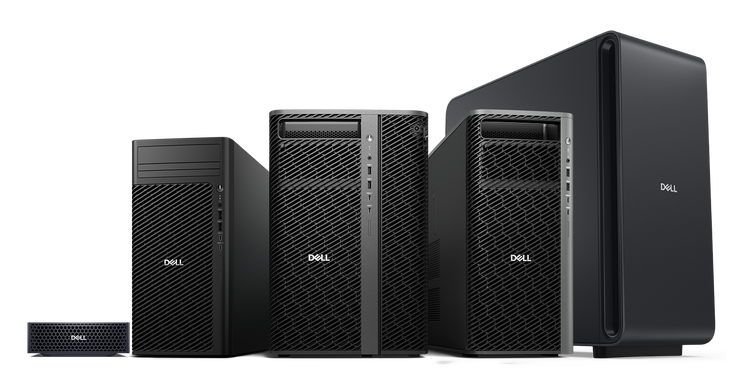
Dell Deskside Agentic AI
Dell unveiled its new Deskside Agentic AI solution, which gives workers the ability to deploy and scale agentic AI workflows locally without the cost, latency and data sovereignty constraints of cloud-only approaches.
Dell said tis new Deskside Agentic AI system—which integrates with the Nvidia NemoClaw secure operations layer to run agents securely on local infrastructure—provides 87 percent savings versus public cloud spend for running, building, testing and fine-tuning agentic AI solutions with a three-month break-even versus public cloud.
Deskside systems keep inferencing local, costs predictable and data secure, giving customers greater control over their AI environment.
From coding assistants and research agents to highly secure, private AI assistants for regulated industries, the solution is offered on a range of Dell high-performance workstations including Dell Pro Max and Pro Precision.
Google Gemini Enterprise Agent Platform
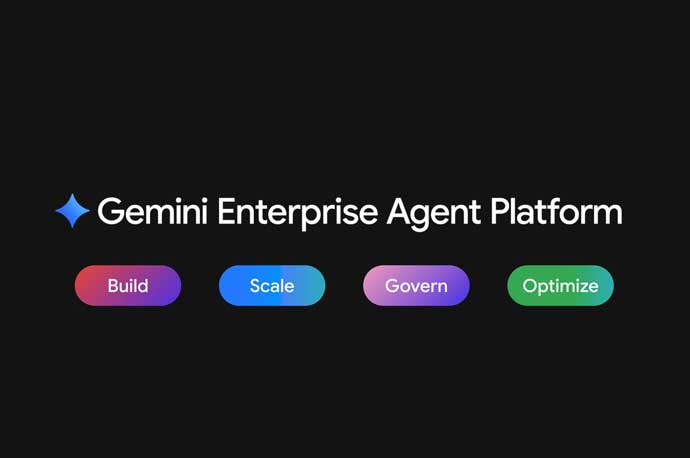
Google launched its new Gemini Enterprise Agent Platform for building, scaling, governing and optimizing agents which gives users access to the company’s most advanced AI models.
Gemini Enterprise Agent Platform supports agents with autonomous reasoning and is integrated with Google’s data and security capabilities.
It brings together a low-code agent studio; agent-to-agent orchestration for agents to delegate tasks to one another; agent registry for indexing internal agents across the organization; agent identity to enforce traceable and auditable authorization policies; agent gateway for real-time policy enforcement; and agent observability for agent auditing dashboards.
The new platform is an evolution of Google’s Vertex AI—bringing model selection, model building and agent building capabilities together with new features for agent integration, DevOps, orchestration and security.
Other capabilities include an agent developer kit with a graph-based framework for defining agent logic, the ability to connect to any MCP server, and a memory bank with memory profiles to provide agents with persistent context and recall of specific user details and project histories.
Microsoft Copilot Cowork
Microsoft’s new Copilot Cowork is a collaboration with Anthropic that can orchestrate full workflows, from building presentations to assembling financials and emailing a team of employees to prepare a user for a customer meeting.
Users can simply describe the outcome they want and Cowork automatically grounds the work in their emails, meetings, messages, files, and data.
Copilot Cowork leverages Microsoft’s enterprise data protection (EDP) and WorkIQ intelligence layer for understanding user work patterns, relationships and organizational context.
Cowork can complete tasks in the background while workers do other things. It can interact with user email, documents, files and data in Microsoft 365 without connectors, integrations or data movement. Data never leaves enterprise boundaries and doesn’t have to run locally on user devices. The data instead stays in the cloud.
Microsoft is also working on out-of-the-box plug-ins across use cases and scenarios for Copilot Cowork.
Nutanix Agentic AI
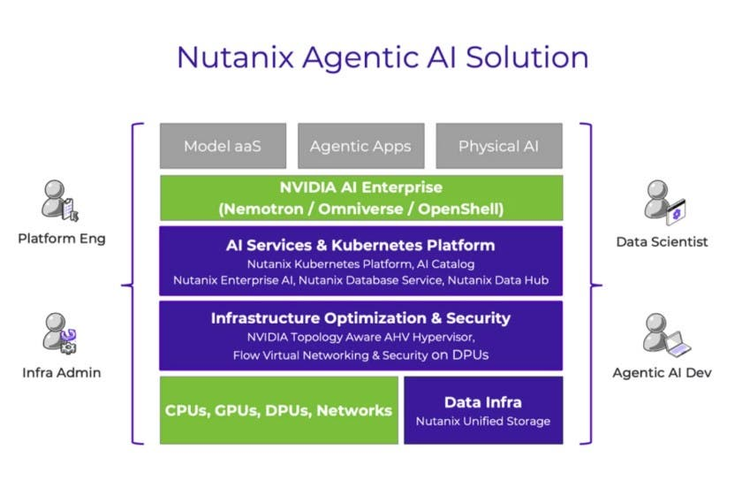
Nutanix launched a new agentic AI software stack with deep integration with Nvidia that offers a cloud operating model to drive Nvidia GPU efficiency and agentic AI transformation for customers.
The Nutanix Agentic AI offering delivers optimized performance and security and is designed to enable lower, predictable token costs by providing things like an advanced AI gateway and model as a service.
It integrates with Nvidia AI Enterprise at the Agent Builder layer and can orchestrate Nvidia’s ecosystem of AI factories, while also letting teams instantly deploy Nvidia NIMs—including Nemotron—to accelerate the development of AI applications.
The new offering automatically optimizes workload placement across GPU-dense servers for maximum performance without the need for manual tuning.
Nutanix Agentic AI extends the company’s AHV hypervisor, Flow Virtual Networking, Nutanix Kubernetes Platform and Nutanix Enterprise AI to enable customers to build, operate and govern AI factories while providing agentic AI developers with models and platform services.
VMware Tanzu Agent Foundations
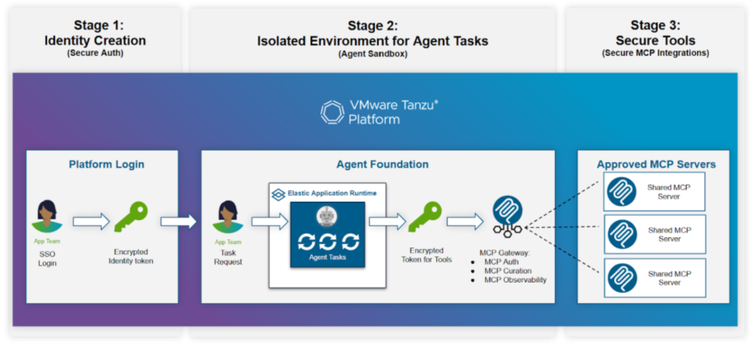
Agent Foundations on Tanzu provides a pre-engineered Platform as-a-Service (PaaS) environment for AI agents, built directly upon the infrastructure layer of VMware Cloud Foundation (VCF).
Agent Foundations is dubbed a secure-by-default agentic runtime designed to accelerate the delivery of autonomous AI applications with key capabilities including immutable supply chain, zero-trust networking and sandboxing.
Agent Foundation includes zero-trust networking and sandboxing by limiting agentic loops through pre-defined resource limits. Connectivity to internal systems and models is never open by default. Access is explicitly granted only via secure service bindings, preventing wandering agents from accessing unauthorized data.
Agent Foundations on Tanzu programmatically leverage VCF APIs to abstract infrastructure complexity away from developers. This allows agents and their dependent services to always have the resources like compute, networking, and storage they need.
It also offers a centralized AI gateway to control tools and model availability, usage, costs, and safety filters across public models and private models on VCF.
Zscaler AI Access Graph
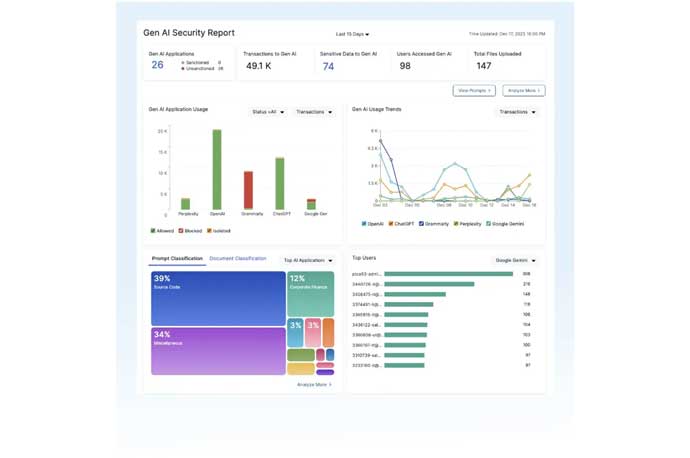
Zscaler’s new AI Access Graph connects the dots of data and identity lineage with AI for enhanced security and governance of agentic AI solutions.
Powered by Zscaler's recent acquisition of Symmetry Systems, Zscaler’s new AI Access Graph maps how identities, applications, and other data sources connect across the enterprise.
The integration of AI Access Graph with Zscaler’s Zero Trust Exchange enables organizations to understand and then enforce policies, reduce unnecessary access and risk, and track data lineage in real-time across every channel.
As part of its Zero Trust Exchange, the company also launched AI Broker to help secure agentic communications through MCP and agent-to-agent (A2A) brokers. It helps organizations understand what each agent is allowed to access and apply fine-grained access across enterprise AI agents.