Accelerating AI Boom Drives Supermicro to Record Q2 Revenue Growth
‘Based on our broad customer back-order forecast and commitment, we believe demand for AI and IT infrastructure remains unprecedentedly strong. Our DCBBS solution is exactly what customers need to build out their AI and cloud much faster, cleaner, and [with] lower total cost,’ says Supermicro Founder, President, and CEO Charles Liang.
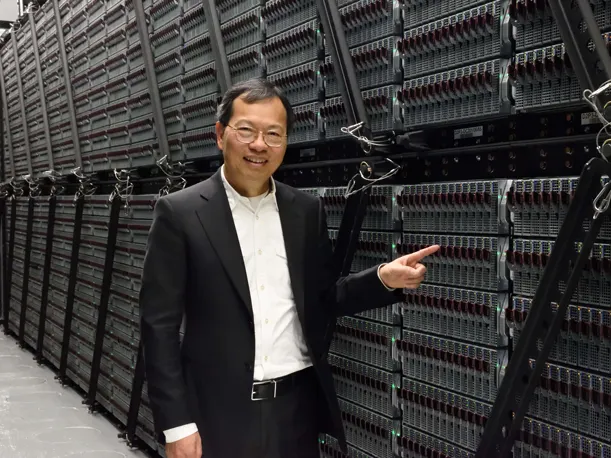
Continued acceleration of AI infrastructure demand across every major customer segment helped propel Supermicro to a strong fiscal second quarter 2026 and is laying the path for continued growth going forward, said Supermicro Founder, President, and CEO Charles Liang.
Liang Tuesday used his prepared remarks during the San Jose, Calif.-based company’s second fiscal quarter 2026 financial conference call highlight year-over-year revenue growth 123 percent to a record $12.68 billion in revenue.
“This strong performance reflects the sustained momentum of our AI solutions and rack-scale systems as customers build out next-generation AI factories,” he said.
[Related: Supermicro CEO: Ready To Grow As Nvidia Ramps Blackwell Production]
Supermicro has been developing some of the largest and most complex AI clusters ever built, highlighting the company’s unmatched capability in large-scale manufacturing and integration, Liang said. He highlighted the company’s new data center building block solutions or DCBBS, first introduced in 2024, and said they have started to gain some key customers’ preference as they look for quicker time to deployment and quicker time to online while reducing costs via better workload optimization and minimal power and water consumption.
DCBBS has helped Supermicro gain share in large, medium, and small AI infrastructure deployments with Nvidia GB300, B200, and B300 and AMD MI350 platforms, Liang said. The company is also preparing for the upcoming Nvidia Vera Rubin and AMD Helios solutions for the second half of this year, he said.
While Supermicro continues to grow its AI factory build-out, customer and product mix are shifting more towards large model builders with pricing leverage that are pressuring the company’s margins, Liang said. During the second fiscal quarter, he said, increased transportation costs and ongoing component shortages and associated pricing volatility are impacting Supermicro’s short-term gross margins.
Supermicro is addressing these issues with a couple of strategies aimed at strengthening the company’s long-term profitability, Liang said.
First, Supermicro has entered its next phase of product evolution with DCBBS as its key focus. As data centers scale, DCBBS is and will become an increasingly important part of our value, Liang said.
“In the first half of fiscal year ’26, DCBBS solutions accounted for 4 percent of our profit,” he said. “We expect this part of our profit to grow and meaningfully contribute to the second half of fiscal ’26. And we see that growth accelerate to at least double this contribution by the end of calendar 2026. With compressed GPU and CPU lifecycles, DCBBS becomes critical and helpful to the value of our server and storage products by enhancing the data center infrastructure time to delivery and time to online, reducing power and water consumption, and simplifying data center management and maintenance.”
In just over one year, the DCBBS product line grew to more than 10 key subsystems including coolant distribution units, rear door heat exchangers, power cells, battery backup, water towers, drive towers, high speed switching, data center management software, and services, Liang said.
“We are expecting this product line to include more new categories such as transformers, next-generation power generators, devices for energy backup, and green power [technologies], further strengthening customer value, accelerating deployment, and supporting long-term profit margin improvements for Supermicro,” he said.
Supermicro is also sharpening its focus on traditional enterprise cloud and edge IoT customers to further diversify revenue with higher margins, Liang said. In addition, the company introduced our X14 and H14 servers featuring pre-configured systems that ship directly from its factory to enable rapid deployment, he said
“Optimized specifically for AI, cloud storage, and telco edge workloads, these servers are ready to power and immediately reinforce Supermicro’s core time-to-market advantage for enterprise customers, channel partners, and SMB end users,” he said.
Supermicro is also driving meaningful cost improvements through enhanced design for manufacturing, including more modularized subsystems and expanded automation across its facilities to bring new platforms to volume production even faster and with higher quality, Liang said.
“As product cycles shorten and technical complexity increases, these designs for manufacturing advancements are essential for scale, efficiency and long-term margin improvement,” he said.
Supermicro also continues to expand its global manufacturing aggressively and strategically, Liang said.
“Our Silicon Valley facility remains the cornerstone of our U.S. operations, delivering faster time-to-market, strong security, and higher quality integration,” he said. “Internationally, new production sites in Taiwan, Malaysia, and Netherlands, and soon in the Middle East, are ramping to increase capacity, support regional [customers], solve AI requirements, and, most importantly, optimize our overall cost structure.”
Supermicro, as the only company with over 32 years of robust server and storage focus, is quickly evolving into a leading AI platform and data center infrastructure total solution provider, Liang said. Strong Q2 performance, rapid expansion of DCBBS product lines, deeper and more customer engagement, and increased global capacity investment position Supermicro well for long-term growth in the face of near-term margin pressures, he said. The company’s focus on enterprise business, design for manufacturing improvements, and the fast-growing DCBBS portfolio all help support higher growth and net margins going forward, he said.
“Lastly, based on our broad customer back-order forecast and commitment, we believe demand for AI and IT infrastructure remains unprecedentedly strong,” he said. “Our DCBBS solution is exactly what customers need to build out their AI and cloud much faster, cleaner, and [with] lower total cost.”
Supermicro By The Numbers
For its second fiscal quarter 2026, which ended December 31, Supermicro reported total revenue of $12.68 billion, up 123.2 percent over the $5.68 billion the company reported for its second fiscal quarter 2025.
Revenue for the quarter beat analyst expectations by a whopping $2.34 billion, according to Seeking Alpha.
Supermicro also reported GAAP net income for the quarter of $400.6 million or 60 cents per share, up from last year’s $320.6 million or 51 cents per share. On a non-GAAP basis, the company reported net income of $486.5 million or 69 cents per share, up from last year’s $383.6 million or 59 cents per share.
Non-GAAP earnings beat analyst expectations by 20 cents per share, according to Seeking Alpha.
Looking ahead, Supermicro expects third fiscal revenue of $12.3 billion, GAAP net income of at least 52 cents per share, and non-GAAP net income of at least 60 cents per share.
For all of fiscal 2026, Supermicro expects to report revenue of at least $40 billion, up significantly over the $22.0 billion the company reported for fiscal 2025.