Alphabet CEO: AI Is Driving Growth ‘Across The Board’
“Overall, we are seeing our AI investments and infrastructure drive revenue and growth across the board to meet customer demand and capitalize on the growing opportunities ahead of us,’ says Alphabet CEO Sundar Pichai.
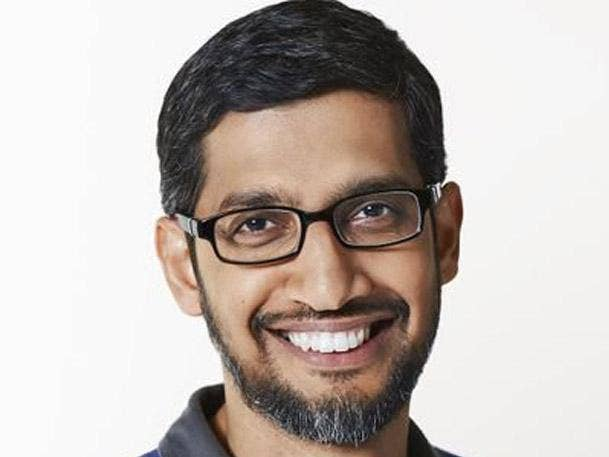
Google parent company Alphabet ended its latest fiscal year with what CEO Sundar Pichai called a “tremendous quarter,” one that saw the Mountain View, Calif.-based company’s annual revenue breach the $400 billion mark for the first time thanks to growth in its AI and Google Cloud business.
On the AI side, Alphabet sold more than 8 million paid seats of its Gemini Enterprise business AI platform, which was launched just four months ago, Pichai told analysts in his prepared remarks during the company’s fiscal fourth quarter 2025 financial conference call. The company’s Gemini AI app now has over 750 million monthly active users, he said.
“We are also seeing significantly higher engagement per user, especially since the launch of Gemini 3 in December,” he said. “Overall, we are seeing our AI investments and infrastructure drive revenue and growth across the board to meet customer demand and capitalize on the growing opportunities ahead of us.”
[Related: Google’s CEO Pichai On Six Key Product Areas For Business Users As Quarterly Revenue Tops $100B]
Growth in Alphabet’s AI business comes from what Pichai called an “unrivaled” infrastructure.
“Our unrivaled infrastructure serves as the bedrock of our AI stack,” he said. “We have the industry's widest variety of compute options that includes GPUs from our partner Nvidia, who announced at CES that we’ll be among the first to offer the latest Vera Rubin GPU platform, plus our own TPUs (Tensor Processing Units) that we have been developing for a decade.”
Alphabet in December also unveiled plans to acquire Intersect, which provides data center and energy infrastructure solutions, Pichai said.
“As we scale, we are getting dramatically more efficient,” he said. “We were able to lower Gemini serving unit costs by 78 percent over 2025 through model optimizations, efficiency, and utilization improvements.”
Alphabet’s new Gemini 3 technology is driving the state of the art in reasoning and multimodal understanding, and has enjoyed the fastest adoption of any model in the company’s history, Pichai said.
“Since launch, Gemini 3 Pro has consistently processed three times as many daily tokens on average as [Gemini] 2.5 Pro,” he said. “Our latest model powers Google Antigravity, our new development platform where agents can autonomously plan and execute complex software tasks. It already has more than 1.5 million weekly active users after launching just over two months ago. Our first-party models like Gemini now process over 10 billion tokens per minute via direct API used by our customers, up from 7 billion last quarter.”
When it comes to Google Cloud, Alphabet’s growth in revenue, operating margin, and backlog highlights the strength of its entire portfolio, Pichai said.
Alphabet exited fiscal year 2025 with double the new customer velocity compared to the first fiscal quarter of the year, he said.
“We are also signing larger customer commitments,” he said. “The number of deals in 2025 over a billion dollars surpassed the previous three years combined.”
Google Cloud also continues to see deeper relationships with existing customers who are outpacing their initial commitments by over 30 percent, Pichai said.
“Nearly 75 percent of Google Cloud customers have used our vertically optimized AI from chips to models to AI platforms and enterprise AI agents, which offer superior performance, quality, security, and cost efficiency,” he said. “These AI customers use 1.8 times as many products as those who do not, enabling us to diversify our product portfolio, deepen customer relationships, and accelerate revenue growth.”
The Google Cloud product line has multiple monetization levers including infrastructure, platform. and high-margin AI-powered products and services, with 14 product lines that each exceed $1 billion in annual revenue, Pichai said.
“We offer leading infrastructure for AI training and inference to our cloud customers, with the industry's widest variety of compute options from our own seventh-generation Ironwood TPU to the latest Nvidia GPUs,” he said. “Our 10-year track record in building our own accelerators with expertise in chips, systems, networking, and software translates to leading power and performance efficiency for large scale inference and training.”
Alphabet By The Numbers
For its fourth fiscal quarter 2025, which ended December 31, Alphabet reported total revenue of $113.83 billion, up 17 percent from the $96.47 billion the company reported for its fourth fiscal quarter 2024.
This includes Google Cloud revenue of $17.66 billion, up from last year’s $11.96 billion; search revenue of $63.07 billion, up from $54.03 billion; YouTube revenue of 8.83 billion, down from $7.95 billion; subscription, platform, and device revenue of $13.58 billion, up from $11.63 billion; and “other” revenue of $370 million, down from $400 million.
The U.S. accounted for $55.44 billion in revenue up from $47.38 billion.
Total revenue beat analyst expectations by $2.34 billion, according to Seeking Alpha.
GAAP net income for the quarter was $34.46 billion or $2.82 per share, up from last year’s $26.54 billion or $2.15 per share.
GAAP earnings beat analyst expectations by 18 cents per share, according to Seeking Alpha.
At the end of the quarter, Alphabet had a total of 190,820 employees, up from 183,323 employees at the end of fiscal 2024.
Total revenue for full fiscal year 2025 was $402.84 billion, up from last year’s $350.02 billion.
Alphabet also reported full fiscal year 2025 GAAP net income of $132.17 billion or $10.81 per share, up from last year’s $100.12 billion or $8.04 per share.
Company shares were down a little more than 1 percent in after-hours trading.