Cisco Execs To Partners: Cloud Control, AI Security Push Create New Monetization Openings
Cisco executives told press and analysts at this week’s Cisco Live conference that AI adoption will depend on security, simplification and scale, with partners central to Cloud Control rollout, monetization opportunities, infrastructure modernization and AI-era services.
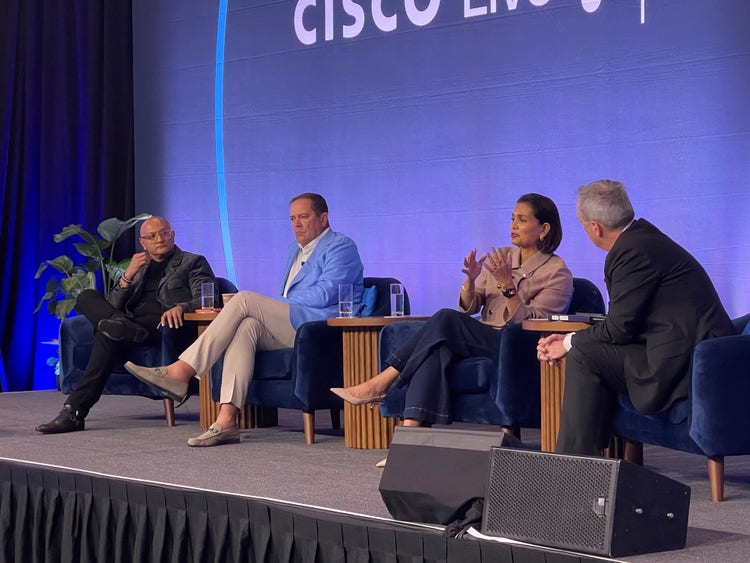
Top Cisco executives used their press conference during this week’s Cisco Live event in Las Vegas to make the company’s strategy clear: The AI opportunity will hinge on security, simplification and scale, and the channel will be critical to delivering all three.
Cisco President and Chief Product Officer Jeetu Patel, Chair and CEO Chuck Robbins and Executive Vice President and Chief Customer Experience Officer Liz Centoni (from left to right in photo) said in response to questions from a packed room of about 100 press and analysts that customers are eager to move on AI but remain constrained by security concerns, operational complexity and aging infrastructure.
Centoni, for instance, said last-year-of-support devices and poor patching practices have become prime targets for AI-driven attacks, while many customers are also unprepared for post-quantum threats such as “harvest now, decrypt later.”
[Related: Cisco Unveils Cloud Control, AI Canvas, Quantum Security Push At Cisco Live]
Cisco’s response, she said, is better real-time visibility across hardware, software, cryptographic assets and security posture, backed by services around resiliency, zero trust and rapid remediation.
“Most organizations probably don’t even know that they’re under attack, and most will be highly surprised when we do a quantum readiness assessment around where they actually sit,” she said.
Robbins and Patel also pushed back on the idea that customers can sit out the AI cycle. Robbins said the bigger risk is underinvesting, even if some parts of the market prove overheated, while Patel said infrastructure demand is already being consumed and not built on speculation alone. Patel also said that token economics must stay tied to measurable business outcomes.
Cisco Cloud Control was positioned as a key part of that strategy: a unifying platform aimed at helping customers manage networking, security and observability across mixed environments with less friction. Robbins said that simplification could finally unlock advanced Cisco capabilities that customers have underused because deployment complexity got in the way. The executives also pointed to service providers as a growing AI-era opportunity, not only for bandwidth expansion but also as potential edge and inferencing partners.
For partners, Patel’s message was direct: Cisco will rely on the channel to scale Cloud Control and its broader AI platform strategy. He said Cisco’s rapid pace of innovation has made it hard to disseminate new capabilities evenly, which is why the company is using controlled availability to train internal teams, solution engineers and partners together.
“We’re bringing the partners along, getting them trained, making sure that the partners are starting to build apps on Cloud Control,” he said. “There’s a tremendous amount of opportunity for partners to monetize and make more money with this because they can add more value in different ways that they might have not even thought about.”
There’s a lot going on at Cisco and its move to unify its networking, AI, observability and security technologies into a tight stack that also plays well with a wider ecosystem. To learn more, here is more of what the company’s top executives had to say.
What is the biggest readiness gap in AI today? What role does Cisco want to play in closing that gap?
Robbins: Right now, every organization is trying to navigate the desire to move faster with the uncertainty of the security posture of the new models. [There’s a] fine line in understanding how you can move forward and take advantage of these capabilities while also ensuring that you’re caring about the trust and the security issues that we all know exists.
Centoni: There are two things I would say in general regarding the readiness gap. One is around last-year-of-support devices. Most customers look at it as an operational drag. Those devices have become ground zero for this new generation of attacks. Mythos is going to change that. The readiness comes from the ability to be able to recognize that but also change the internal operational models and how they patch for it. You can’t take days and months. It needs to be in hours and maybe sometimes minutes.
The second is around quantum. It’s the ‘harvest now, decrypt later.’ Most organizations probably don’t even know that they’re under attack, and most will be highly surprised when we do a quantum readiness assessment around where they actually sit.
As organizations struggle to keep pace with vulnerabilities, especially those that are AI-weaponized, how is Cisco IQ going to help tip the scales toward defenders?
Centoni: I think the first thing is getting visibility into your entire environment. Today I would say with most customers, it’s guesswork. It’s spreadsheets. They’re making security decisions based on guesswork. [They need] an always-current view of what’s in their environment: their hardware assets, their software assets, their cryptographic assets, their security posture in real time, and the ability to then act on it. … Most organizations are still trying to figure this out. The first part is giving them that landscape visibility view into their security posture and then helping them through their own internal operational processes. But that’s just addressing the problem right now. There’s a lot of work to be done around going in and helping a customer assess their network resiliency. Most customers haven’t done that in a long time because they architected these for various use cases, and over time they built one layer on top of another.
We have a network resiliency service that helps our customers identify everything from the design of the network, the security controls they put in place, things like zero trust, and how we can help them deploy shields on Live Protect that’s coming up. These are all things we’re putting together as services for our customers. The key is two things: simplicity and speed. The challenge there is managing that with their internal processes and controls, their compliance, their security gateways. You’ll see us work with our customers on this because [what we’ve seen with] Mythos is just the start. Notice we didn’t call it Mythos services. It’s resilient infrastructure services for future AI-generated attacks.
What happens if the AI bubble bursts?
Robbins: I don’t know what the bubble bursting would look like. But with the dot-com era, there was a lot of discussion about bubbles bursting and all that stuff, but eventually the winners emerged, and we’ve been on a 25- to 28-year technology tear that was built on the companies that survived that bit of a massacre. Back in the day, I think we went from $80 a share to $6, so I have the scars.
For me and our business, this is a very simple decision: The risk of not doing AI is much greater, and that’s all I need to know. When we move forward, we’ll adapt as needed. We’ll adjust our strategy as needed, and I think in general you’ll find that most CEOs are going to feel exactly that way, even though they may not know how to operationalize that yet. FOMO [fear of missing out] is real, and the fear that competitors are moving faster than me because they’re willing to take a little more risk than I am is absolutely a part of the discussions we’re having right now.
You have a group of CEOs today that have built their entire executive careers during times of crisis. There is no normal. I don’t know when I experienced anything normal since I started this job. We went through a lot of crazy geopolitical stuff that started in 2016 and beyond, and then we got into the pandemic supply chain shocks and inflation that none of us have ever managed through. Now we have a combination of all these things.
Patel: I think there’s two conditions that can hold true at the same time. There can be some companies that have frothy valuations and have a secular shift happening simultaneously, which is what’s happening right now. The second thing is, if you look at most of the demand signals on infrastructure right now, we are supply constrained. But it’s not like we're building out infrastructure like in the previous eras where we’re waiting for it to be consumed. It is actually being consumed. No. 3, when you think about where the risk lies, it would be when the cost of tokens and the value derived from the tokens actually have a dissonance, and that’s the thing that we as an industry have to be really careful of. We want to make sure that we’re economically generating tokens that create the necessary and desired output from an end result perspective on the core metrics that a business is trying to measure [and] is in equilibrium with the cost of the tokens.
What is the rollout plan for Cisco Cloud Control? Are there cross-selling opportunities in Cisco’s enterprise customer base that can leverage AI agents and support a refresh across networking and security?
Patel: Cloud Control [is] the very first time that we’ve taken multiple personas across multiple domains and pulled them together for multiple use cases. We’re still in the early days. Over the next quarter or two, we will make sure that as we learn more, we incorporate feedback into the products. The cycle times of these things are extremely fast. From the time someone gives us feedback to the time we can incorporate things into the product, this is a matter of hours and days, not weeks and months. Our goal is making sure that the first set of customers that we have are wildly successful with it, and once that happens, you will start to see this getting rolled out in different ways.
On the cross-selling side, it seems logical to me that if you go out and manage it in a unified way, lower your marginal cost, troubleshoot across domains, and keep it open to the ecosystem, that would have natural benefits to Cisco. What we want to do right now is be maniacally focused on delighting users and making sure there’s a huge amount of simplification without trading off the sophistication.
Robbins: For years, I think Cisco won based on the expansive set of features we had, and then over time customers placed less value on those features because the complexity to deploy them was too great. And so we ended up with this normalization even though we had more sophisticated technologies. I think this may be the breakthrough that actually solves that and brings a lot of those capabilities to life with customers that have, in many cases, been dormant for a while.
Customers over the last 20 years have deployed mixed-vendor infrastructure, which is challenging to modernize. How can Cisco become an agnostic player and offer businesses a way to manage their entire infrastructure?
Robbins: First and foremost, almost every customer without exception over the last year has told me that they have reduced the number of strategic partners they have so they can move faster. This has been a general theme that we heard. And I think to the extent we make it easier for them to move faster with us, then we’re going to be good. Customers are increasingly not interested in piece parts and components anymore. They don’t want to be systems integrators anymore. They’re trying to get to the outcome, and increasingly they’re seeing pressure from their version of me trying to get to the outcome. … Over the last two years, we’ve made a ton of progress in integrating our portfolio in a way that would lead our customers to feel better about investing in these platforms because they work better together.
Talk about the role of telcos and other communication service providers in the AI economy. Can you see them going beyond connectivity to influence the edge and other new business models?
Robbins: I think they see a path towards what their role is for them to monetize AI. It’s not a stretch for the business model. It’s not something new they have to learn. There are just core bandwidth requirements that are going to be needed, which is what they do. We’re seeing them build out their network capacities. I [estimated increases of] 3X in three years, and who knows, we maybe underestimated that. So that’s one piece. The second is, I absolutely think there’s a lot of customers who have these old central offices with mini data centers all over their networks, and they do think that over time somehow they’ll find a way to monetize that. Some of them are thinking about just selling additional leasing space at the edge so that people who are providing these solutions can get paid on that. Others want to partner to build stacks with companies like us and offer inferencing services. It’s evolving right now, but I think that’s how they see their role.
Patel: If you look at our broad Cisco framework, secure global connectivity is one thing that we actually explicitly call out because we feel it has such an important role to play, especially because agents in the workplace are going to be prominent. One of the things to take away from this is the volume of increase of network infrastructure is not just going to be limited to data centers. Campuses and branches are going to see a huge uptick in volume because there’s a whole new category of computing that’s being built, deskside computing. And that’s where you’re going to start to see these agents run. We’re going to need to make sure they communicate with agents that might be in the data center. And so connectivity fabric is going to be more and more important. Our engagement with service providers has only increased over the past couple of years.
Robbins: I’ll take you back to when we used to talk a lot about the competitive differentiation that we attained by having a service provider business and an enterprise business, and the fact that we could bridge those two. Now we have an incredible cloud business, service provider business, and an enterprise business that’s inclusive of public sector, commercial, and everything else. I think that differentiation is probably going to start to re-emerge because we can actually stitch those solutions together.
How will Cisco use AI to expand the security and networking businesses and attack security competitors?
Patel: If you look at what is happening right now with workforces around the world, you will see a massive level of augmentation of capacity like we talked about with agentic AI. The big difference right now is delegating a task to an agent and trusted delegation to an agent is the difference between bankruptcy for a company or market leadership because people just don’t trust agents completely right now to do business-critical tasks that are going to be fully autonomous. And so we have a massive opportunity where I don’t even think the TAM [total addressable market] is fully quantified yet in terms of agents being secure. If you have trillions of agents that need to be secured, you’re going to need to have identity around those agents. You’re going to need to make sure that you secure every action that the agents take, and you’re going to need to figure out how you can effectively intersect those agents at any point in time. So from my perspective, we have an enormous opportunity. The acquisitions that we’ve made, whether it be Galileo around the observability of agent behavior, which, by the way, gets into trust because if you can observe the behavior and dynamically enforce guardrails based on the behavior anomalies that you start to observe, there’s a tremendous amount of upside on that front.
The second area is this notion of non-human identities. Right now, the industry is largely focused on zero trust with human identities, but as you go from access control to action control, identity is going to play a pretty central part, which is why we’re really excited about the acquisition we made with Astrix. [When we demo’d Cisco Cloud Control], there were six or seven products behind the scenes that actually had different capabilities that got stitched together in Cloud Control with an app called Agent Security. That app completely took away the seams from those different products and gave a unified way to think about agent security, end to end, from start to finish, from the identity standpoint, from making sure that you discover agents to do action control and then making sure you can intercept the agents as well. And so I feel there’s a tremendous amount of potential here.
[Regarding competitors,] we’ve got to just keep our heads down. We’ve got some structural advantages on our side, such as security being baked into the fabric of the network, making sure that we have massive level of telemetry, having Splunk as a strategic asset, and having this an AI-forward mental model, as well as an execution record.
Robbins: With these agents and the real-time, low-latency activities they’re going to be driving, sometimes they’re going to work in the old batch mode overnight, which is great, but a lot of them are going to be around real-time interactions at the customer experience point. The only way you’re going to secure that is to deploy security services at the packet level on the flow through the network. That’s the only way to do it. None of my security competitors have networking, and none of my networking competitors have security. So it’s up to us to take advantage of this. We have to execute. We have to get it done, and we are inherently advantaged as we move forward.
Patel: One thing that’s really important here is the silicon that we built over time. That is one of our very strong strategic advantages. Don’t rule out the fact that over time you might want to edge security into the silicon itself.
Following this week’s news from Cisco Live, where will Cisco invest to widen the gap between it and its competitors?
Robbins: I’ll start playing it simple at the silicon level because fundamentally we are between silicon and optics. We control so much of the system build that it’s an inherent advantage. I fundamentally believe that supply chain is going to be a massive competitive differentiator for companies over the next five years, and controlling more of your supply chain is going to be a massive competitive differentiator as you look to the future.
If you’re selling to cloud providers today, the value is either in the software or the silicon. If they move to open-source software and you don’t have silicon, you have no value. So as we can integrate more tightly, can go from the OS through the system down to the silicon and then at the optic layer and can actually build integration points, it just continues to differentiate us from a platform perspective as we go forward. A lot of our competitors will struggle to be able to control all those aspects.
For the new technologies launched this week including Cisco Cloud Control, what’s the plan for rolling that out to the channel? How quickly can this be brought to channel partners?
Patel: One of the challenges that we haven’t cracked the code on completely is the volume of innovation that we’ve been doing over the past few years. Getting that evenly disseminated to all of our customers and to channel partners has always been challenging because you can’t get it out fast enough because the cycle time and the amount of capabilities being rolled out are so huge.
[Now] we’ve actually gotten ahead. Our internal team of engineers and SEs, as well as our partners, we’re making sure that we’re bringing them along. That’s why we’ve done a controlled availability right now. We’re bringing the partners along, getting them trained, making sure that the partners are starting to build apps on Cloud Control. There’s a tremendous amount of opportunity for partners to monetize and make more money with this because they can add more value in different ways that they might have not even thought about.
Frankly, one of the benefits of building a platform like this is you can’t forecast how people are going to use it. People are using it in creative ways, and we’re starting to see that not just with the internal teams but also with partners. You should expect us to make sure that we have a very organized rollout plan with partners over the course of the next few quarters. Remember, we have about 1,000,000 customers that we have to roll this out to over time. Partners are going to be central to make that happen because they give us the scale and the feet on the street, especially in geos where we sometimes might not have the level of scale.