Confluent Current 2026: 5 Big Streamhouse, IBM And AI Takeaways
One of the biggest reveals at Current 2026 was new capabilities for building what Confluent calls a Streamhouse, a data architecture that aims to keep business context current for AI agents, applications and analytics as they make decisions and take action.
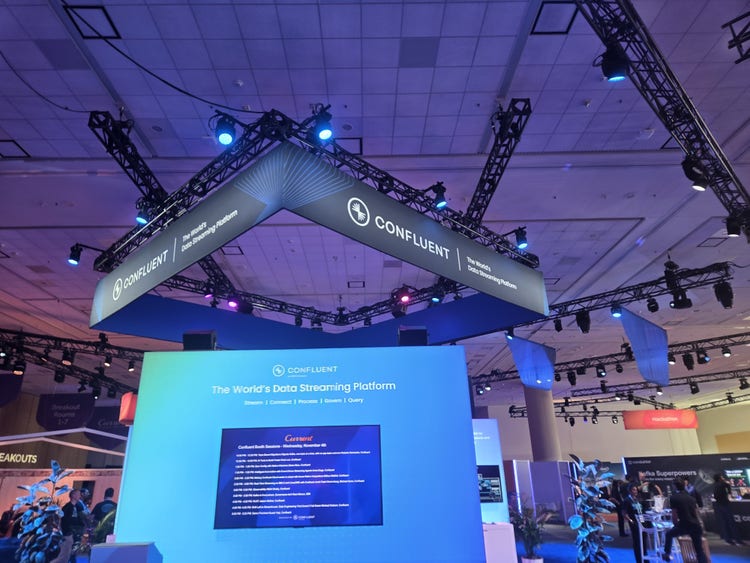
Confluent’s Streamhouse architecture, its future under IBM and expanded opportunities for partners were among the biggest themes at the vendor’s Current 2026 event.
Tony Giang, founder and CEO of Psyncopate Technologies, a Dallas-based Confluent solution provider, told CRN in an interview that Streamhouse is part of the toolset for governing data up front, applying schemas to the data and accessing data earlier upstream at a lower cost.
“When we go talk to our customers, it’s just another piece or another option that they can consider,” he said. “We present them all options and we present to them the pros and cons of it all, and so it’s a really strong message.”
[RELATED: IBM Completes $11 Billion Confluent Acquisition]
Giang said that in the AI era, customers are increasingly seeking real-time data for better AI-powered insight.
“In the past, if you’re a manufacturing company that didn’t need data until 12 hours from now, who cares?” he said. “But now with AI, if you want to take advantage of AI, you have to be real time.”
An October report from research firm IDC points to the market potential for solution providers looking into data streaming. A survey of 635 IT and data decision-makers from organizations worldwide showed that about 16 percent of organizations have extended real-time data movement to all workflows that require it.
Trust—a major benefit of working with solution providers—ranked as the main challenge for organizations interested in real-time data movement.
The percentage of organizations running multiple agentic applications in production rose from 8 percent among those with limited real-time data integration to more than 50 percent among those with comprehensive coverage, according to IDC. More than 30 percent intend to increase data governance and observability spending by 25 percent or more. More than 6 percent plan a 50 percent or greater increase in governance.
Here’s more of what you need to know coming out of Confluent Current 2026.

What Is A Streamhouse?
One of the biggest reveals at Current 2026 was new capabilities for building what Confluent calls a Streamhouse, a data architecture that aims to keep business context current for AI agents, applications and analytics as they make decisions and take action.
Unlike data lakes, warehouses and lakehouses, which primarily support historical analysis and batch processing, Streamhouse continuously captures, processes, governs and serves the current state of the business. Confluent positions the architecture as a real-time operational layer that complements existing analytical systems rather than replacing them.
Confluent also made Lightning Tables generally available on Amazon Web Services, with plans to extend it to other clouds, Sean Falconer, Confluent’s vice president of product, AI products and strategy, told CRN. Lightning Tables materializes Kafka data into continuously updated, queryable tables without requiring separate ETL pipelines, databases or caches.

What Changes For Confluent Under IBM?
During a press and analyst event, Shaun Clowes, general manager of Confluent and data at IBM, said that the systems of record, processing systems and secure infrastructure spanning cloud, on-premises and hybrid offer synergy for Confluent and that the integration is less about bundling and more about helping enterprises with data siloed across various systems.
“IBM is the company helping people basically take their workloads wherever they need to put them and solve business problems with technology,” he said. “Confluent and Kafka and Flink are already naturally integrated among many of IBM’s products … to move data around from wherever it’s created to wherever it needs to go. So the synergy is there naturally from a product perspective.”
Flink is an open-source processing engine designed to perform complex computations on data streams in real time.
IBM’s history of keeping Red Hat and HashiCorp open bodes well for Confluent, he said. “There are very few vendors that are trying to do that—they are actually trying to go the other way,” he said. “So IBM is a natural home for us in that sense.”
During the latest quarterly earnings call from IBM, executives shared that Confluent growth helped support 20 percent growth year over year in its data business and about 20 percent bookings growth.
Enterprises seeking to unlock data to power AI apps, with 90 percent of enterprise data still not on the cloud and more than 70 percent of organizations reporting insufficient real-time data infrastructure, bodes well for Confluent, IBM Chairman, President and CEO Arvind Krishna said on the call, according to a transcript.
“We believe Confluent is uniquely positioned with a complete open and hybrid approach that helps clients avoid lock-in while deploying wherever the data resides,” Krishna said.
Confluent and Red Hat have a potential collaboration across OpenShift inference servers and Confluent real-time inference in air-gapped environments, factory floors and other industrial environments, for example, Confluent’s Falconer said.

Partner Data Streaming Opportunities
The AI era and deeper focus on the data streaming products and services Confluent brings creates greenfield opportunities for its partner ecosystem—and now the IBM partner ecosystem.
Clowes (pictured right) told a CRN reporter during a press conference at Current 2026 that any beliefs that solution providers would become unnecessary in the AI era have been dashed because organizations will turn to trusted advisers to harness data fast.
And for any customers restructuring their technology stacks, solution providers will be the ones putting the building blocks in place.
“We are in the middle of the most incredible technology transformation of our entire careers,” Clowes said. “The people that can harness their data fastest are the ones who will win. They will need a bunch of SIs to help them do that.”
Thomas Mahaffey, chief data strategist for the strategy, architecture and innovation wing of Accenture—No. 1 on CRN’s 2026 Solution Provider 500—shared on stage during Current 2026 that about 80 percent of Accenture's data flows over Kafka topics and approximately 50 mission-critical processes use the Confluent backplane. In one staffing application, he said, requests that previously took days to reach appropriate workers now arrive within seconds.
The solution provider also plans to leverage streaming for clients’ AI for business intelligence, conversational analytics and improving chatbot experiences with clients’ data. “There’s a sigh of relief that they know now how they’re going to get that data,” he said.
Confluent Expands Its AI, Data Streaming Portfolio
The vendor moved Confluent Intelligence’s on-premises AI model serving in Confluent Platform for Apache Flink into open preview, giving users access to production-grade, lightweight specialized AI models from a curated catalog.
It also introduced a conversational assistant for querying real-time Flink data in natural language without writing SQL.
Other products reaching GA include Managed Model Inference for LLMs on AWS, Google Cloud Platform and Microsoft Azure.
Managed Model Inference aims to give users a zero-configuration capability for calling supported AI and machine learning models from Flink SQL, enabling real-time inference without managing credentials, endpoints or serving infrastructure.
Real-Time Context Engine became GA for users looking to serve fresh context to AI agents through Model Context Protocol (MCP) as an access pattern for Lightning Tables. Confluent also moved managed MCP servers into GA for users working with AI assistants. Confluent Skills also became GA as complementary coding-assistant plugins for designing, building and debugging Kafka Streams applications without using MCP tools.
Confluent Private Cloud gained multi-tenancy to allow users to consolidate Kafka clusters, reduce the total cost of ownership and on-board in minutes on private infrastructure.

AI’s Future: Confluent Executives On Human Roles, Standards And Guardrails
Confluent executives at the event shared their thoughts on AI’s future.
Clowes said he doesn’t foresee humans becoming useless as AI agents become more capable, but agents can take over time-consuming work such as triaging emails, alerts and messages. And that busy work spans company divisions from engineering to finance and human resources.
Humans also naturally gravitate to areas where they can add value in an organization, he said. “We’re constantly breaking out of whatever the boxes you put us in,” he said. “That’s a good thing.”
Falconer said standardized model APIs could accelerate adoption, pointing to Anthropic’s MCP as an example of how a common interface can help AI tools proliferate.
Stephen Deasy, Confluent CTO, told CRN in an interview that software is increasingly moving from deterministic to probabilistic, with organizations constantly running evaluations as new models come out and users want to try new prompts and different types of context.
Key is guardrails, including role-based access controls and client-side field encryption, he said.
“The recurring theme that we see through all of that is really this need for that rich context in real time to be able to evaluate both in real time and historically how that data is behaving,” Deasy said.