Dell CEO Michael Dell: ‘Structural Shortage’ In AI-Driven Compute Market ‘Probably Worse’ In 2027
‘You just have a structural shortage probably worse in 2027 than in 2026 from everything that we see,’ says Dell Technologies CEO Michael Dell.
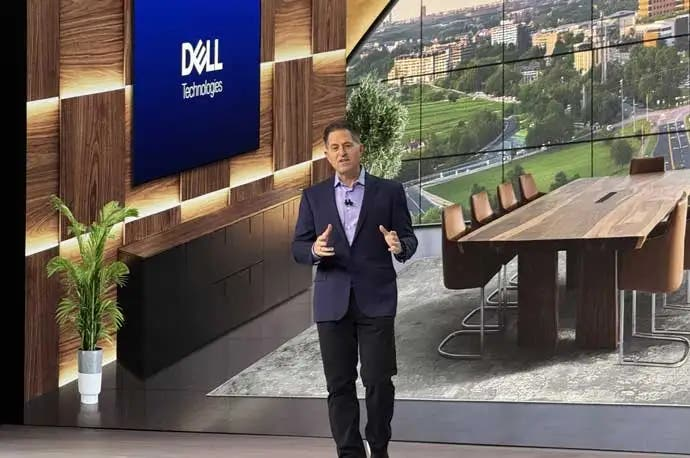
Dell Technologies CEO Michael Dell Wednesday told investors at the Goldman Sachs Communacopia + Technology Conference that the “structural shortage” of semiconductors driving higher compute and PC prices in the midst of the AI boom is “probably” going to be “worse” in 2027.
“All of the improvements in the models, particularly from basic LLMs (large language models) to reasoning to agents has occurred well within the time frame required to build a new semiconductor fab, so you just have a structural shortage probably worse in 2027 than in 2026 from everything that we see,” said Dell in an interview at the conference with Goldman Sachs analyst Katherine Murphy. “Yes, costs are going up. Yes, we price all that through. But you know customers sort of go through five stages of grief (saying initially), ‘OK the price went up I don’t really like that.’ You know what is worse than that? They don’t have availability. Because they can’t run their business and that is a disaster.”
Once customers come to grips with the higher costs of infrastructure, Dell said they ask: “Are you going to be able to supply us with what we need over the next year or two years? So that is what we work on with our customers. We watch closely for any signs of double ordering or things that are not being utilized and we don’t see that.”
Dell told Goldman Sachs investors that the company believes the “integrity” of its “demand signal” in the midst of the component shortages and rising memory prices is the “best” in the industry. “We are more directly working with customers of all types and we see what the actual demand is from the end customers,” he said.
Dell acknowledged that with the “tighter the supply environment,” the company is probably going to do better than competitors. “That’s been heuristic for a long time,” he said. “We have incredible relationships with our (semiconductor) supplier partners. We also have this broad portfolio. We can sort of move supply around to where the demand is.”
The semiconductor manufacturers also know that Dell is a “reliable counterparty” that will be able to take on the semiconductor output from high capital expenditure semiconductor fab investments through every market cycle, said Dell.
“We have the broadest set of customers and they want to know that there is going to be demand in 2032 and 2038,” said Dell. “The relationships go back many, many decades. That is incredibly important.”
Another big factor in the midst of the current “structural shortage” is that customers know that they can “count on” his company, said Dell. “Particularly now when there are these supply chain challenges they know from prior periods we deliver what we say we are going to deliver. Not everybody does that.”
C.R. Howdyshell, CEO of Independence, Ohio-based Dell Titanium partner Advizex, a Myriad360 company, said Dell’s supply chain prowess is unmatched and is going to become even more critical next year.
“Having confidence in supply chain execution is going to become even more critical next year with things getting worse – not better,” said Howdyshell. “The potential exposure for customers not prepared is significant. That makes Dell’s supply chain experience that much more valuable.”
Howdyshell said Advizex and Myriad are doing detailed product planning schedules with customers to ensure that IT projects are not delayed in the wake of the supply chain crisis. “That is creating some pull-forward spend from customers,” he said. “That is going to impact next year’s spending too.”
Dell, for his part, said business line executives are realizing that they need AI to be more competitive, innovative and faster. “So the conversation is sort of leaving the traditional (IT) budget discussion because this is how you create value in companies,” he said.
“Now companies sort of understand this is how you become more efficient and how you become more innovative,” he said. “If you had 200 people doing something now you can have 50 people doing the same thing with $10 million of AI spend and it costs half as much and it actually works better. So what’s happening is the CEOs and the business line executives are all figuring out they need AI to be more competitive, to be more innovative, to be faster. So the conversation is sort of leaving the traditional budget discussion because this is actually how you create value inside companies."