ESET Launches AI-Era Security Portfolio
‘When you look at the market overall, everybody is extremely overwhelmed with what’s going on with security, particularly now with AI,’ says ESET’s Ryan Grant.
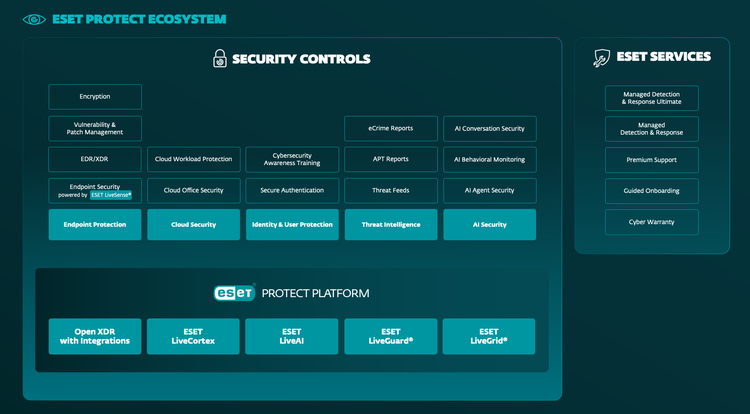
ESET is releasing a new all-in-one product portfolio aimed at the channel with a goal of improving client cybersecurity postures and outcomes as artificial intelligence increases the volume of attacks and introduces new attack surface areas.
The Bratislava, Slovakia-based cybersecurity vendor is making Protect available to channel partners and customers in the U.S., Italy and Slovakia first with a phased launch plan set for other global markets.
The aim with Protect is to help its solution providers scale and remain profitable with recurring revenue in the AI era, Ryan Grant, ESET country manager for U.S. and Canada, told CRN in an interview. He described the ESET Protect portfolio as a shift toward cybersecurity as a service, although the packages use seat-based pricing.
ESET is not looking to make money through tokenization, Grant added.
“When you look at the market overall, everybody is extremely overwhelmed with what’s going on with security, particularly now with AI,” Grant said. “We’re really trying to offer effortless cybersecurity for everybody in this AI era.”
[RELATED: Delivering Reliable Connectivity And Cybersecurity On The High Seas: Inside MSP Marlink’s Approach]
ESET has about 10,000 partners worldwide, according to CRN’s 2026 Channel Chiefs.
Travis Woods, founder of San Francisco Bay area-based ESET solution provider Fort Point IT, told CRN in an interview that he has seen high demand from clients for AI governance and making sure sensitive data is where it belongs.
Part of the work includes educating customers on the correct way to store and protect data, with clients sometimes not realizing they weren’t following best practices. He is working to create better “visibility into the AI usage, how it’s being used, if these are sanctioned models or not sanctioned models” to combat shadow AI.
ESET’s product portfolio is an essential part of his security stack, Woods said.
“They’re such a research-first-driven company,” Woods said. “Whenever any news breaks about a big incident or whatever, you always see the ESET attribution. … It gives me comfort that there’s efficacy to the product and my customers are safe.”
ESET Promises Simplified Portfolio For AI-Era Security
Grant positions the Protect portfolio as a way to drive simplicity in a security market growing in complexity. While other vendors have been adding AI capabilities through acquisitions, ESET has ingrained it through native innovation, he said.
“We have bundled it all into a very simple offering,” Grant said. “And it’s not stitched together with separate consoles. It’s really one system. And it really is to allow for people to effectively just have cybersecurity in a box.”
Protect breaks down into three separate tiers. Protect Core, aimed at clients with at least five seats, brings baseline security for AI stacks. This tier protects against ransomware, phishing and zero-day threats.
The next tier, Protect Premium, aimed at clients with at least 10 seats, adds autonomous managed detection and response (MDR), threat monitoring and containment. ESET security experts monitor these services 24 hours a day, seven days a week, according to the vendor.
And the final tier is Protect Ultimate. Available for clients with at least 10 seats, Ultimate brings MDR to advanced environments, live contact with the ESET threat-hunting team plus enterprise-grade threat analysis and remediation.
Each tier also has Plus packages for email security, multifactor authentication (MFA), vulnerability management, patch management and other services, according to ESET. The vendor’s MDR Guided Onboarding, for example, is meant to help clients align deployments with best practices from the jump, reducing setup complexity and implementation risk.
As part of another Plus package, ESET has partnered with Cysurance to deliver cyber warranty financial and operational assurance to clients, with up to $1 million financial coverage for ESET customers, according to the vendor.
And another Plus package includes ESET Cybersecurity Awareness Training with online education, testing and cyber resilience resources for employees.
The trainings meet insurance requirements and a variety of regulatory requirements including Network and Information Systems Directive 2 (NIS2), HIPAA, the PCI framework, the Sarbanes-Oxley Act (SOX), the General Data Protection Regulation (GDPR) and California Consumer Privacy Act (CCPA).
AI Agent Security And Governance Take Center Stage
ESET wants to protect users in every environment in the AI era, Grant said. The vendor’s tools should prevent data uploads to unauthorized popular AI chatbots, and monitor AI agents for their intentions, behavior and what data they can access.
And while AI offers efficiencies in security such as cutting down on alert fatigue, ESET still emphasizes humans in the loop. “We have 24-by-7 monitoring that’s watched over by a human,” Grant said. “We’re not taking our hands off the wheel completely.”
“Our recommendations for how people should be thinking about the tools is, yes, embrace the tools,” Grant said. “But at the same token, have the technology that’s actually treating the AI tools and the agents almost like an employee. … We’re not trying to slow down the advancements of using the agents. However, you should be testing those agents to understand what skills it is using.”
To that point, the vendor’s threat report for the first half of 2026 showed that, based on an analysis of about 900,000 AI skills—third-party code that plugs into AI systems and extends their capabilities from popular repositories—ESET identified 25,000 suspicious skills and more than 3,000 outright malicious ones. More than 80 percent of the analyzed skills execute commands without user initiation. About 30 percent download third-party tools into user environments.
“We’re unpacking what the agent’s doing,” Grant said. “And then we’re actually observing what it’s doing in a sandbox environment. … If we feel like it’s clean, then we can push it into production. And then once it’s pushed into production, we can actually see and make sure it’s actually staying within the guardrails that were defined, that we saw in the testing area.”
ESET is also leaning into seat-based pricing, with Grant seeing customers “a bit surprised on the cost of AI from prompting and the tokenization, the impact that’s having.”
“We did not want to go that route,” he said. “Given we’ve been in AI since ’97, for us, we had a really strong foundation to begin with, and we just basically built upon it.” ESET traces its origins to an antivirus its founders developed in 1987, with the company officially formed in 1992.