For MSPs, AI Success Will Come Down To Trust, Data, Business Outcomes: Panel
‘It’s not a technology outcome. It’s a business outcome. Having those conversations, understanding their business and how AI can really optimize their business is where you have to lean in,’ says Nucleus Networks CEO Jennifer Roy.
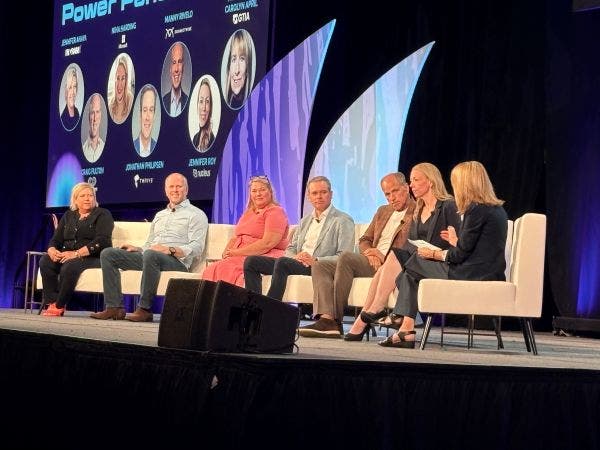
MSPs all want to be strategic advisors to their customers, and now as AI moves from pilot project into day-to-day business, they have a chance to prove it. But adding AI to the stack isn’t enough. The opportunity is to rethink how they run their own businesses, advise customers, measure value and decide what to build themselves versus where to lean on vendors and distribution.
That was the central theme among channel executives during a GTIA Power Panel at the non-profit’s San Diego-based conference earlier this month. The panel was moderated by Carolyn April, vice president, head of research and market intelligence at GTIA; and included Jennifer Anaya, SVP, global marketing at Ingram Micro; Craig Fulton, M&A advisor at Evergreen; Nina Harding, corporate vice president at Microsoft; Jonathan Philipsen, EVP, channel and alliances at Thrive; Manny Rivelo, CEO of ConnectWise; and Jennifer Roy, CEO of Nucleus Networks.
The next phase of AI adoption, they said, will not be won by the MSPs that push the most AI tools but by the partners that can turn AI into business results for customers.
GTIA’s April said the channel is experiencing a familiar pattern as MSPs went through a similar period of uncertainty when cloud computing emerged.
[Related: Amid AI Surge, ‘Trust Is Becoming The Product’: GTIA Exec]
“We said this about the cloud too, right? The cloud came out, and everyone was asking, ‘Do we really want to do this? What’s our value statement going to be if we move people to the cloud now?’ There was a lag,” she said. “And with AI, there’s this new shift. It’s like you’ve worked so hard at automating your own business. Well, now you have to automate your customer’s business for the first time.”
Her advice to MSPs was to resist the temptation to transform everything at once.
“I would focus on improving your customer experience,” she said. “Put AI in your service delivery teams so they can respond faster, get through things faster. You can scale your business, deliver a better experience and grow without having to bring more resources in.”
From Selling Technology To Selling Outcomes
Evergreen’s Craig Fulton said the shift is already changing what customers expect from MSPs.
“The challenge I think that we’re all facing with the channel is how do you evolve into this outcome-based methodology where the customers are actually asking for SLAs versus what’s the cost of a renewal?” Fulton said. “It’s a very different landscape.”
That change also puts a premium on specialization. More and more customers want partners who understand their businesses, not just deploy technology. “They don’t want to just buy technology anymore,” he said. “They want someone that’s going to be in it to co-create.”
That idea of “co-creation” could help define the channel’s next chapter, he added. Rather than just recommending products, MSPs can sit with customers, figure out where the core business problems are, test where AI can help and tie those efforts back to business goals.
Philipsen said Thrive is approaching AI through two lenses: what it can purchase off the shelf to improve its own efficiency, and what it can develop into a differentiated capability.
He said Thrive is using AI alongside its development capabilities to create better workflows between its teams and customers.
“That’s one of the use cases where people buy from us,” Philipsen said. “It’s not just that we have the platform. It allows us to have visibility into the larger clients, into their service desk and their backlogs. We have developers on staff, so we’re leveraging AI to develop transparent work streams back and forth.”
He also sees an opportunity where customers are experimenting with AI before they have a formal strategy.
“There’s no playbook for it,” he said. “We have clients coming to us with ideas like, ‘How can Claude help me?’ That’s just an example of an end user being dead set on one large language model. So let’s take that as an opportunity to educate ourselves and understand which are the right models that are more impactful for us.”
That makes advisory services increasingly important, he added, because customers and MSPs are essentially learning together.
Governance Has To Come Before AI Experimentation
Nucleus Networks CEO Jennifer Roy argued that MSPs need to establish a stronger operational foundation before attempting to build sophisticated AI offerings. She pointed to the need for consistent security standards across customers.
Without that foundation, she said AI deployments could become difficult to secure and govern. She also urged MSPs to use AI internally before asking customers to trust them with it.
“You have to eat your own dog food or drink your own champagne before you can ask your clients to trust you to implement it into their business,” she said. “The biggest opportunity is internal. You have to start using it, get comfortable, get training, work through programs.”
The customer conversation should then move beyond technology and toward business results.
“It’s not a technology outcome,” Roy said. “It’s a business outcome. Having those conversations, understanding their business and how AI can really optimize their business is where you have to lean in.”
On whether to build or buy AI tools, Manny Rivelo, CEO of ConnectWise, said MSPs should focus on the AI capabilities that are core to their businesses. AI may be revolutionary, he said, but that doesn’t mean every AI capability should be built internally.
“If you’re an MSP, it’s the service delivery, it’s that intimacy, it’s that touch to that end user,” Rivelo said. “If I’m applying AI toward my core to differentiate my business completely in the way I deliver my services, that’s a good use.”
The best AI investments, he argued, are those that create a concrete promise to customers.
Trust And Data Will Define The Next Phase
Microsoft’s Nina Harding said AI has moved well beyond early tests and pilot projects and is now beginning to make a foundational difference inside businesses. But as adoption accelerates, she said the next issue for partners and customers is trust.
“It’s very easy today in the world of AI for anyone in a company to take their credit card, swipe it and all of a sudden they’ve introduced a third-party agentic platform into your environment and it’s going after your data,” Harding said. “You need to start with that foundation of security and building that trust.”
And Rivelo warned that data leakage can begin with harmless AI use. But for MSPs, that creates an opening, and a responsibility, to become experts in AI governance, security and data protection.
For Ingram Micro’s Jennifer Anaya, she believes the channel should view this moment as bigger than simply another technology cycle.
She argued that distribution, too, has an opportunity to rethink how it serves partners by reducing friction, lowering costs and providing resources that MSPs cannot maintain themselves.
“AI really isn’t as much about technology as it is about a time for us to really think big,” Anaya said. “The channel is in an absolute power position of what’s happening with this because partnering is so critical for these kinds of solutions.”
Juan Mack agreed with the panel, reiterating that MSPs looking to adopt AI should first see where the technology can make the biggest difference.
“It’s very important to understand where we want to apply it,” Mack, technology and business operations manager at Jasper, Ind.-based Matrix Integration, told CRN. “If AI is going to help you be different on the services you’re delivering to your customers, you should be able to focus on that. Then there’s the context… your internal code, your internal processes, and how you can use AI within that.”
For Mack, that means MSPs shouldn’t rush to turn AI into a customer-facing offering. Instead, they can begin by improving their own operations and cleaning up the data and processes that AI will rely on.
“You need to make sure that you have that clean foundation in order to apply AI to your business,” he said. “I think it’s going to help a lot of MSPs mature in a very significant way and faster.”