Logitech Enterprise Products Reveal: 5 Things To Know
Logitech next reports quarterly earnings on Oct. 27 for the second quarter of its 2027 fiscal year, spanning the three months ended Sept. 30.

A Logitech soundbar meant to reach medium-to-large rooms and future-proof users for new AI experiences.
The next iteration of Logitech’s Tap IP meeting room touch controller.
And new audio technology that can replace complex ceiling speaker systems and even allow two people at a conference table to hear two separate feeds without headsets.
These are some of the biggest reveals by the Lausanne, Switzerland-based device maker during its next-generation video devices Logi Launch event that runs through Friday and comes just weeks before second fiscal quarter earnings.
Logitech next reports quarterly earnings on Oct. 27 for the second quarter of its 2027 fiscal year, spanning the three months ended Sept. 30.
[RELATED: Microsoft Rebuilds Copilot Around Home, Code, Autopilot: 5 Things To Know]
The vendor added compute headroom to account for the extra resources needed for AI-powered experiences not only today, but in the future, Henry Levak, general manager of the Team Workspace Solutions Business Group at Logitech, told CRN during a product demonstration at Logitech’s campus in San Jose, Calif.
“There are going to be features between now and the next six years—I have ideas of what some of them are. There’ll be some that I’m not even familiar with,” he said.
Logitech also wants to prepare users for the inevitable back-and-forth on whether AI is best processed through the cloud or at the edge.
“Everyone starts with cloud. They realize it’s really expensive. And then they move to the edge, and then they are like, ‘Oh, we need more compute.’ I’ve seen this play out in pretty much any world I’ve ever worked in. IoT, smart home,” Levak said. “Where does it live? It’s a combination of the two.”
John Richards, vice president of engineering at Tampa, Fla.-based Logitech partner AVI-SPL—No. 57 on CRN’s 2026 Solution Provider 500—told CRN in an interview that the COVID-19 global pandemic shifted more clients with office space to think about the platforms they pick more so than the setup of various rooms, increasing demand for more services and holistic consulting by AVI-SPL.
“Now we’re pulling that together into the data, the analytics, the ROI, the productivity, all of what we call the outcomes,” he said. “We’re really seeing those conversations come together in the integration world in a way that [before] they might have been more siloed in different departments, whether it be IT, human resources and others.”
Read on for more details on Logitech’s new product line for enterprise-grade AV needs.
Sound Shape Audio Technology
At the heart of Logitech’s product reveals Thursday is Sound Shape, audio technology that directs ultra-focused beams to specific spots of the room, evenly distributing sound across 65 feet of space.
Logitech describes the technology as achieving the kind of sound distribution that rooms used to set up through ceiling speaker arrays that can prove costly and have complex wiring jobs for IT teams.
In a demonstration for CRN, Logitech executives showed that it is possible for two people seated across from each other at a conference table to hear two different audio feeds from the soundbar at the front of the room without bleeding and without headphones.
“We can amplify French here, and we can avoid French here,” Karthik Rajagopal, Logitech’s head of engineering, video collaboration, told CRN during the demonstration. “You genuinely create these amplification zones and avoidance zones. Think about a room where an event is going on, there’s no sound leaking to people who are working next door.”
Logitech calls this capability a concept in development. The vendor is working to integrate real-time translation capabilities of Microsoft Teams’ Interpreter and Zoom’s Voice Translator with this technology. That integration could pave the way to new approaches to global business negotiations, multi-regional training environments and other use cases, according to Logitech.
Rally Bar 2
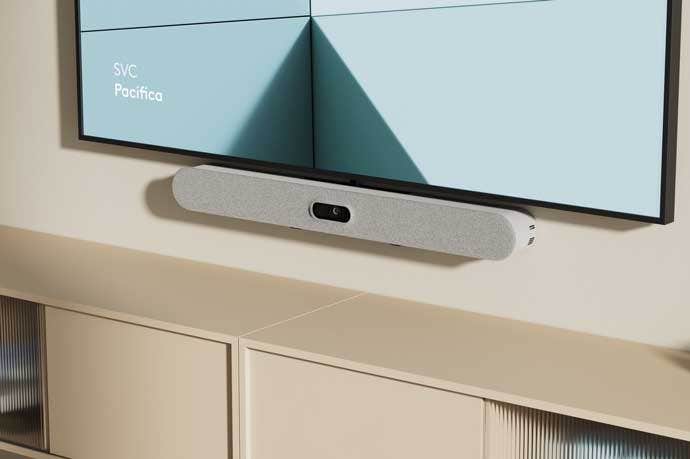
This second generation of Logitech’s Rally Bar is powered by a Qualcomm chipset with four times more edge AI processing power than other video bars on the market, according to the vendor.
Rally Bar 2 has already started shipping. Pricing starts at $4,200.
The bar is aimed at medium-to-large rooms and has four speakers, six beamforming mics with a pickup range of about 23 feet, occupancy detection and environmental sensing, according to Logitech. The goal is for the bar to support broadcast-style rooms and deeper rooms than the previous iteration.
It has custom 115-degree lenses and 1-inch sensors for visual clarity. The bar measures 3.8 inches high by 33.8 inches wide and 3.7 inches deep. The second-generation Rally Bar is slightly longer than the past generation, but also thinner.
Logitech’s RightSound 3 technology brings meeting rooms AI-powered audio and embedded sensors allow users to book meetings when people walk into the room. The bars provide occupancy data for workplace executives to make better decisions around their physical footprints.
Logitech promises easy installation in minutes by one person. The Rally Bar 2, housed in an aluminum unibody, is certified for Microsoft Teams, Zoom Rooms and Google Meet. The bars are built on Microsoft’s Device Ecosystem Platform (MDEP) and meet the vendor’s enterprise-grade security standards, according to Logitech.
Rally System 2 Pro
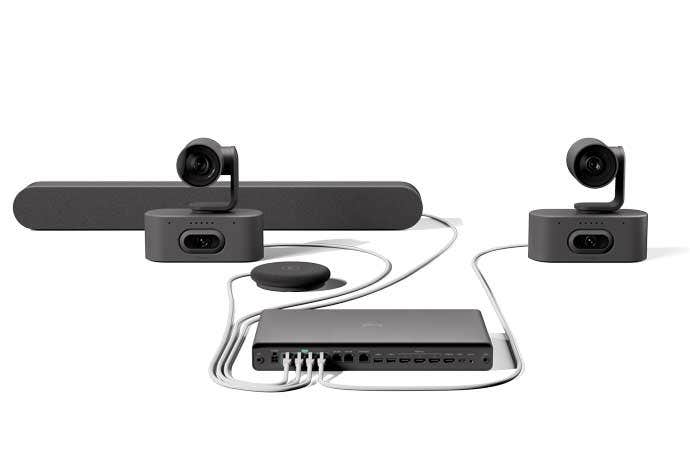
The second generation of Logitech’s modular portfolio for large, divisible, multi-purpose rooms includes the RoomMate 2 Pro, Rally AI Camera Pro, Rally Speaker 2, Logitech Link and RightSight 3.
Second-generation iterations of its Rally System, RoomMate and Rally Speaker will become available summer 2027. The RightSight 3 camera-switching capability is set for availability in the second half of 2027.
The system runs Microsoft Teams, Zoom and Google Meet. It is deployable in Google Android, PC and bring your own device (BYOD) setups.
The RoomMate 2 Pro, powered by Qualcomm, runs up to three displays with 4,000-pixel (4K) horizontal resolution plus multiple cameras, speakers and mic pods. “This is a powerhouse,” Levak said.
Logitech’s dual-camera Rally AI Camera Pro device offers users a wide-angle, 1-inch sensor with the vendor’s optical pan-tilt-zoom (PTZ) camera design.
And Rally Speaker 2 brings a linear, seven-driver beaming networked speaker to rooms. The speaker promises people in the back of the room the same volume and intelligibility that people in the front of the room experience.
The Rally Speaker 2 uses a two-dimensional array, which means users can control sound horizontally and vertically, Rajagopal said.
Rajagopal said that the linear array projects sound in a way that avoids walls and avoids losing energy. “What we are trying to do is how do you make sure the waves are compressed in a way that it actually reaches only the farthest participant, and of course the people in the front as well,” he said. “These work in unison to deliver that.”
Rally Speaker Pro, Max editions
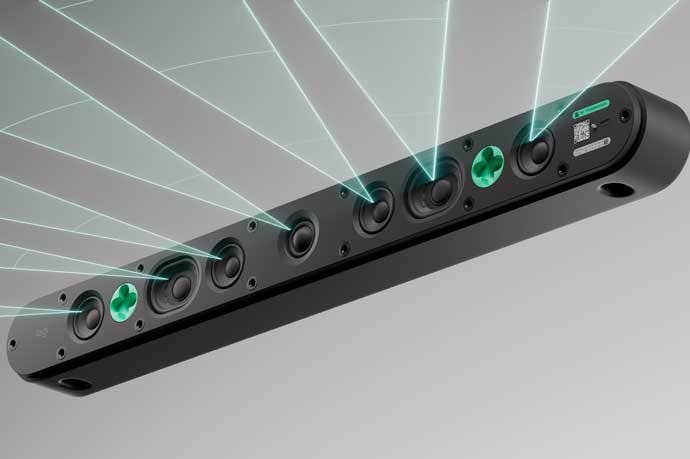
Logitech’s upcoming Pro version of the Rally Speaker 2 soundbar delivers 32 micro-drivers and Sound Shape to distribute sound evenly throughout large rooms, according to the vendor.
And the Max version brings the micro-driver count to 64 and covers an extra-large 65-foot room. Users only need to place these speakers at the front of the room, avoiding the more complex ceiling speaker architecture.
The micro-driver approach differs from other soundbars that use two or three standard speakers, according to Logitech. Standard speakers can lose significant volume from the front of a room of about 40 feet to the back. Rally Speaker 2 Pro loses only about the sound level of a human breath, so users should find sound volume identical whether they are close to the speaker or in a back row.
These soundbars shoot precise beams of sound to specific places without the sound bouncing off walls. The effect can be two people across from each other at a conference table hearing either the same sound or different sounds without any bleed over.
Tap Product Updates
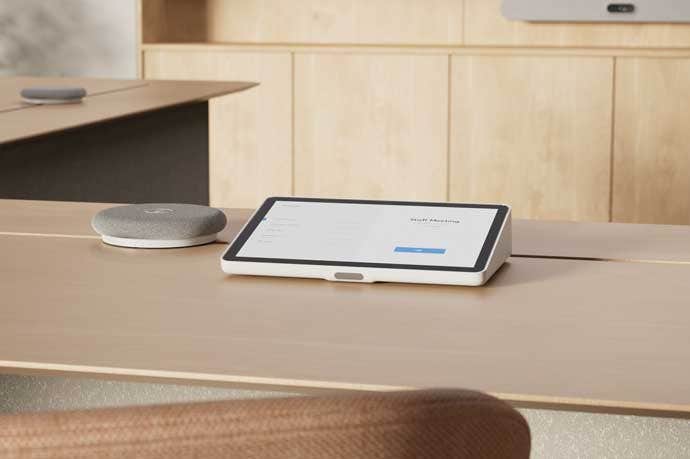
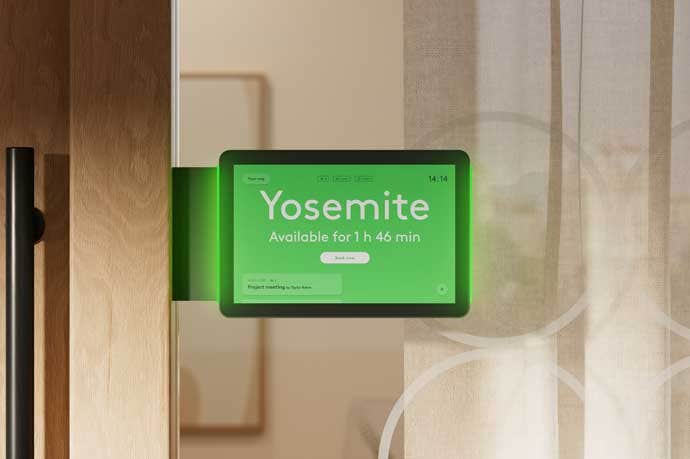
Logitech also unveiled the second generation of its Tap IP meeting room touch controller and its Tap Scheduler scheduling panel. Tap IP 2 and Tap Scheduler 2 have already started shipping. Each of these devices is priced at $1,299.
Tap IP 2 has a 10.1-inch touch display and allows users to share content, mute participants and turn cameras on and off. Its motion sensors work when mounted on a wall upside down. Users can secure Tap IP 2 devices with table mounts for flat placement, riser mounts for a raised viewing angle and wall mounts to save table space in smaller rooms. The table and riser mounts fit standard grommets and rotate 180 degrees.
These devices measure 2.21 inches high by 9.69 inches wide by 6.74 inches deep.
Tap IP 2 works with Microsoft Teams Rooms on Android, Zoom Rooms and Google Meet Rooms, according to Logitech. Tap IP 2 is also built on MDEP with third-party validation for enterprise-grade security.
Tap Scheduler 2 promises users a brighter display with a higher, 1,200-pixel (1200p) resolution, improved compute and built-in motion sensor.
Scheduler 2 works with any scheduling application for finding and booking open meeting spaces. It also has a 10.1-inch LED display. The Scheduler 2 measures 6.5 inches tall by 9.69 inches wide by 1.12 inches deep.
The device includes glass, mullion or wall mounts and works with Microsoft Teams, Zoom Workspace and Appspace.
Users don’t have to use Tap Scheduler 2 for video rooms, and the display pairs with Logitech Spot presence detection to see if people don’t show for a meeting.
The touch controller and Scheduler 2 come in graphite and off-white, and their displays enter sleep mode when not in use to consume less power, auto-waking when people enter the room.