Logitech Expands Into Pro AV Market With Rally 2 Portfolio
‘Typically, less than 10 percent of all the spaces fit into that world, but it’s 90 percent of their headache,’ says Henry Levak, general manager of the Team Workspace Solutions Business Group at Logitech.
The Lausanne, Switzerland-based device maker has already started rolling out second-generation iterations of its Rally Bar, Tap IP and Tap Scheduler offers, Logitech said in a statement Thursday. The vendor will next report quarterly earnings on Oct. 27 for the second quarter of its 2027 fiscal year.
Second-generation iterations of its Rally System, RoomMate and Rally Speaker will become available in summer 2027. The RightSight 3 camera-switching capability is set to become available in the second half of 2027.
Rally Bar 2 is priced at $4,200. Tap IP 2 and Tap Scheduler 2 are each priced at $1,299. Logitech did not reveal pricing information for the upcoming products. Logitech disclosed the new devices as part of its Logi Launch event that runs through Friday.
Expanding into training rooms, multi-purpose rooms and divisible rooms is important for solution providers, Henry Levak, general manager of the Team Workspace Solutions Business Group at Logitech, told CRN during a product demonstration at the vendor’s campus in San Jose, Calif.
Paradoxically, customer satisfaction (CSAT) scores are typically higher for smaller meeting rooms and lower for complex rooms, Levak said.
“It’s actually a relatively small percentage of most companies’ deployments—typically, less than 10 percent of all the spaces fit into that world, but it’s 90 percent of their headache,” Levak said. “This is where most of the energy goes into. And that’s because typically, when you design a space like this, you have complex audio solutions, ceiling speakers and mics.”
[RELATED: Microsoft Rebuilds Copilot Around Home, Code, Autopilot: 5 Things To Know]
Logitech’s top channel goals for 2026 include improving partner technical skills and encouraging partners to sell a broader part of its portfolio, according to CRN’s 2026 Channel Chiefs.
John Richards, vice president of engineering at Tampa, Fla.-based Logitech partner AVI-SPL—No. 57 on CRN’s 2026 Solution Provider 500—told CRN in an interview that he has seen a mega cycle of new product and refresh opportunities.
Demand around equipment that is not only ready for AI, but properly secured for the new technology era—married with the amount of COVID-19-era hardware purchases now aging out of the workplace has also created opportunities for AVI-SPL, he said.
“We’re seeing this refresh cycle have so much alignment across so many different technology suppliers,” he said.
Historically, edge and unified communications (UC) devices didn’t always have the latest chipsets. But that AI and security concern by end users with the speed of innovation in software has put a new focus on what’s inside the devices, Richards said.
“It becomes much more important for them to be much more powerful, have a lot more headroom for features that maybe are not enabled today, in order to get a usable lifespan out of the products to meet what we’re typically used to in an enterprise environment,” he said.
Logitech bills the launch of its second generation of smart video collaboration devices as its biggest ever for enterprise products. The products aim to make users ready for cutting-edge meeting experiences while also future-proofing them as new AI-powered experiences arrive.
Sound Shape Audio Aims To Eliminate Complex Ceiling Speaker Deployments
At the heart of Logitech’s product reveals Thursday is Sound Shape, audio technology that directs ultra-focused beams to specific spots of the room, evenly distributing sound across 65 feet of space. Logitech describes the technology as achieving the kind of sound distribution that rooms used to set up through ceiling speaker arrays that can prove costly and have complex wiring jobs for IT teams.
In a demonstration for CRN, Logitech executives showed that it is possible for two people seated across from each other at a conference table to hear two different audio feeds from the soundbar at the front of the room without bleeding and without headphones.
Someone seated on one side of the conference table, for example, could hear a presentation in English while someone on the other side of the table hears the same presentation in Spanish, all without hearing the sound beamed to the opposite side of the table.
“Fundamentally, what we’re saying is the install problem is solved by physics,” Karthik Rajagopal, Logitech’s head of engineering and video collaboration, told CRN during the demonstration.
Logitech calls this capability a concept in development. The vendor is working to integrate the real-time translation capabilities of Interpreter in Microsoft Teams and Zoom’s Voice Translator with this technology. That integration could pave the way to new approaches to global business negotiations, multi-regional training environments and other use cases, according to Logitech.
Rally Bar 2 Brings More Compute For Future Meeting Experiences
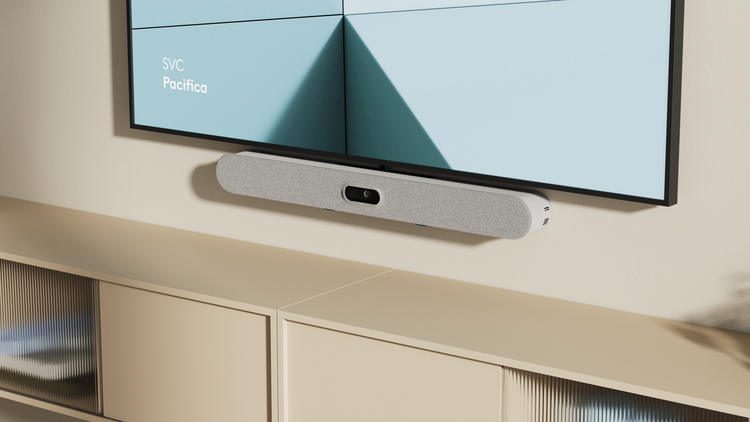
This second generation of Logitech’s Rally Bar is powered by a Qualcomm chipset with four times more edge AI processing power than other video bars on the market, according to the vendor.
That larger amount of compute is meant to accommodate future features and make the bars a longer-term investment for users.
The bar is aimed at medium-to-large rooms and has four speakers, six beamforming mics with a pickup range of about 23 feet, occupancy detection and environmental sensing, according to Logitech. The goal is for the bar to support broadcast-style rooms and deeper rooms than the previous iteration.
It has custom 115-degree lenses and 1-inch sensors for visual clarity. The bar measures 3.8 inches high by 33.8 inches wide and 3.7 inches deep. The second-generation Rally Bar is slightly longer than the past generation, but also thinner.
Logitech’s RightSound 3 brings meeting rooms AI-powered audio and embedded sensors allow users to book meetings when people walk into the room. The bars provide occupancy data for workplace executives to make better decisions around their physical footprints.
RightSight 2 allows for automatic framing for groups, individuals and speakers. Users can leverage a group view, grid view, speaker view and camera zone.
Logitech promises easy installation in minutes by one person. The Rally Bar 2, housed in an aluminum unibody, is certified for Microsoft Teams, Zoom Rooms and Google Meet. The bars are built on Microsoft’s Device Ecosystem Platform (MDEP) and meet the vendor’s enterprise-grade security standards, according to Logitech.
Beyond Device Refresh
Logitech also prides itself on a 10-year support timeline for its first-generation devices in this portfolio. The first Rally Bars were introduced in 2021, with certified support through 2030.
Clients looking to replace first-generation Rally Bars with existing service packages just have to switch out the device and keep their existing service package for the room, according to the vendor.
The bar supports up to four mic pod peripherals with a category cable run from the bar to the pod, with an option for daisy chaining, he said.
The bar’s sensors allow it to count people and measure the temperature and carbon dioxide levels in a room, leveraging technology from Logitech’s wall-mounted sensing device Spot.
“Video is certainly a primary use case, but it’s not the only use case,” Levak said. “Now more and more people rely on us for environmental sensing.”
Rally System 2 Pro Targets Large, Divisible And Multi-Purpose Rooms
The second generation of Logitech’s modular portfolio for large, divisible, multi-purpose rooms includes the RoomMate 2 Pro, Rally AI Camera Pro, Rally Speaker 2, Logitech Link and RightSight 3.
The system runs Microsoft Teams, Zoom and Google Meet. It is deployable in Google Android, PC and bring your own device (BYOD) setups.
The RoomMate 2 Pro, powered by Qualcomm, runs up to three displays with 4,000-pixel (4K) horizontal resolution plus multiple cameras, speakers and mic pods. “This is a powerhouse,” Levak said.
Logitech’s dual-camera Rally AI Camera Pro device offers users a wide-angle, 1-inch sensor with the vendor’s optical pan-tilt-zoom (PTZ) camera design.
And Rally Speaker 2 brings a linear, seven-driver beaming networked speaker to rooms. The speaker promises people in the back of the room the same volume and intelligibility that people in the front of the room experience.
The Rally Speaker 2 uses a two-dimensional array, which means users can control sound horizontally and vertically, Rajagopal said.
Logitech Link is a native audio-visual over internet protocol (AV-over-IP) technology that allows the vendor’s devices to connect through category cables, which aim to be simpler than external extenders and power over ethernet (PoE) injectors.
And RightSight 3 brings users improved multi-camera tracking with an option for multiple wall-mounted cameras or cameras at the center of the table. In the second half of 2027, Logitech plans to make RightSight 3 available as a free CollabOS software update.
RightSight 3 promises AI-powered echo suppression, noise suppression, voice equalization (EQ) and speech direction.
Logitech’s Sync allows users to remotely adjust settings, deploy software updates, provision rooms, monitor device health and more, according to the vendor.
Rally Speaker Pro, Max Editions Look To Cover Larger Spaces
Logitech’s upcoming Pro version of the Rally Speaker 2 soundbar delivers 32 micro-drivers and Sound Shape to distribute sound evenly throughout large rooms, according to the vendor.
And the Max version brings the micro-driver count to 64 and covers an extra-large 65-foot room. Users only need to place these speakers at the front of the room, avoiding the more complex ceiling speaker architecture.
The micro-driver approach differed from other soundbars that use two or three standard speakers, according to Logitech. Standard speakers can lose significant volume from the front of a room of about 40 feet to the back. Rally Speaker 2 Pro loses about the sound level of a human breath, so users should find sound volume identical whether they are close to the speaker or in a back row.
These soundbars shoot precise beams of sound to specific places without the sound bouncing off walls. The effect can be two people across from each other at a conference table hearing the same sound—even different sounds—without any bleed over.
Tap IP 2, Tap Scheduler 2 Expand Workplace Management Capabilities
Logitech also unveiled the second generations of its Tap IP meeting room touch controller and its Tap Scheduler scheduling panel.
Tap IP 2 has a 10.1-inch touch display and allows users to share content, mute participants and turn cameras on and off. Its motion sensors work when mounted on a wall upside down. Users can secure Tap IP 2s with table mounts for flat placement, riser mounts for a raised viewing angle and wall mounts to save table space in smaller rooms. The table and riser mounts fit standard grommets and rotate 180 degrees.
These devices measure 2.21 inches high by 9.69 inches wide by 6.74 inches deep.
Tap IP 2 works with Microsoft Teams Rooms on Android, Zoom Rooms and Google Meet Rooms, according to Logitech. Tap IP 2 is also built on MDEP with third-party validation for enterprise-grade security.
Tap Scheduler 2 promises users a brighter display with a higher, 1,200-pixel (1200p) resolution, improved compute and a built-in motion sensor.
Scheduler 2 works with any scheduling application for finding and booking open meeting spaces. It also has a 10.1-inch display, with light-emitting diode (LED). The Scheduler 2 measures 6.5 inches tall by 9.69 inches wide by 1.12 inches deep.
The device includes glass, mullion or wall mounts and works with Microsoft Teams, Zoom Workspace and Appspace.
Users don’t have to use Tap Scheduler 2 for video rooms, and the display pairs with Logitech Spot presence detection to see if people don’t show for a meeting.
The touch controller and Scheduler 2 come in graphite and off-white, and their displays enter sleep mode when not in use to consume less power, auto-waking when people enter the room.
Latest Quarterly Performance
Logitech last reported quarterly earnings on July 28. The vendor saw sales grow 7 percent year on year to $1.23 billion in its first quarter of the 2027 fiscal year.
The company’s operating income using Generally Accepted Accounting Principles was $259 million, up 60 percent year on year. Without using GAAP, operating income was $290 million, up 44 percent. The vendor’s cash flow from operations came in at $167 million.
Logitech executives said to expect about $1.2 billion in sales in the second fiscal quarter, relatively flat growth year on year. The company expects to lose up to $20 million in net sales during the quarter due to the temporary closure of a facility for one of Logitech’s semiconductor suppliers. Logitech expects to resolve the issue by its fourth fiscal quarter, but it could cost Logitech up to $200 million in net sales in the third quarter.
The company expects non-GAAP operating income between $185 million and $210 million. The company has not issued a formal full-year fiscal year 2027 outlook.
Logitech CEO Hanneke Faber said on the earnings call that video collaboration net sales grew 9 percent year on year ignoring foreign exchange during the quarter, reaching $185 million, according to a call transcript. That revenue increase was not materially benefitted by a price increase Logitech did in May to account for the increased cost of memory. VC represents about half of Logitech’s business-to-business (B2B) channel sales. The other half is personal workspace (PWS) products
She identified plenty of growth ahead, estimating that globally less than a quarter of meeting rooms are VC enabled with demand for AI-powered notetakers and other experiences a tailwind.
With video equipment usually lasting five to seven years, companies are looking at a need to refresh equipment purchased during the height of the COVID-19 pandemic and rush to remote workforces, she said.
That made VC Logitech’s No. 4 business by revenue and its second-fastest growing business during the quarter. Gaming saw $354 million in revenue, up 9 percent year on year. Pointing devices saw $227 million in revenue, up 14 percent. And keyboards and combinations saw $228 million in revenue, flat year on year.
Tablet accessories fell 2 percent year on year to $89 million. Webcams fell 11 percent to $77 million. Headsets fell 5 percent to $44 million. And mobile speakers, PC speakers and other products fell 15 percent to $23 million.
“Logitech’s video conferencing solutions are now used by more than 70 percent of Fortune 500 companies, putting us on a very short list of preferred suppliers as organizations refresh and expand their meeting spaces,” she said.
Faber added that the vendor didn’t see pull-forward demand in video conferencing despite price increases and the memory shortage crisis.
Logitech CFO Matteo Anversa said on the call that the vendor has secured the memory components it needs for the VC business in fiscal 2027.