Microsoft Q1 Earnings: CEO Nadella Touts AI Consumption, Usage-Based Billing Growth
‘As agents take on higher-value work, consumption opens up business-funded demand, with spending tied directly to the value these agents deliver,’ says Microsoft CEO Satya Nadella.
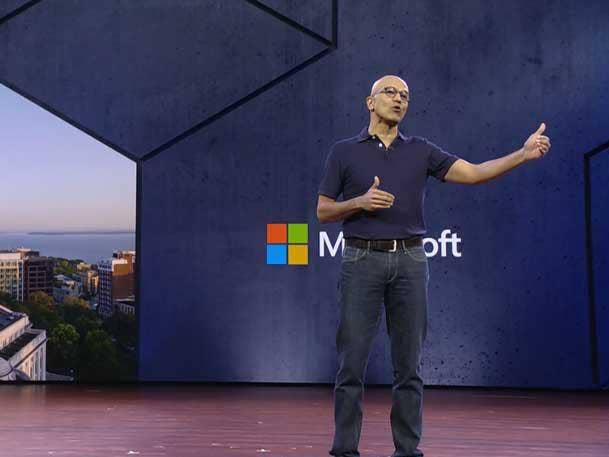
Microsoft is seeing an increase in its consumption-based artificial intelligence business as the channel prepares for on-by-default usage-based billing for eligible services used under Microsoft 365 Copilot Business licenses.
The number of Copilot customers actively consuming credits through usage-based billing grew more than 75 percent over the quarter, Microsoft Chairman and CEO Satya Nadella (pictured) said on the Redmond, Wash.-based tech giant’s latest quarterly earnings call Wednesday.
Credit consumption from agentic features on Microsoft’s GitHub business—which previously started leveraging usage-based billing—has more than doubled, the CEO said on the call, which covered the first quarter of its 2027 fiscal year. The quarter ended Sept. 30.
Consumption plus seat subscriptions increase Microsoft’s total addressable market and average revenue per user, Nadella said. “As agents take on higher-value work, consumption opens up business-funded demand, with spending tied directly to the value these agents deliver,” Nadella said.
[RELATED: How Solution Providers Are Putting AI Agents To Work]
The Redmond, Wash.-based vendor has about 500,000 partners worldwide, according to CRN’s 2026 Channel Chiefs.
The new on-by-default usage-based billing configuration starts Dec. 1 for the Microsoft 365 Copilot Business licenses aimed at small and midsize businesses with up to 300 seats per tenant. The licenses will allow solution providers to set the spending limit to zero to turn off usage-based billing and have an adjustable default spending limit automatically set at 4,000 Copilot Credits per user, per month.
Wayne Roye, CEO of New York-based Microsoft solution provider Troinet, told CRN in a recent interview that he sees more value in creating AI systems for customers as opposed to customizing specialized agents to suit individual organizations’ needs.
“If you create a solution that fixes a problem—it’s repetitive, and you can do it every single time to get the same outcomes that you can gauge and give metrics on—that is a value proposition,” he said.
Microsoft Copilot Consumption, Usage-Based Billing Grow
Nadella referenced the education needed for helping customers understand when the compute afforded under a Microsoft license is enough and when usage-based billing is preferred—a task Microsoft solution providers are helping customers navigate, they tell CRN.
Nadella does not want customers “token-maxxing”—maximizing the consumption of AI input and output tokens at the cost of performance—and he feels “very good about the progress” in educating customers.
“We’re trying to make sure that customers understand both options [and] they’re able to use the two options in the optimal way that benefits them,” the CEO said. “We don’t want them to overbuy one thing and then feel like they’re ‘token-maxxing’ because that doesn’t serve anybody’s purpose. We want to make sure that they understand the value of the subscription and how it’s a continually improving value. It’s not even static. And at the same time, you can exercise this consumption meter.”
Microsoft CFO Amy Hood pointed to Microsoft’s Frontier Co., a forward-deployed engineering division, and “changes in our sales motion” with Microsoft 365 as ways to help with customer education on licensing and consumption pricing.
Hood expects the embrace of consumption pricing to move slower compared with coding users, “but I also still think we’re still seeing encouraging signs, and I’m still positive about that,” the CFO said on Wednesday’s call.
“We want them [customers] to utilize both the Copilot license to its fullest and understand when the consumption meter is delivering value to them,” she said.
Microsoft Reports New Copilot, GitHub, AI Agent Milestones
Nadella delivered a host of new usage milestones across the vendor’s product portfolio while adding that the AI market is maturing well, with customers increasingly focused on cost, reliability and security while optimizing models, workloads and tokens rather than the latest “shiny object.”
“Some of the shiny object stuff is waning,” he said. “It’s not about the next big thing. They’re really more about, ‘Wow, can I build the system? Can I own the weights? Can I manage my costs? Can I have reliability? What about security?’ And so, in that sense, the enterprise breadth motion is starting.”
Nadella appeared to take a swipe at other vendors that are depending on revenue from a handful of AI upstarts during the massive capacity build-out to enable AI workloads.
“The enterprise stuff is not, like, a quarter over quarter,” Nadella said. “It’s a decadelong thing, and that’s what I’ve been waiting for. As opposed to like four customers who buy a lot of capacity from you, and you can show a few quarters of growth. And that’s not a business, as far as I'm concerned. So I want the breadth. We are well positioned on the breadth.”
Microsoft is still open to large business from large businesses “as long as the pricing is right,” he said. “If not, we will be patient about building the breadth business.”
Microsoft did not disclose new user numbers around the Copilot AI tool, instead focusing on revenue and usage momentum. As Nadella shared:
- Automated tasks have nearly doubled since July
- Daily users are up nearly 50 percent quarter over quarter and more than fivefold year over year
- User satisfaction improved nearly 20 percent quarter over quarter to an all-time high
- Ninety percent of Copilot queries used the new auto mode, which dynamically routes tasks across AI models with the goal of finding the best quality, speed and cost
- The number of customers with more than 50,000 Copilot seats increased more than eightfold year over year
Auto mode and model routers create competitive environments for AI models for every prompt and every task, with platforms such as Copilot and GitHub serving as ways to prevent model lock-in, Nadella said on the call.
“We really want to build a model system that delivers customers’ value continuously versus them being stuck in any one thing,” Nadella said.
Thousands of customer organizations now use the recently released E7 license that combines Copilot, the Entra security product suite, Agent 365 AI agent control plane and products sold under the less expensive E5 license, Nadella said.
E7 now has millions of paid seats, Hood added.
In the Microsoft-owned GitHub business:
- Agent-generated pull requests—which allow developers to propose changes to a project’s source code—increased sixfold over the past six months
- Agents now open more than one-third of all pull requests on the platform
- GitHub Advanced Security revenue increased more than 50 percent year over year as customers use its AI capabilities to scan entire repositories and fix vulnerabilities in real time
Microsoft is investing in Copilot as the new operating system for work, with the vendor introducing 30 new Copilot skills across the Dynamics 365 CRM and ERP suite, Nadella said.
In Microsoft’s data platform, data layer and database businesses:
- Foundry now has more than 120,000 customers
- Revenue more than tripled year over year
- The number of customers building agentic solutions with multiple models increased fivefold year over year
- Revenue from open-source models on Foundry increased tenfold
- Fabric now has more than 44,000 paid customers, up more than 50 percent year over year
- More than 19,000 customers now use Foundry and Fabric
- Nearly 60,000 customers are accessing context across Microsoft IQ, up 25 percent quarter over quarter
- PostgreSQL growth accelerated for the fourth consecutive quarter
- The number of PostgreSQL customers also using Foundry accelerated to 90 percent year over year
Nadella touted progress in Microsoft’s first-party models business as well.
- The MAI-Cyber model now powers more than 40 percent of the scans in Microsoft’s agentic MDash code scanner, with 18 percent lower cost per scan
- MAI-Code-Flash saw 3 million users in GitHub Copilot in the last month alone
- The Microsoft-Decision-1 model for structured decision-making has seen more than 4,000 organizations using it in the first month since its release
- MAI-Base-2 recently completed pre-training and outperforms other open-weight models with four to 12 times greater training compute efficiency and will be used in upcoming MAI models across thinking, code and cyber
And in security and AI agent governance:
- Customers have used Microsoft Purview to audit more than 7.6 billion agent activities to date, up fivefold quarter over quarter
- More than 50 million agents are now in the Agent 365 registry, up more than 30 percent quarter over quarter
Microsoft CapEx Hit $45.2 Billion
Microsoft spent $45.2 billion on capital expenditure and finance leases during the quarter as it expanded AI capacity, adding 24 data centers across five continents. Nadella said Microsoft increased Copilot workload throughput by more than 50 percent sequentially, while Hood said some third-party capacity deliveries were delayed.
About three-quarters of that CapEx was for GPUs and CPUs and included the higher memory and storage costs plaguing the entire channel.
Microsoft’s Maia 200 accelerator chips are delivering up to 1.7 times more tokens per watt across the AI experiences in Microsoft’s Teams collaboration application and Copilot. The Maia 300 iteration should deliver 40 percent more tokens per watt compared with leading GPU-based systems. Microsoft also continues to use chips from manufacturers including Nvidia and AMD.
Microsoft’s operating expenses during the quarter increased 6 percent year over year due in part to investments in R&D compute capacity, Hood said on the call.
Microsoft expects CapEx of $50 billion for the second fiscal quarter and about $170 billion for the calendar year, lower than expected due to third-party delays, Hood said.
Although Microsoft expects “to continue to remain free cash flow positive in FY27,” Hood opened the door to borrowing, saying “to complement cash generated by the business and preserve financial flexibility, we will access additional sources of funding when we believe it is attractive to do so.”
Azure Growth Helps Microsoft’s $92.3 Billion Quarter
Microsoft reported bringing in $92.3 billion in revenue for the quarter, up 19 percent year on year. Operating income was $45.9 billion, up 22 percent ignoring foreign exchange.
Net income using GAAP—and including OpenAI investments—was $36.6 billion and increased 32 percent year on year.
Without using GAAP, it was $36.4 billion, up 19 percent year on year ignoring foreign exchange. OpenAI cost Microsoft $207 million during the quarter.
Microsoft Cloud brought in $63.9 billion in revenue and grew 31 percent year on year ignoring foreign exchange. Revenue from Microsoft’s Azure cloud increased 48 percent year on year despite the delays in third-party capacity. Foundry and improved CPU monetization helped drive Azure growth.
However, a tough comparison against large Azure customer commitments last year resulted in commercial bookings falling 11 percent year on year ignoring foreign exchange.
Microsoft 365 commercial cloud revenue increased 19 percent year over year ignoring foreign exchange on an adjusted basis. For comparison, Microsoft 365 consumer cloud revenue increased 16 percent ignoring foreign exchange.
Industry solutions cloud revenue—which includes Dynamics 365—increased 10 percent year on year.
Hood attributed commercial cloud growth mostly to GitHub Copilot adoption and usage, with the business seeing weaker sales in Microsoft 365 E3 licenses and stand-alone products. Paid M365 commercial seats grew 5 percent year over year.
Productivity and server licensing revenue decreased 2 percent year over year ignoring foreign exchange. Frontier and support services revenue increased 5 percent, ignoring foreign exchange, most of that coming from support.
Microsoft Agents, Infrastructure Revenue Jumps 25 Percent
This marked the first quarter to use Microsoft’s updated reporting business segments, which divides the tech giant’s business into two segments. One is agents and infrastructure, and the other is devices and consumer.
In agents and infrastructure, Microsoft saw $76.8 billion in revenue, up 25 percent year on year. Its commercial remaining performance obligation (CRPO), a measure of its business backlog, increased 73 percent to $677 billion. RPO has a weighted average duration of 2.3 years. Microsoft will recognize about 30 percent of it in revenue in the next 12 months. The remaining portion, recognized beyond the next 12 months, nearly doubled year on year.
This segment includes the Microsoft 365 Copilot AI tool, GitHub Copilot developer AI tool, Agent 365 AI agent orchestration tool and the Maia 300 chip business.
Revenue from Microsoft’s devices and consumer business segment was $15.5 billion for the quarter, down 3 percent year on year. Revenue from Microsoft’s Xbox gaming division and Bing search and advertising revenue are included in that dollar amount.
Revenue from Windows OEMs and devices, including Microsoft’s Surface tablets, fell 22 percent year on year. Windows OEM revenue was below expectations and decreased 28 percent ignoring foreign exchange.
Hood attributed the disappointing results to a tough comparable to last year’s Windows 10 end of support. OEM and channel-partner inventory drawdowns, along with weaker PC demand, also contributed. Inventory levels remain elevated, she said.
Cash flow from operations was $58 billion, up 29 percent, driven by strong cloud billings and collections. And free cash flow was $18.6 billion, reflecting higher capital expenditures.
Microsoft Forecasts More Azure Growth
Hood said to expect revenue from the agents and infrastructure business segment of $80.1 billion to $80.7 billion. That would mark growth year over year of 24 percent to 25 percent.
Last year’s big Azure commitment signings will also make measuring growth in the business difficult, Hood said. The vendor expects Azure revenue growth for the quarter of about 50 percent, with the CFO saying she expects Microsoft’s engineers to keep finding efficiencies even with the volatility of token pricing.
M365 Commercial Cloud should grow year over year by about 19 percent and see better sales in E3 and stand-alone products. M365 consumer cloud revenue should grow in the low teens.
Productivity and server licensing revenue should decline in the mid to high single digits. Industry solutions cloud should grow in the mid to high single digits. Frontier and support services should grow in the low to mid-single digits.
The devices and consumer business segment should bring in revenue of $15.9 billion to $16.4 billion. Hardware revenue in the quarter should decline year over year. Windows OEM and devices revenue should decline in the mid 30s, with factors including elevated inventory levels, PC market demand and last year’s elevated performance from Windows 10 end of support.
Overall, Microsoft executives expect to see revenue of between $96 billion and $97.1 billion. That would mark growth year over year of 18 percent to 19 percent. Operating expenses should come in at $18.5 billion to $18.6 billion, up 9 percent.
Microsoft’s stock rose about 3 percent after market close Wednesday, trading at about $550 a share around 5 p.m. Pacific.