Microsoft Q3 Earnings: Nadella Says AI Agents Change How Customers Pay
Microsoft reported $82.9 billion in total revenue from the quarter, up 15 percent year on year ignoring foreign exchange.
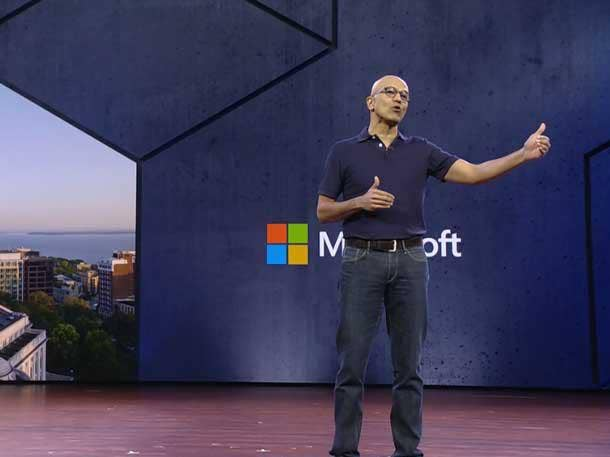
Microsoft reported growing usage of its artificial intelligence tools while detailing a business model that is evolving beyond per-seat applications and consumption-based cloud infrastructure to an AI-era model combining the two.
Satya Nadella (pictured), chairman and CEO of the Redmond, Wash.-based technology giant, said that the vendor’s coding business is already user-based and usage-based at scale and described an evaluation-based or outcome-based model where customers pay based on value created by AI agents working with users or on their behalf—a model members of Microsoft’s 500,000-member partner ecosystem are also exploring with customers.
“Whether it’s customer service, whether it’s individual productivity, team productivity, a business process, some cost per [user] is either decreasing because of the use of agents, or some revenue is increasing because of agents—because it was able to compress these workflows,” Nadella said Wednesday during the vendor’s quarterly earnings call, covering its third fiscal quarter for the three months ended March 31.
[RELATED: Microsoft Partner Chief Nicole Dezen Details E7, Agent 365 Push]
Microsoft Q3 Earnings Highlights
Microsoft CFO Amy Hood said on the call that the vendor’s bookings measure is also changing to have per-seat licenses and a meter like the Azure cloud business.
“You’ll just bill for usage,” Hood said on Wednesday’s call. “If that usage has great value to customers … then you’ll keep spinning [the meter], and they’ll keep using those agents if they’re adding direct value or growth to your business.”
As an example of Microsoft’s Copilot AI assistant reaching a habitual level of use with customers, Nadella said that the AI tool has reached the same level of weekly engagement as Microsoft’s Outlook email application.
“We are at the beginning of one of the most consequential platform shifts that will change the entire tech stack as agents proliferate and become the dominant workload,” Nadella said. “This will drive TAM [total addressable market] expansion and change the value creation equation across the entire economy.”
Microsoft Eyes Usage-Based, Outcome-Based AI Pricing
Nearly 60 percent of Microsoft customer service customers are already purchasing usage-based credits, Nadella said on the call. The Microsoft Copilot credit consumptive offer nearly doubled quarter over quarter as customers increasingly extend Copilot with custom agents tailored to their workflows.
Microsoft is also moving GitHub Copilot to a usage-based pricing model to align pricing to actual usage and costs, Nadella said. That starts June 1.
The CEO looks at seat-based pricing as an entitlement to some consumption with some base usage rights bundled in. Beyond a certain level of consumption, users can see overages into pure consumption pricing. Long-term commitments to consumption can come with discounting.
Customers will evaluate where token value results in outcomes and then refine their budgets. IT budgets in the AI era could see reallocation from operating expenditures and other line items on customer income statements, the CEO said.
Compared with Microsoft’s business model transition in the consumption-focused cloud era, the vendor’s AI margins have actually been better, Hood said.
“What we’ve been really focused on is making sure that the business models reflect how these applications are both getting built and the value that they’re bringing,” the CFO said.
Nadella Details Copilot, GitHub, Agent Adoption Milestones
Microsoft’s CEO provided his regular updates on usage across a variety of Microsoft products and services.
Microsoft Foundry, the unified Azure Platform-as-a-Service offering, saw the following.
- More than 10,000 customers now use more than one model on the platform
- 5,000 customers use open-source models
- The number of customers that have used Anthropic and OpenAI models doubled quarter over quarter
- More than 300 customers are on track to process more than 1 trillion tokens on Foundry this year, accelerating 30 percent quarter over quarter
In agents and Copilot:
- Nearly 90 percent of the Fortune 500 now have active agents built with Microsoft’s low- code, no-code tools
- Tens of thousands of companies are already managing tens of millions of agents in Agent 365
- Microsoft 365 Copilot seat adds more than doubled year over year, representing its fastest growth since launch
- Microsoft now has more than 20 million Microsoft 365 Copilot paid seats
- The number of customers with more than 50,000 seats quadrupled year over year
- Monthly active usage of first-party Microsoft agents grew sixfold year to date
- Copilot queries per user grew nearly 20 percent quarter over quarter
- Nearly 140,000 organizations now use GitHub Copilot, and enterprise subscribers nearly tripled year over year
- GitHub Copilot’s command line interface (CLI) usage nearly doubled month over month
In security and devices:
- The number of Security Copilot customers doubled year over year
- Data security triage agents handled more than 2 million unique alerts in the quarter
- Microsoft Purview has audited 35 billion Copilot interactions to date, up sevenfold year over year
- Monthly active Windows devices surpassed 1.6 billion
In database and AI context:
- Azure Cosmos DB saw 50 percent revenue growth year over year driven by AI app workloads
- Microsoft now has 35,000 paid customers of the Microsoft Fabric Software-as-a-Service analytics platform, up 60 percent year over year
- The amount of data in the Microsoft Fabric OneLake data lake increased nearly fourfold year over year
- More than 15,000 customers now use both Foundry and Fabric, up 60 percent year over year
- Thousands of enterprises already are accessing context across the Microsoft Fabric, Foundry, Microsoft 365 and security graph that make up Microsoft’s unified IQ layer
- The system of work behind Work IQ now spans more than 17 exabytes of data, growing 35 percent year over year
- Each day, Work IQ receives billions of emails, documents and chats; hundreds of millions of Teams meetings; millions of SharePoint sites
“Our North Star remains the same—giving customer value with highest-quality and top-class innovation,” Nadella said. “This is what gives me confidence in our ability to shape the next phase of growth for our company and our customers.”
Nadella On OpenAI Partnership, Microsoft’s AI Advantage
Nadella told analysts on Wednesday’s call that “overall, we feel good about our partnership with OpenAI” after revamping their deal in part to allow each company more freedom to work with rivals.
The new deal reflects growth and evolution by both companies throughout the AI era plus the different customer bases “have different expectations in terms of their model diversity,” Microsoft’s CEO said.
“I’m always very, very focused on any partnership, on ensuring that there’s a win-win construct at all times,” he said. “That’s how you can remain good partners.”
Also, during the call, Nadella spoke to Microsoft still holding a significant competitive advantage in AI due in part to its prowess in the big AI addressable markets of knowledge work, coding and security.
This year, some of the most exciting uses of AI are plug-ins in Word and Excel and command-line interfaces in coding tools, boding well for the productivity and developer tools giant.
Microsoft Expands AI Infrastructure, Tackles Capacity Constraints
In infrastructure, where the cost of AI compared with its returns has been a concern for Microsoft analysts, Nadella mentioned improvements and milestones including:
- Reduced lifetimes for new GPUs in Microsoft’s biggest regions by nearly 20 percent since the beginning of the year
- Brought the Fairwater data center in Wisconsin online six weeks ahead of schedule
- Delivered a 40 percent improvement in inference throughput for Microsoft’s most-used models across Copilot
- Added another gigawatt of capacity this quarter
- Microsoft remains on track to double its overall footprint in two years
- Millions of servers across Microsoft’s fleet are powered by its custom networking, security and virtualization silicon including Azure Boost, first-party CPUs and accelerators
- New data center investments across four continents
- Microsoft’s Maia 200 AI accelerator offers more than 30 percent improved tokens per dollar compared with the latest silicon in its fleet
- The accelerator is now live in Microsoft’s Iowa and Arizona data centers
- Microsoft’s Cobalt server CPU is deployed in nearly half of its data center regions
During Wednesday’s call, Hood said that she feels “quite good about our ability to work through the physical sort of limitations” of meeting AI demand.
She foresees that Microsoft will in the second half of the 2026 calendar year—which is the first half of Microsoft’s 2027 fiscal year—get “some insights into our abilities to increasingly put pressure on efficiencies, being able to speed up the deliveries into our data centers and make that what I would call revenue ready as quickly as we can.”
Still, expect pressure between first-party usage and meeting Azure demand to persist, she said.
Nadella added that Microsoft’s capacity investments are to make sure it’s ready for sudden surges in usage, using agent mode in Excel as an example. Innovation in AI models led to sudden increased demand for the offer. “You have to be ready for those opportunities,” he said.
Capital expenditures in the fourth fiscal quarter should increase to more than $40 billion, with $5 billion from higher component pricing and finance leases, Hood said.
For calendar year 2026, Microsoft expects to invest about $190 billion in CapEx, $25 billion of that due to higher component pricing. “We remain confident in the return on these investments given higher demand signals and increasing product usage, as well as the efficiencies we’re already driving across the platform,” Hood said.
Microsoft Q3 Revenue, Profit and Segment Performance
Microsoft reported $82.9 billion in total revenue from the quarter, up 15 percent year on year ignoring foreign exchange.
The vendor’s operating income grew 16 percent year on year to $38.4 billion. Net income grew 23 percent year on year to $31.8 billion using GAAP. Without using GAAP, net income grew 18 percent ignoring foreign exchange. The non-GAAP percent excludes OpenAI investment impact.
Microsoft’s AI business surpassed an annual revenue run rate of $37 billion, more than double year on year.
Microsoft Cloud revenue grew 25 percent year on year ignoring foreign exchange to $54.5 billion during the quarter. The vendor saw commercial remaining performance obligation (cRPO) almost double year on year to $627 billion.
Microsoft’s productivity and business processes segment—which includes Microsoft 365 commercial cloud, M365 consumer cloud, LinkedIn and Dynamics 365—saw $35 billion in revenue during the quarter, up 13 percent year on year ignoring foreign exchange.
M365 commercial cloud revenue grew 15 percent year on year. Consumer grew 29 percent. D365 grew 17 percent.
Microsoft’s “intelligent cloud” segment—which includes Azure—grew 28 percent year on year to $34.7 billion. Azure and other cloud services revenue grew 39 percent year on year.
Microsoft’s “more personal computing” segment–—which includes Windows OEMsnand devices, Xbox and search ads–—ell 3 percent year on year ignoring foreign exchange. Windows OEM and devices revenue fell 3 percent year on year.
Microsoft Q4 Guidance
Hood said to expect $86.7 billion to $87.8 billion, growth of 13 percent to 15 percent year on year, in total fourth fiscal quarter revenue. The vendor will take a one-time cost of about $900 million related to its voluntary retirement program.
The CFO said to expect revenue of $37 billion to $37.3 billion, growth of 12 percent to 13 percent year on year, in Microsoft’s productivity and business processes segment in the fourth fiscal quarter.
The M365 commercial cloud should see revenue growth to be between 15 percent and 16 percent year on year. Microsoft expects net paid seat adds to increase sequentially, which will drive continued average revenue per user growth.
M365 commercial products revenue should grow in the mid-single digits. M365 consumer cloud revenue growth should be in the low 20 percent range, down sequentially with last year’s price increase. Dynamics 365 revenue should grow year on year in the low double digits, down sequentially.
Microsoft’s intelligent cloud segment revenue should reach $37.95 billion to $38.25 billion, growth of 27 percent to 28 percent year on year. Microsoft expects Azure revenue between 39 percent and 40 percent. Azure should show modest growth acceleration in the second half of the calendar year compared with the first half, Hood said.
The vendor expects on-premises server business revenue to decline in the mid-single digits. The more personal computing segment should see revenue between $11.75 billion and $12.25 billion, with “complex PC market dynamics impacted by memory prices” a factor, Hood said.
Windows OEM revenue should decline in the high teens, with 6 points of impact from less benefit from last year’s Windows 11 migration cycle, 6 points of impact from inventory levels and 6 points of impact “from a lower PC market as prices increase due to memory cost,” the CFO said. Windows OEM and devices revenue should decline in the mid to high teens.