Oracle Q3 Earnings: ‘SaaSpocalypse’ Is Coming—Just Not For Oracle, Executives Say
‘We think the SaaSpocalypse applies to others,” says Chief Technology Officer and co-founder Larry Ellison.
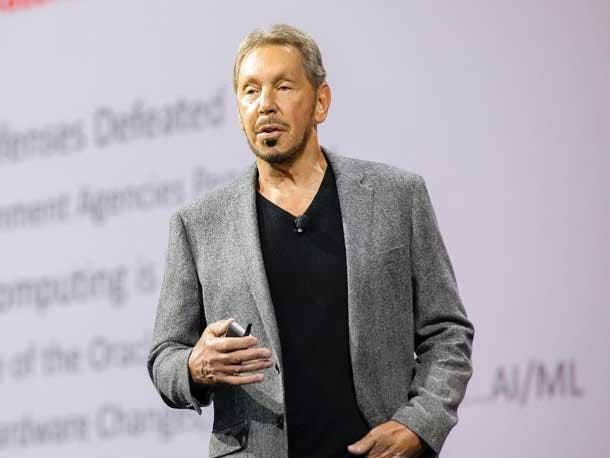
Oracle co-CEO Mike Sicilia and Chief Technology Officer and co-founder Larry Ellison dismissed concerns around a “SaaSpocalypse” of more traditional enterprise software-as-a-service vendors getting disrupted by artificial intelligence upstarts including Claude maker Anthropic and ChatGPT maker OpenAI–with single-focus SaaS vendors more vulnerable to disruption than the database products giant.
“You’ve all heard the thesis or theory that new companies coding quickly using AI will spell the death of SaaS–I don’t agree with that at all,” Sicilia said. “I do think that AI tools and their coding capabilities would be a threat if we weren’t adopting them, but we are. Very rapidly.”
Ellison, who co-founded the vendor in 1977, added that Oracle coding tools allow it to build a comprehensive set of agents for automating entire health care and financial services ecosystems.
“That’s why we think we’re a disruptor,” he said. “That’s why we think the SaaSpocalypse applies to others.”
The executives spoke with investors and analysts Tuesday on its earnings call covering the third quarter of its 2026 fiscal year. The quarter ended Feb. 28.
[RELATED: Oracle Targets Job Cuts In The Thousands: Report]
Oracle Q3 Earnings Results
Oracle’s NetSuite division is part of CRN’s 2026 Partner Program Guide.
The Austin, Texas-based database products and cloud vendor is leveraging AI coding tools and smaller engineering teams to build new SaaS products–including a new website generator used to build Oracle.com–and embed agents into existing applications and suites, Sicilia said.
Customers have not shown an appetite for tossing existing retail merchandising, core banking, demand deposit account, electronic health record and other complex, mission-critical systems to adopt a new system with AI features. Instead, customers so far prefer to consume AI features out of the systems they already have. Unlike the AI upstarts, Oracle also has decades of experience in various industries and regulatory compliance, he said.
“We think AI is disruptive–we do,” Sicilia said. “But we think we’re the disruptor because we’re actually embedding the AI right into our applications full stop.”
The co-CEO took a swipe at enterprise software rival Salesforce–which, like Oracle, saw its stock decline when Anthropic stunned Wall Street analysts with recent innovations. New website generating and lead generating capabilities are “products that Salesforce.com does not have,” he said.
“We’ve built these new CX (customer experience) products to help our customers sell, not simply to administer a forecast or generate email opens,” Sicilia said.
Oracle has delivered more than 1,000 agents in its horizontal back office and industry apps, Sicilia said. That doesn’t include customer-built agents and agents Oracle uses internally. A banking apps suite by Oracle alone has hundreds of embedded AI agents available for no additional cost to customers. In the quarter, Oracle saw more than 2,000 customers go live with Oracle application projects, Sicilia said.
“These are not systems that can be replaced by a small collection of these features cobbled together and bolted on in the name of AI,” he said. “Some smaller or single-focus SaaS players may well be disrupted, but Oracle will not be among them.”
On Tuesday’s call, Oracle co-CEO Clay Magouyrk said that OpenAI’s Codex and Anthropic’s Claude “are incredible tools” and that inference through those tools is creating “a huge amount of demand.”
Fight For The AI Interaction Layer
In the competition over which vendors will conquer the AI interaction layer, Sicilia said that data gravity is a key factor. Customers want to build AI agents in systems of record like those supplied by Oracle.
“That is the data from an inferencing standpoint, from a retrieval augmented generation standpoint, it’s going to be highly relevant and highly specific, and add a bunch of context to AI,” he said.
Oracle’s AI Agent Studio works with data outside of its Fusion business apps suite, and Oracle offers an AI data platform development environment for customers and partners to build more specific agents with any AI model, Ellison said.
AI Infrastructure Halo Effect
Oracle’s AI infrastructure business is creating a halo effect on its applications business, Sicilia said–which could be of interest to Oracle solution providers.
The vendor training so many models on its Oracle Cloud Infrastructure (OCI) and so closely provisioned for its applications allows the vendor to embed high quality AI services right into its apps as features, Sicilia said.
Oracle serves the model vendors for training and embeds the output into its apps. Oracle’s role as custodian of much of the world’s mission critical data means its customers can unlock AI use cases with that data quickly, he said.
AI Infrastructure Updates
During the call, Magouyrk said that concerns around latency with AI is getting alleviated through product innovations in inference architecture and by AI accelerators, with Oracle’s choices for giant centralized data centers in lower-populated areas of Texas and Wyoming not a major concern for latency.
When asked on the call about private large language models, Magouyrk said that he is not seeing customers training their own LLMs. Instead, they are taking the best models and combining them for leveraging with private data, and Oracle has responded to this by making its AI database easy to connect with third parties and through its AI data platform offer.
Much work remains moving customers from on-premises environments to the cloud so that they can better take advantage of private data with AI tools, he said.
“Across the stack, we’re seeing a lot of momentum,” he said.
OCI’s margins continue to strengthen over time, Magouyrk said. Oracle continues to see 30 percent to 40 percent margins on AI data centers, with the vendor optimizing the cost of networking, hardware and power over time.
About 10 percent to 20 percent of total spend on these data centers goes to general purpose compute and adjacent services with higher margins. The multicloud database business has margins in the 60 percent to 80 percent range.
“We’re very, very good at minimizing the time under which that (data center) construction is happening,” he said. “We’re very, very good at reducing those costs during that time period. But they’re not zero. And so, as our business is going to this hyper growth phase, that’s the only drag on profitability.”
Oracle has secured more than 10 gigawatts of power and data center capacity coming online over the next three years, he said. More than 90 percent of the capacity is funded through partners, with plans to finish this month. Oracle has tripled its manufacturing sites and increased rack output fourfold in the last year. Time from rack delivery to revenue has reduced by 60 percent in the past several months.
Oracle Q3 In Detail
Oracle reported $553 billion in remaining performance obligations, quadruple year over year ignoring foreign exchange. That RPO is also up $29 billion from the prior quarter and is due to AI contracts that don’t require incremental fundraising by Oracle.
Most of the equipment needed is either funded upfront through customer prepayments so that Oracle can purchase the graphics processing units or the customer buys the GPUs and supplies them to Oracle, according to the vendor.
Total revenue grew 18 percent ignoring foreign exchange, hitting $17.2 billion.
Cloud revenue was $8.9 billion, up 41 percent ignoring foreign exchange. Cloud infrastructure revenue grew 81 percent year on year to $4.9 billion. Cloud database revenue grew 35 percent year on year. Multicloud database revenue grew sixfold. AI infrastructure revenue tripled year on year.
Oracle has 33 cloud regions live with Microsoft, 14 with Google and eight Amazon Web Services regions, with plans to reach 22 AWS regions in the fourth fiscal quarter.
Cloud application revenue grew 11 percent year on year ignoring foreign exchange to $4 billion. The business has an annualized run rate (ARR) of $16.1 billion.
Fusion Cloud enterprise resource planning revenue grew 14 percent ignoring foreign exchange to $1.1 billion. Supply Chain Management (SCM) grew 15 percent year on year. Human Capital Management (HCM) grew 15 percent. And customer experience (CX) grew 6 percent.
NetSuite Cloud ERP revenue grew 11 percent year on year to $1.1 billion. And SaaS solutions for hospitality, construction, retail, banking, restaurants, local governments and telecommunications combined grew 19 percent year on year.
Oracle reported $5.5 billion in operating income using Generally Accepted Accounting Principles. Non-GAAP operating income was 7.4 billion, up 14 percent year on year ignoring foreign exchange. GAAP net income was $3.7 billion. Non-GAAP net income grew 18 percent year on year to $5.2 billion.
Operating cash flow over the past 12 months grew 13 percent with foreign exchange, reaching $23.5 billion.
During the quarter, Oracle delivered more than 400 megawatts to customers. Ninety percent of that committed capacity was delivered on or ahead of schedule, according to Oracle.
New FY 2027 Forecast
Although Oracle restated its expected $67 billion in revenue in fiscal year 2026 and $50 billion in capital expenditures, the vendor increased its revenue forecast for FY 2027 to $90 billion, which would mark growth of about 33 percent year on year.
For the fourth fiscal quarter, Oracle expects total revenues to grow from 18 percent to 20 percent year on year ignoring foreign exchange. It expects total cloud revenue to grow between 44 percent to 48 percent ignoring foreign exchange.
Oracle’s stock jumped 8 percent after market close Tuesday, trading at about $162 a share.