‘Real Pilots, Real Implementations, Real Results:’ Conduent Says AI Experience Center Shows Impact Of AI-Driven Results
‘This is how AI works in the real world,’ says Nitin Jain, vice president of corporate strategy at Conduent. ‘Not as a theory, not as a lab experiment, but as a practical solution that creates better outcomes for employees, clients and the people they serve. That’s the point of our Experience Center: to close the gap between possibility and performance and to make AI real.’
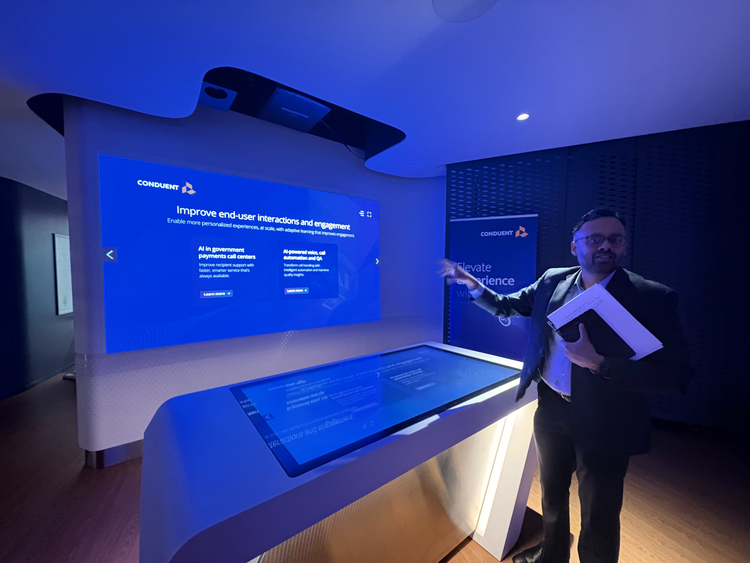
Conduent is showing how AI is delivering a tangible impact with its new AI Experience Center, a hands-on space where customers can see how AI is driving results in engagement and operations.
“There’s a lot to be excited about, but at Conduent our focus is on making that excitement real—real pilots, real implementations, real results,” said Nitin Jain, vice president of corporate strategy at Florham Park, N.J.-based solution provider Conduent, No. 29 on CRN’s 2025 Solution Provider 500 list. “This is how we’ve approached AI since the early 2000s, using it to enhance experience, efficiency and quality for our clients and to improve the lives of millions of people each day.”
The AI Experience Center, which opened last summer at the company’s headquarters, is divided into interactive stations focused on end-user engagement, core operations, and enterprise and support functions.
“This is about creating dedicated time and space for real conversations about AI,” Jain told CRN. “Innovation isn’t a two-minute discussion. We want clients to come here, see what’s already working and then whiteboard how AI can reimagine their business processes.”
One station focuses on AI-driven end-user engagement in government services, where Conduent manages millions of calls each month related to programs like SNAP (Supplemental Nutrition Assistance Program), WIC (Women, Infants and Children) and unemployment insurance.
“These calls often come from seniors, people with disabilities or individuals who aren’t highly technical,” he said. “So you have to be thoughtful about how AI is implemented.”
And three capabilities are already in production: interactive voice response, agent assist tools that search for relevant policy and workflow information, and automated quality assurance reviewing every call.
“Even saving 20 or 30 seconds per call has a cascading impact at our scale,” he said. “AI becomes the search engine for the agent instead of the agent having to search across multiple systems.”
One solution uses generative AI built on Microsoft Azure OpenAI to guide agents through complex workflows in real time. “Previously, agents had to dig through multiple databases. Now the answer is fed to them instantly, which improves resolution speed, shortens training time and reduces wait times for callers.”
Outside government services, the Experience Center uses AI-driven agent training simulations, real-time translation and automated quality assurance. Another station highlights use cases such as intelligent document processing, fraud detection where Conduent reports a 150 percent increase in detection capacity, and advanced analytics for medical companies.
“This is not just a pilot,” Jain said. “These are real solutions, already in production, delivering real impact.”
The final station focuses on enterprise functions, including human resources and benefits within a company. “Employees expect instant, on-demand answers. They don’t want to call and wait. They want to use natural language and get clarity quickly,” he said.
Tools such as Conni, a virtual benefits assistant built on Microsoft Azure OpenAI, help employees navigate health, financial and wellness decisions “Everything is based on client context. That’s how you build trust,” he said.
One example demonstrated a use case of an employee planning for maternity leave and interacting with Conni to summarize coverage, estimate out-of-pocket costs and comparing plan options. The outcome was a faster, more informed and less stressful experience for the employee, Jain said.
“AI will take away some tier-one tasks,” he said. “But our focus isn’t labor reduction—it’s quality, efficiency and differentiation. The win is when AI improves experiences, strengthens execution, and helps organizations and people grow. That’s what we’re showing here.”
One theme throughout the center is the challenge of the “execution gap” in enterprise AI. While excitement around AI is high, many companies struggle to move from pilot projects to full-scale production.
“A lot of people think you just apply GenAI and something magically happens,” he said. “What we’ve learned is that business process expertise is essential. You can only guide AI effectively if you deeply understand how the work actually gets done.”
Rather than asking AI open-ended questions, the solution provider defines what the technology should look for and how outcomes should be classified.
“We don’t just ask AI to tell us if something is fraud or an adverse event. We tell it exactly what to find and how to evaluate it, and that only comes from deep operational expertise,” he said. “Most companies classify, catalog and analyze information. Whether it’s medical data, airline complaints, marketing feedback or customer service interactions, the same operational challenges exist, and that’s where these solutions apply.”
But it’s all about production readiness, according to Jain. Taking it into production, handling data requirements, network dependencies, support models and governance are the challenges, and that’s where oversight is crucial.
“These systems don’t set themselves up,” he said. “You need people who understand the process, the risks and the operational realities.”
The AI Experience Center welcomes customers to view real-world demos and brainstorm how they could apply agentic AI to their own business. “That’s the whole point,” he said. “We want teams to ideate together and connect AI directly to their business challenges.
“This is how AI works in the real world,” he added. “Not as a theory, not as a lab experiment, but as a practical solution that creates better outcomes for employees, clients and the people they serve. That’s the point of our Experience Center, to close the gap between possibility and performance and to make AI real.”