Salesforce CEO Benioff Says ‘Apps Are Not Dying’ As AI Drives CRM, Agentforce Growth
‘We’re told agents accessing our system would kill apps—well, actually, usage is exploding,’ Salesforce CEO and co-founder Marc Benioff said.
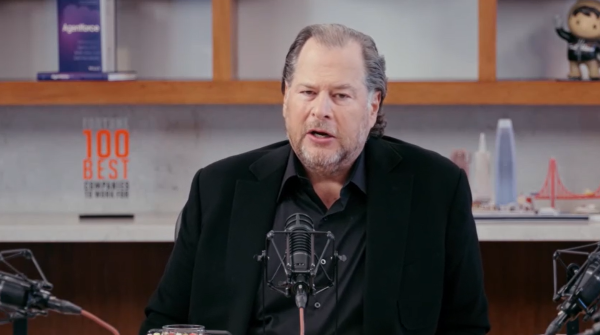
Salesforce CEO and co-founder Marc Benioff pointed to results from the vendor’s latest fiscal quarter as proof that customer relationship management software and software-as-a-service can not only survive the artificial intelligence era but make AI usable for businesses.
The San Francisco-based CRM and SaaS giant saw agentic use of its applications through Model Context Protocol (MCP) and command-line interface (CLI) calls surge sixfold, Benioff said Wednesday on Salesforce’s latest quarterly earnings call, covering the second quarter of its 2027 fiscal year.
“We’re told agents accessing our system would kill apps—well, actually, usage is exploding,” said the CEO while covering results from the three months ended July 31. “And we’re told the frontier models would eliminate the need for CRM. Instead, they depend on it. And we’re showing how one plus one can equal three.”
[RELATED: CData Expands Data Connectivity Options For AI Developers]
Salesforce Q2 Counters SaaSpocalypse Fears
Leah Sand, senior vice president of the AI-first marketing and engagement practice at St. Louis-based solution provider Perficient—whose partners include Salesforce—told CRN in a recent interview that this marketing and engagement practice has grown explosively due to the importance of systems needing to support creative and campaign operations and customer demand for more autonomy in account-based marketing (ABM).
Perficient has differentiated itself in the space through the depth of its capabilities with a set of vendor alliances, including leveraging Salesforce and AI startups that can integrate with Salesforce, such as Gradial and Swantide.
Customers “want to solve for asset variations at scale,” Sand said. “It’s both getting more complex and simple because we’re focused on either addressing a client problem, closing an execution gap for them or opening up net new territories, like AEO and GEO,” which refer to the answer engine optimization and generative engine optimization strategies for digital marketing in the AI age.
“We’re helping them close the execution gap,” she said. “It takes some discernment to figure out when to use what and what is valuable. What should be generative, what should be agentic, what should really just be automation.”
Benioff Doesn’t See Customer Focus On Models
Benioff said he does not foresee enterprises setting up their own AI model expertise and maintenance operations, instead consuming models through packaged software like Salesforce in the front office and Slack as a collaboration application.
Customers tend not to know the semiconductors they use and which data center, router, switch, fiber, cable and interconnect they use, instead just wanting their applications to work. Salesforce customers have not asked him about something as specific as open-source models and frontier models, with room for a variety of model types in the market, the CEO said.
“At some level, we too will get abstracted back to kind of how the way the world used to be,” Benioff said. “I believe the highest level of value is at the application layer. So, I couldn’t tell you from my phone all the way through Salesforce and Slack all the way down to what the hardware infrastructure is, and I shouldn’t have to worry about that.”
He continued: “I don’t think that’s where customers’ heads are at. At least when they talk to me, that’s not what their heads are at.”
Salesforce also has custom models running in its platform and available on marketplaces like Hugging Face.
Salesforce, Anthropic Launch Expanded ‘Claudeforce’ Partnership
Still, Benioff illustrated the power of Salesforce as an interaction layer and data layer with an expanded strategic partnership with Claude maker Anthropic.
Revealed just before Wednesday’s call, the companies have united Claude reasoning and Salesforce’s enterprise harness under the so-called “Claudeforce” partnership. The partnership has so far resulted in a Salesforce in Claude offer available to select pilot customers, with open beta expected next month.
The Salesforce in Claude plugin has 37 prebuilt sales skills that enable sellers and agents to reason over live revenue context, automate pipeline updates and take governed action from Claude. The vendors plan to introduce more integrations across Claude, Salesforce and Salesforce’s Slack division in the future.
Benioff described the offer as “a radically different type of interface on top of Salesforce’s entire platform” on the call. Customers can see “all this value that they have in their systems that has been trapped becomes un-trapped.”
He said Claudeforce can unlock AI insights with customers’ data without the use of forward-deployed engineers (FDEs), which have been a target of investment by a variety of vendors.
Miguel Milano, Salesforce president and chief operating officer, clarified that Slack remains an important interaction layer for Salesforce, “but not everybody has Slack.”
“They are complementary,” Milano said. “Slack, you are working with your teams. It’s a multiplayer surface. With … Claudeforce and Salesforce in Claude, we are simply going deep and researching, understanding your business.”
Agents built on Claude can investigate business pipeline risks within the month and the quarter, with an option to send messages based on the results through Slack to account executives, for example, the COO said.
More activity on the network with agents, a variety of user interfaces and new applications translate into more activity on Salesforce services, Benioff said. Nine of the top 10 AI companies more than quintupled Salesforce spend year over year.
Salesforce saw its strongest net-new annual order value (AOV) growth in four years and near-record-low attrition during the quarter, countering fears around a “SaaSpocalypse” of AI costing SaaS vendors value and customers.
“This nonsense of this SaaSpocalypse—I think it’s time for it to stop,” Benioff said. “Apps are not dying. In fact, they’re growing. … Frontier models depend on CRM (customer relationship management). They make sure that it works, that it all comes together. They do not replace them.”
Customers Want AI Pricing Flexibility
Benioff said that AI customers still seek a variety of ways to buy products and services, with per-user, per-agent, overage charges, consumption-based and outcome-based pricing all resonating with different customers.
Likewise, solution providers have explored outcome-based pricing and other engagements with customers to make up for AI’s potential to erode hourly billing and other traditional ways channel partners bill clients.
“Customers want to buy and want to price in different ways—this is something I’ve learned really aggressively recently,” Benioff said. “Because customers want that kind of diversity in pricing, we’ve created a high level of flexibility. And that I think has really expanded our ability to sign very large transactions with our customers.”
Milano said bookings grew triple digits, doubling year on year. Half of the bookings came from customers wanting more consumption and credits, with these sales cycles to increase credits taking up less time than the initial sales cycle. The vendor has also looked to upgrade more customers to premium editions.
Salesforce added 2,000 paying customers into production, up 70 percent quarter over quarter, and added hundreds of AI agents that are consistently consuming Salesforce products. Milano even gave out a customer phone number and websites on the call where analysts can see Salesforce AI in action.
Customers that start the agentic journey with Salesforce are, on average, already at double the annual order value, with the potential of tripling or quadrupling their AOV, Milano said.
“We meet customers where they are in their journey,” he said.
Salesforce has plenty of room to grow, with only 5 percent of knowledge workers using its Sales and Service Clouds having upgraded to higher-end editions, which gives Salesforce a 60 percent to 80 percent premium, Milano said. Claudeforce, Headless 360 and other value-added agentic capabilities are available in premium Salesforce editions.
“That’s what our hope is: is that we will offer more value for our customers and unleash trapped value, and that that’s going to give us this huge leg up,” Benioff said.
“We’re still trapped in some ways in old per-user pricing models,” the CEO continued. “But the opportunity to build much more aggressive pricing to really represent the value that we’re offering our customers, I think, is enormous.”
Slackbot, Agentforce Hit Growth Milestones
During Wednesday’s call, Salesforce revealed that Slackbot has amassed 1 million active users five months after launch. That’s also more than double quarter to quarter and helped Slack deliver its fastest quarterly net-new annual order value (NNAOV) growth since acquisition.
Since the release of Slackbot, upgrades to premium Slack editions have tripled, Robin Washington, Salesforce president and chief operating and financial officer, said on the call.
Salesforce showed that it has grown in newer product verticals, with its Agentforce IT service reaching 450 customers since its launch in November, taking customers from ServiceNow, Benioff said. Agentforce Life Services now has more than 140 customers.
“We expand it to be not just sales, not just service, not just marketing, not just commerce, not just analytics, but also IT service and other critical functionality, all of that can be revealed and now rendered through the Agentforce user interface,” Benioff said.
Bookings from Agentforce 1 Edition and Agentforce for Apps more than doubled quarter over quarter. Within Salesforce, its Help Agent has surpassed 5 million customer conversations with 64 percent resolved autonomously. Slackbot has driven 8.1 million hours of annualized productivity gains for Salesforce employees, more than double quarter over quarter.
The vendor has delivered 7 billion agentic work units (AWUs)—a Salesforce metric for measuring actual work finished by AI agents instead of raw computer data usage—across Agentforce and Slack to date. The second quarter alone saw 3.2 billion AWUs, almost double quarter over quarter.
In the second fiscal quarter, Data 360 ingested 104 trillion records, up fourfold year over year. Salesforce’s Zero Copy capability ingested 82 trillion records, more than eightfold year over year. Data 360 processed 22 terabytes of unstructured data.
Salesforce Revenue Tops $11 Billion In Q2
Salesforce reported current remaining performance obligation (cRPO) of $33.5 billion, up 14 percent year over year ignoring foreign exchange. The vendor’s RPO was $66.3 billion, up 11 percent year over year.
The vendor brought in $10.8 billion in subscription and support revenue, up 11 percent year over year ignoring foreign exchange. Informatica contributed $440 million of that revenue.
Salesforce saw $11.3 billion in total revenue for the quarter, up 11 percent year over year. Informatica contributed $456 million to that revenue.
Net income was $3.5 billion for the quarter, up about 87 percent year over year.
The vendor’s operating cash flow was $1.3 billion, up 71 percent year over year. Salesforce’s $1.1 billion in free cash flow marked 81 percent growth year over year.
Salesforce’s annual recurring revenue with Agentforce and Data 360 more than tripled year over year to $3.9 billion. Agentforce’s ARR exceeded $1.5 billion, more than triple year over year. Salesforce has started counting ARR from Slackbot, Headless 360 and other AI offerings in that Agentforce ARR figure.
Salesforce Raises Fiscal 2027 Revenue Outlook
The vendor said to expect third fiscal quarter revenue of $11.42 billion to $11.5 billion, which would mark an increase of 11 percent to 12 percent year over year. Informatica should contribute about 4 points to that growth.
Salesforce expects cRPO to grow about 14 percent year over year in the third fiscal quarter. That doesn’t include any contribution from the Contentful and Fin companies Salesforce is working to acquire. The vendor expects to close the acquisitions during the third fiscal quarter.
Looking ahead, Salesforce increased its fiscal year 2027 revenue expectation to $46.1 billion to $46.4 billion. That would mark an 11 percent increase year over year ignoring foreign exchange. Informatica should contribute about 3 points to that growth.
The $300 million increase to that full-year outlook mostly comes from Contentful and Fin, with $100 million from organic growth, according to Salesforce.
Salesforce also increased its full-year subscription and support revenue growth to about 12 percent ignoring foreign exchange, with Informatica contributing about 3 points of growth.
Salesforce still expects full-year operating cash flow growth and free cash flow growth of about 4 percent to 5 percent year over year.
Salesforce’s stock grew about 13 percent after market close Wednesday, trading at about $230 a share.