The 10 Coolest Open-Source Software Tools Of 2026 (So Far)
Here’s a look at 10 open-source software tools—including software for AI application and agent development, AI application monitoring and observability, running large language models on personal computers, and managing data used by AI systems—that have caught our attention this year.
Keeping An Open Mind
Open-source software tools continue to surge in popularity because of the multiple advantages they provide including lower upfront software and hardware costs, lower total-cost-of-ownership, lack of vendor lock-in, simpler license management and support from active communities.
In the following slides, as part of the CRN 2026 Year So Far project, we take a look at some of the most popular open-source software products that have caught our attention.
Not surprisingly, the current wave of AI, agentic AI and generative AI application development is fueling the emergence and adoption of many new open-source technologies.
As AI moves beyond early development and trial stages and into large-scale deployments, businesses and organizations are finding that they need better tools to accelerate AI development, manage data used by AI apps, monitor AI systems in production, and control token usage and other AI-related costs that are rapidly eating into IT budgets.
Several of the tools and technologies on this list are managed by the Apache Software Foundation (ASF) while others have received funding from the Y Combinator startup accelerator.
These products are available under open-source licenses such as the MIT License, Apache 2.0 License, GNU GPL, and others. Many of them are managed by community organizations that oversee the products’ ongoing development from contributors. Others are developed by startups that offer commercial editions and services of their products in addition to open-source versions of their software.
Agenta
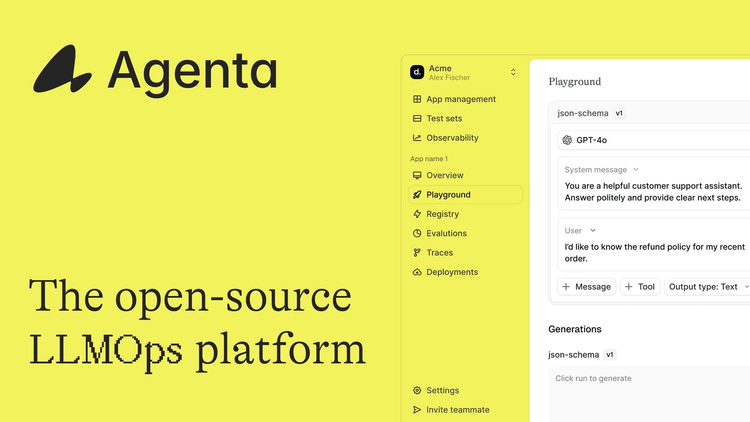
Agenta is an open-source LLMOps platform that helps developers and subject matter experts build, evaluate, run and monitor reliable AI and Large Language Model (LLM) applications. It acts as a centralized workspace for prompt management, version control, performance testing AI applications and debugging.
Agenta is developed by Agenta.ai, headquartered in Berlin, Germany.
With Agenta developers can centralize, version and iterate prompts without altering core application code. They can create test sets and evaluate applications using built-in metrics and custom code. And they can track application inputs, outputs, token usage and costs while monitoring how agents perform in production.
Agenta provides a workspace where engineers, product managers and domain experts can collaborate on prompt engineering and testing in one platform, according to Agenta.ai.
Agenta is available under the open-source MIT License.

Apache Gravitino
Apache Gravitino, the first of several Apache Software Foundation (ASF) open-source technologies to make this list, is a high-performance, geo-distributed and federated metadata lake. Think of it as an uber catalog of data catalogs.
With Gravitino, organizations can assemble a metadata lake that serves as a unified data and AI asset management platform. Such a framework provides organizations with unified access and data governance across diverse, geographically dispersed data sources including relational databases, file stores and event streams.
Gravitino has emerged as a key infrastructure component in today’s AI and data landscape with its ability to unite data silos in a multi-cloud world and enable autonomous AI agents to leverage metadata to discover, understand and act upon the data they need to function.
Gravitino was originally developed by Datastrato, open-sourced in 2023 and donated to the Apache Software Foundation Incubator in 2024. It graduated from the Incubator in May 2025 to become an Apache Top-Level Project, a status for mature open-source initiatives with high levels of governance and community support.
Gravitino is available with the Apache 2.0 license.
In March, Datastrato introduced Apache Gravitino 1.2 with new capabilities the company said advanced the software from a passive metadata catalog to an operational layer for lakehouse systems. Apache Gravitino 1.3 debuted in June with federated IRC (Iceberg REST Catalogs) and multi-cloud support within a single catalog.
Apache HertzBeat
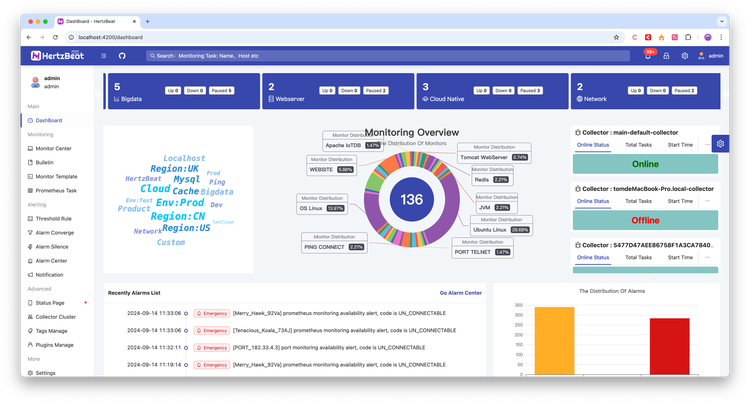
Apache HertzBeat is an AI-powered, real-time monitoring and observability system for monitoring the performance of IT systems and infrastructure including servers, networks, databases, applications, cloud services, containers, websites, APIs and more.
HertzBeat makes it possible to detect and rectify system anomalies and issues before they impact users. The software provides centralized alerting—with notifications sent through tools such as Slack, email, Discord and Telegram—and status page building capabilities.
HertzBeat is built on an agentless design and connects directly to target systems to collect telemetry data. It uses YAML templates for protocol flexibility to support protocols such as HTTP, JMX, SNMP, and JDBC, according to the Apache HertzBeat website.
HertzBeat is available with the Apache 2.0 license.
Apache HugeGraph
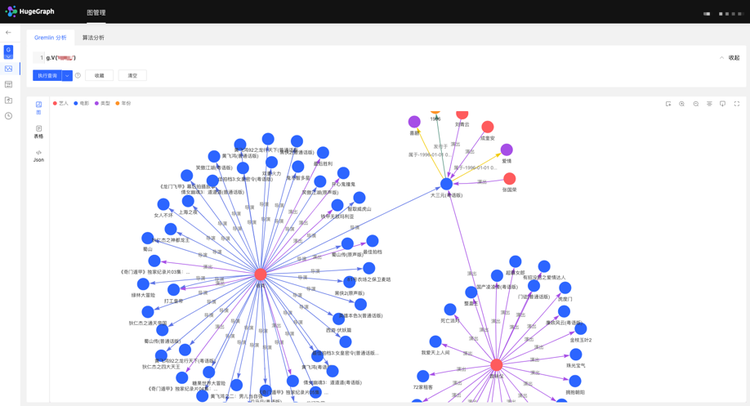
HugeGraph is a full-stack platform that integrates a graph database, graph computing functionality and AI capabilities for massive data storage, real-time querying, and offline analytics.
Graph has emerged as a critical technology for enhancing large language model accuracy, explainability, and contextual memory.
By supporting flexible query patterns, HugeGraph can process hundreds of billions of graph elements with millisecond-level latency, according to an Apache Software Foundation (ASF) description. The software has already proven itself in such applications as social networking and security and is now targeted toward connecting massive datasets with large language models to power data-driven AI applications.
(A graph is essentially a network of interconnected data. It includes tools, frameworks and systems that create structures that represent, store and analyze data with a focus on the relationships between data points.)
In February, ASF announced that HugeGraph had been designated a Top-Level Project (TLP), a status for mature open-source initiatives with high levels of governance and community support.
HertzBeat is available with the Apache 2.0 license.
Arize Phoenix
Arize Phoenix is an open-source AI observability and evaluation tool developed by Arize AI, headquartered in Mill Valley, Calif., and the open-source community. Arize Phoenix helps developers understand and improve AI applications by providing a workflow for application debugging and iteration, according to the Arize AI website.
Arize Phoenix makes it possible to collect trace information from AI applications to see what happened during a run, score outputs using evaluation tests to identify failures and regressions, iterate on prompts, and optimize applications with experiments that compare changes on the same inputs.
The software works with popular frameworks (LlamaIndex, LangChain, DSPy, Mastra and Vercel AI SDK), model providers (OpenAI, Bedrock and Anthropic), and languages (Python, TypeScript and Java).
Arize Phoenix is built on top of OpenTelemetry, an open-source framework that standardizes the collection, processing and export of observability data from applications, and is powered by OpenInference instrumentation, an open-standard for tracing and monitoring the performance of AI and LLM applications.
Arize Phoenix is available under the open-source Elastic License 2.0 (ELv2).

HelixDB
HelixDB is a high-performance OLTP graph-vector database, built in Rust on object storage, that’s designed for use by developers building AI, agent, RAG (retrieval augmented generation) and knowledge applications.
The founders at HelixDB, a Y Combinator-backed startup, make the argument that as AI agents replace traditional software, they need better ways than traditional databases to store, recall and reason over contextual data.
Vector databases are growing in popularity because they provide the speed and performance needed by generative AI applications and AI agents. (They store, manage and index data as “vectors” that can be grouped and compared based on their similarity.) Graph technology, as we saw with the HugeGraph platform, has emerged as a critical technology for enhancing large language model accuracy, explainability, and contextual memory.
HelixDB provides these capabilities in one database, providing the “knowledge infrastructure every AI agent will depend on,” according to the company’s Y Combinator web page. The database integrates semantic meaning (via vector types) with data relationships (through graph types), providing a sophisticated solution for AI retrieval engines for agents and large language models.
The HelixDB company, based in San Francisco, launched in early 2025. In addition to the open-source HelixDB (available through GitHub and other sources), the company sells commercial products such as Helix Enterprise and Helix Cloud.
HelixDB is available under the GNU Affero General Public License v3 (AGPL-3.0).

LangGraph
LangGraph is an open-source framework for building complex, production-ready AI agents.
LangGraph uses graph-based structures to model agent behaviors as graphs and define workflows as nodes and edges. That makes complex agent interactions within multi-agent systems more structured, scalable and easier to control, according to the GeeksforGeeks website.
LangGraph is developed by San Francisco-based LangChain, which also develops the open-source LangChain framework for connecting large language models with external data sources. (The LangChain company also markets commercial products such as LangSmith, a platform for observing, tracing, evaluating, testing and deploying AI agents and LLM-power applications.)
LangGraph is available under the open-source MIT License.

Metaflow
Metaflow is an open-source Python framework and library used by machine learning engineers and data scientists to build and manage demanding “real-life” ML and data science projects, according to the metaflow.org community site.
Metaflow was originally developed at Netflix to help developers and data scientists who worked on large-scale ML and data science projects. Netflix open-sourced Metaflow in 2019 and today it’s used by hundreds of companies for diverse projects across GenAI, computer vision, business-oriented data science, statistics and operations research.
Metaflow provides a unified API that bridges the entire infrastructure stack, from local notebooks to cloud infrastructure, making it possible to execute data science projects from prototype to production, according to metaflow.org. Key features include workflow structuring, automatic versioning and checkpointing, integrated data storage, and scalable compute without the need to rewrite code.
Metaflow is available under the Apache License, Version 2.0.

Ollama
Ollama is a groundbreaking platform that backers say democratizes access to large language models.
The Ollama software allows users to download and run large language models directly on their own computers, including PCs, eliminating the often-complex setups and high subscription costs of running AI models offline.
Ollama runs AI completely on device without sending data to external servers, ensuring data privacy. Users can build privacy-focused applications that handle sensitive personal or business data, according to the Udemy blog. Running models directly on a device also provides reduced latency and faster responses.
Ollama creates an isolated environment on a user’s device, according to a Hostinger tutorial, and includes all the necessary components for deploying AI models including model weights (pre-trained data the models need), configuration files that define how models behave, and necessary dependencies—including libraries and tools—to support the model’s execution.
Ollama supports dozens of popular open-weight models such as Llama, DeepSeek, Mistral, Gemma and Qwen. And it exposes an OpenAI-compatible local REST API that makes it easy to plug local AI into applications, scripts and coding tools.
The Ollama software was created by developers Jeffrey Morgan and Michael Chiang in 2023. Today they are co-founders of the Ollama company, which received Y Combinator funding in late 2021, and Morgan is CEO.
Ollama is available under the open-source MIT License.
Zed
Zed is a next-generation, high-performance, multiplayer code editor that its creators say is lightweight, extensible, and built with collaboration among people and—increasingly—AI agents, at its core.
Zed was developed by the original creators of Atom, the popular desktop text and code editor, as an alternative to legacy Visual Studio Code (VS Code). Zed was built from scratch with a Rust-native architecture and a focus on maximizing efficiency and integration with modern development practices.
Zed allows multiple people to work together on the same code, using a built-in collaboration server, and it runs AI agents in parallel to help write, navigate and edit files.
The tool features built-in Language Server Protocol (LSP) support for languages such as Rust, Python and TypeScript. And Zed renders its UI on GPUs for faster performance.
Zed’s developers announced in January 2024 that the technology had become an open-source project. Zed is available under the GPL-3.0, AGPL and Apache 2.0 open-source licenses.