Global Leadership, Local Impact: Ingram Micro Execs On How Distributor Is Driving Partner Growth Worldwide
‘At the end of the day, regardless of all the acronyms and complexity, our goal is to simplify the process for customers who are focused on delivering real business outcomes,’ says Ingram Micro CEO Paul Bay.
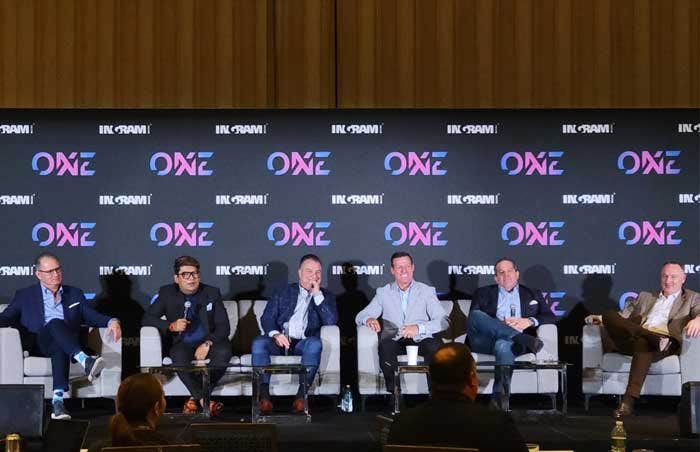
From North America’s AI-driven insights to Asia-Pacific’s thriving ecosystem of AI and cloud innovation, each region is playing a pivotal role in helping partners deliver more value to their customers and capture new growth opportunities.
Paul Bay, CEO of the Irvine, Calif.-based distributor, said the company’s expanding Centers of Excellence are a cornerstone of this effort.
“We now have them in each of our four regions,” he said during a press panel at the company’s One event in Washington, D.C., last week. “Their purpose is to strengthen our capabilities in countries that may not yet have certain skill sets and, more importantly, to help our partners who may also need that support. In some cases, we’re even providing these services to vendors … allowing them to outsource their Level 1 and Level 2 support to us. These Centers of Excellence have become a key differentiator for us as we go to market globally.”
The company’s Xvantage platform ties these regional efforts together, creating a “single-pane-of-glass” experience that simplifies fragmented marketplaces. The goal is to simplify the process for partners focused on delivering stronger business outcomes.
The Xvantage platform is designed to simplify and automate how partners and vendors do business with Ingram Micro. The platform serves as a unified, AI-driven ecosystem that brings together commerce, insight and operational tools in one place. It leverages data analytics, automation and machine learning to give users real-time visibility into inventory, pricing and customer opportunities while streamlining everything from quoting to fulfillment.
And with the company’s Intelligent Data Assistant (IDA), Ingram Micro is leveraging AI to streamline various business processes, contributing to its growth and customer engagement strategies.
“With IDA, we’re moving beyond simply following up on quotes,” said Bill Brandel, executive vice president and president of North America at Ingram Micro. “We’re now using data-driven recommendations that expand opportunities our partners might not have considered. Combined with the explosion of the hyperscaler opportunity, this has become a major growth engine for our business.”
Sanjib Sahoo, Ingram Micro’s president of global platforms, said IDA acts as an intelligent operating system by automating basic tasks, freeing teams to deliver insights that help partners identify new opportunities.
“The real value comes when humans and AI work together to drive outcomes,” he said.
Bay, Brandel and Sahoo joined Ingram Micro’s global leaders from Latin America, EMEA and Asia-Pacific to discuss how they’re helping partners around the globe. From financing models and partner training to AI enablement and marketplace unification, Ingram Micro’s global strategy reflects a single vision: help partners grow faster, operate smarter and deliver greater value to their customers, wherever they do business.
Here’s what they had to say.
Bay On Global Centers Of Excellence As Major Differentiator
If you look at our Centers of Excellence, we now have them in each of our four regions. Their purpose is to strengthen our own capabilities in countries that may not yet have certain skill sets and, more importantly, to help our partners who may also need that support. In some cases, we’re even providing these services to vendors, since we already have the expertise in place, allowing them to outsource their Level 1 and Level 2 support to us. These Centers of Excellence have become a key differentiator for us as we go to market globally.
Bay On How Xvantage Unifies Fragmented Marketplaces Into A Single Platform
From an Xvantage standpoint, our focus isn’t on managing fragmented marketplaces or isolated transactions—we’re bringing everything together into a single, unified platform, a true single pane of glass. That’s how we’re creating a seamless experience for our partners who are building and deploying solutions.
At the end of the day, regardless of all the acronyms and complexity, our goal is to simplify the process for customers who are focused on delivering real business outcomes. It’s not just about hyperscaler delivery; that’s only one part of the equation. On average, our global solutions include six different types of technologies and services working together.
Partners don’t want to lose visibility into their customers, especially when hyperscalers make commitments that require partners to pay down rebates or manage credits. Our role is to make that process as simple and transparent as possible, no matter how the technology is deployed. We want our solution provider customers to own their business relationships and maintain full visibility into the end users they serve.
Ultimately, this marketplace isn’t just about one technology. It’s about an ecosystem of hardware, software, cloud and services coming together to deliver complete business outcomes for end customers.
Bay On Evolving Partners Into Trusted Advisers
We’re investing in training, both internally and for our partners. For example, we map out how team members can pivot from handling inbound tasks to engaging in outbound activities. Our global training programs focus on helping team members progress and become the trusted advisers of the future.
The goal is to give partners the intelligence and mindset to act differently, shifting from simply selling technology to delivering business outcomes. With the industry moving toward cloud, subscriptions and as-a-service models, partners must guide customers through complex journeys, ensuring adoption, renewals and upgrades. While the solution provider industry has been resilient despite predictions of disintermediation, the opportunity now lies in evolving to a more consultative role, focusing on value and outcomes rather than just technology. This evolution requires all of us—vendors, distributors and partners—to learn, adapt and train for the next generation of business practices.
Bay On How Partners Struggle With Limited Budgets
The biggest challenge our partners face is managing limited budgets while trying to adopt new technologies like AI; they need to decide what to cut and evaluate the ROI. To support them, we provide programs that guide them through AI adoption, helping them define the business outcome they’re trying to achieve, understand whether the solution is vertical-specific or replicable, and implement it effectively. Our global Enable AI program walks partners through this multistep journey so they can deploy AI solutions successfully and meet their customers’ needs.
Bay On Combining Financing, Multivendor Collaboration And Community Engagement
The financing piece is an important opportunity, and we should explore it not just in traditional ways but also through unique financing solutions enabled by our scale. Beyond our credit capacity, third-party financing and multivendor solutions could be leveraged to subsidize participation in the tech stack, encouraging adoption of more technology. The key is aligning our capacity, vendor capacity and solution provider commitments to end users. Communities like Trust X Alliance provide an ideal forum to explore these ideas globally.
Sahoo On Being A Data- And AI-Driven Platform Organization
Our journey began with data, the data itself, the data mesh and the engines that power the core business logic behind our platform. One of the things we focused on early was understanding the different journeys: our partner journey, our internal journey and our vendor journey. As we’ve evolved toward operating as a true platform company, we’ve examined each of these journeys to see how we can best leverage AI.
Today, AI is delivering real value across our processes. In the early days, our partners integrated with us through code, through our APIs and platform connections. Now, we have visibility into 75 to 100 million quotes across the industry. We use AI to analyze around 50 different attributes from that data and determine the propensity of our partners to find new opportunities. Based on that analysis, we proactively reach out to partners, and we’re seeing significantly higher conversion rates from those AI-identified opportunities compared to others.
Sahoo On The Platform’s Value
The real difference in our approach is intelligence. I often describe the platform as an intelligent operating system. As we automate basic fulfillment tasks, it frees up our team to provide insights and consulting for our partners. While technology can handle coding, building and solving complex tasks, our true value comes from combining outcomes with intelligence.
The platform evolves in phases, incorporating more humanized AI over time. The system learns continuously, but it requires high-quality, integrated data from both internal associates and partners to function effectively. For example, the intelligence in our IDA system depends on coding integrations and the data we gather. Without it, AI cannot generate meaningful insights. Ultimately, our model is about a collaborative cycle of humans and AI working together to deliver results.
Brandel On What's Driving North America’s Growth
For North America, it’s pretty straightforward—we’re seeing growth in two main areas.
First, with IDA, the biggest opportunity lies in how we’re evolving beyond simply following up on existing quotes and closing deals. We’re now adding AI-driven insights and recommendations, which help expand opportunities our partners might not have initially considered. These insights have become a major growth engine, significantly contributing to our North American business. Second, there’s the cloud and hyperscaler opportunity, which has absolutely taken off, and we believe this is just the beginning.
We’re achieving this through our platform, leveraging automation and data insights to help partners identify where the best opportunities exist. By combining the strength of our platform with our people, vendors and their programs, we’re seeing a real shift in how we go to market. You can already see this transformation where partners, vendors and Ingram are working together seamlessly to drive growth. That’s where we’re seeing the momentum today.
Diego Utge, EVP, Global Group President, APAC, On AI As Major Growth Driver In The Region
A key growth area for us is AI. In fact, the vast majority of global AI patent applications are coming from the Asia-Pacific region, led by China and followed by Singapore, both of which are driving significant innovation. We’re supporting this momentum by helping our partners build a strong AI ecosystem by bringing together vendors that provide the necessary networking, compute, storage, observability and security solutions for AI workloads.
This year, we launched a dedicated Center of Excellence in Singapore, where our partners and systems integrators can conduct proof-of-concept testing with specific technologies and solutions. It’s creating a strong collaborative environment for innovation.
We’re also leveraging best practices from our global corporate teams to scale AI knowledge and capabilities across the region. Alongside AI, cloud and Everything-as-a-Service models continue to be powerful growth engines, driving recurring revenue and new infrastructure investments, including data center expansion in several countries. Altogether, this creates a positive, circular momentum that continues to fuel our success in Asia-Pacific.
Utge On Standardizing And Scaling Proven Business Cases
It’s not just about replicating solutions across countries or regions; we also replicate them within a specific solution. For example, we might work with two or three vendors and focus on a single solution, developing a business case that can then be replicated by other vendors and go-to-market teams.
We create proofs of concept in our Centers of Excellence, leveraging significant technology and intellectual property developed by our experts. Working closely with vendors, we package these solutions so they can be deployed in a specific market, whether targeting SMEs, SMBs or other segments. This approach isn’t just cross-geography; it also involves replicating successful business cases for a given solution across different markets.
Luis Ferez, SVP, Global Group President, Latin America, On Supporting Partners
We’ve been building a very strong value proposition by leveraging the knowledge and expertise of our customers. We offer a full range of professional services to support our partners in developing and managing their infrastructure. This allows them to create a strong value proposition without needing to make large up-front investments in infrastructure that might not be immediately worthwhile.
The second thing we’re focused on is recognizing that Latin America is a region with varying levels of maturity across countries. We’re learning from the most advanced markets, for example, Brazil, where technology adoption is very high and where we have strong expertise in selling cloud solutions alongside hardware. We’re taking those best practices and exporting them to other countries in the region, helping accelerate development across markets.
Ultimately, we’re building a strong network that combines our capabilities with the expertise of our regional partners so we can collectively pursue the growing opportunities emerging across Latin America.
Matt Sanderson, EVP, Global Group President, EMEA, On Investing In Full-Service Capabilities
We’re operating across very diverse countries with varying skill sets. We’re selling a wide range of solutions and backing them with services. We started years ago in hardware, then expanded into networking, data centers and collaboration. Now, our primary focus is on cloud services, which is really driving our overall cloud business.
We’re working closely with our partners and, in many cases, on their behalf so they don’t have to make the same infrastructure investments we’ve already made. This approach is having a material impact for both us and our partners.
Beyond consultancy and assessments, we also handle engineering and carry that through to full service desk support, offering a complete, end-to-end suite of services for our partners, and increasingly, for vendors as well. Many vendors are looking for Level 1 and Level 2 support and are shifting their operational expenses to other areas, so we’re stepping in with our existing infrastructure to meet that need. This is helping us accelerate growth and strengthen our relationships across the partner ecosystem.
Sanderson On Understanding Partners’ Needs
It’s our responsibility to better understand our partners, especially as the solutions they sell become increasingly complex and require more services. Some partners prefer not to make certain investments and want to focus on high-margin areas, like services or subscriptions, which we can take on ourselves. Therefore, it’s more important than ever to understand what our partners will need for the future.