Arctiq Heats Up Managed Backup, Networking Services With Verinext Acquisition
‘We had what I think is a great managed security offering, and Verinext had a great managed backup and managed network offering. There was no overlap. No overlap in geography, no overlapping customers. Now all of a sudden, we can do more for our customers in terms of managed IT. We could do managed security for them, but we didn’t have a managed backup offering. Now together, we can go to those customers and manage more of their operations together,’ says Arctiq CEO Paul Kerr.
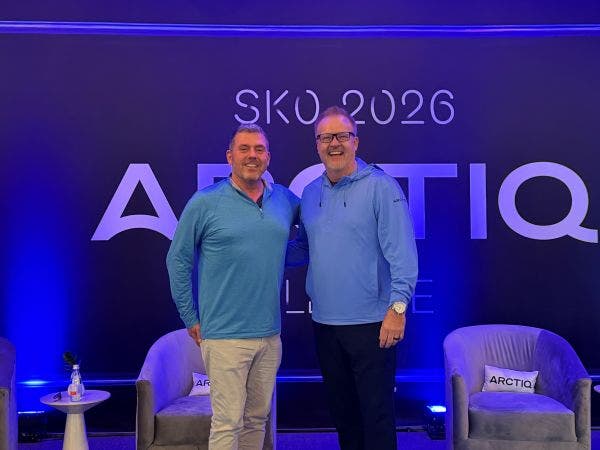
IT solution provider Arctiq this month closed its acquisition of fellow channel partner Verinext, bringing together two companies with virtually no geographic, customer or skillset overlap into a new channel powerhouse.
Nashville, Tenn.-based Arctiq signed the deal to acquire Blue Bell, Pa.-based Verinext in January. The deal officially closed in early February.
The close came just in time to scramble for extra hotel space for Verinext employees to join Arctiq’s annual sales kickoff this week in Miami, said Arctiq CEO Paul Kerr, who appeared on-stage with Verinext President Ashby Lincoln.
[Related: It’s A Lot More Than EBITDA When It Comes To MSP Valuations: Exec]
Kerr (in above photo on left) said that Arctiq, ranked No. 105 on CRN’s 2025 Solution Provider 500, had three primary focus areas around cybersecurity, traditional data center, and AI and IT automation.
With Verinext, ranked No. 101 on CRN’s 2025 Solution Provider 500, Arctiq gains a well-oiled managed data protection capability, he said.
“We had what I think is a great managed security offering, and Verinext had a great managed backup and managed network offering,” he said. “There was no overlap. No overlap in geography, no overlapping customers. Now all of a sudden, we can do more for our customers in terms of managed IT. We could do managed security for them, but we didn’t have a managed backup offering. Now together, we can go to those customers and manage more of their operations together.”
For instance, Kerr said, while Arctiq had a great network business as part of its data center business, Verinext had a much more mature networking practice. Therefore, he said, Arctiq going forward will have a complete standalone networking practice to support its customers.
Verinext brings a number of other new capabilities to Arctiq, Kerr said.
“Verinext had a very strong financial option for customers really around leasing for customers who wanted to do Capex or Opex,” he said. “We did not have that Opex model. With Verinext capital, we will have access to that type of financing for our customers across North America. And then in places where they did networking and we did networking, or they did data center and we did data center, we see ourselves able to deliver more technical skill and more experience with our strategic partners to our customers.”
Arctiq and Verinext were roughly equal in revenue terms, and prior to the acquisition were both backed by private equity, Kerr said.
“In Verinext’s case, their private equity was looking to sell and ours was looking to buy,” he said. “Otherwise it would have been Verinext buying us. In this case, Gallant Capital Partners, the private equity firm I work with, worked with Verinext’s private equity firm. It’s just a transaction. All we did was consolidate banks. They are there to support growth, either through acquisitions like Verinext or through organic build.”
Private equity serves as more than a bank to a solution provider, Kerr said.
“Some days they’re more than my bank,” he said. “They’re my judge and jury. But for the most part, they’re our bank and support mechanism behind the business. I think in both cases, with Verinext and Arctiq, they were strong supporters of us going out there and building a better company.”
Private equity is an important part of a solution provider’s growth, Kerr said.
“Traditionally, if you’re not private equity-owned, it’s hard to grow through acquisition,” he said. “Private equity opens that path for us. Otherwise, you’re left with pure organic growth. You’ve got to work harder, sell more to customers, take that capital that you’ve earned from the first customer to go and hire additional people to in hopes getting growth.”
Private equity was key to bringing Arctiq and Verinext together, Kerr said.
“It takes time to build a business,” he said. “It takes time to win customers, to gain their trust, to grow the market, to cross-sell customers. You could spend maybe five-plus years building a business. With this transaction, we get to come together with an unbelievable southeast and Pennsylvania presence that might have taken us a decade to do, and then it may not have been successful. I mean, I would have had to compete against Verinext. They’re pretty damn good. So I would have had to displace the competitor. Now we have an opportunity to grow together with complementary solutions.”
When asked why Verinext was interested in being acquired, Lincoln told CRN that the company had been looking to grow and bring new offerings to its customers.
“It took 20 years to grow to a certain size, and then in the last four we were able to double that size,” he said. “And then here we go again. What comes with the acquisition is more resources, geography expansion, and more support for our customers. And I think all these things lined up and felt good here because of the cultural fit that we have.”
Both Arctiq and Verinext focused on doing right by customers and always looking for the best architectures, Lincoln said.
“One of the things that really took off for us in our conversations with Arctiq and Paul and his team was the cultural fit and even to the name of the company,” he said. “The Arctiq name is short for ‘architecture IQ,’ and that’s the same starting point in what we do every day for our customers and our employees. And if you believe in doing right by people and being really good at what you’re talking about and working hard to take care of people, finding somebody else that is like-minded is tremendously valuable, And we’ve done that here.”
Going forward, the combined company will keep the Arctiq name.
Kerr declined to discuss the financial terms of the Verinext acquisition. He did say the combined company now has more than 500 employees. No jobs are slated to be cut as the two companies come together, he said.
“We discussed every single account,” he said. “I think Verinext had north of 750 accounts, depending on buying cycle. I think there were three overlapping accounts. The first thing you look for when you do these deals is, what account overlap do we have. Because if Verinext had a rep and I have a rep and they have an SE (sales engineer) and I have an SE, you don’t need eight legs going to a sales call.”
Integration of the two companies is still in its early phase, and Kerr said he is not sure how much work will need to be done.
“Maybe a ton,” he said. “I might put a profanity in front of that. But we have good integration leaders, and we’re building work streams of people from Verinext and Arctiq to practically and thoughtfully look and say, what is the outcome we want? We want a better outcome for our customers. How do we thoughtfully make those decisions? What is the best professional services management tool? On RFPs, how do you respond? How do we respond?”
For now, the two are putting the right leaders in place to answer those questions, Kerr said.
“But supporting the field and the customers has to stay front and center,” he said. “You can’t get mired in integration. It’s all about the customer and the outcome we deliver, so it’s important to not lose sight of that.”
Verinext is Arctiq’s fourth or fifth acquisition, and the solution provider has another six in the pipeline, Kerr said.
Arctiq and Verinext found each other via what Lincoln called a matchmaker.
“It was Guggenheim Partners that put us together,” he said. “They do a lot of things. They own the Los Angeles Lakers. They own the Los Angeles Dodgers. But they’re also matchmakers in the technology field. For someone getting ready to go to market, Guggenheim has relationships and connections to find what is going to be a good fit for you, and they provide guidance and support. So they’re the ones that made the introductions.”
When asked how Guggenheim knew Arctiq was in the market for an acquisition, Kerr said that company’s job is to understand who’s selling and who’s interested in buying and then, to what Ashby said, they’re the matchmaker. They connect you, and they make sure the first and second and third dates went well. Their job is really to connect buyers and sellers and to shepherd the process. And they’re the best in the industry.”
Scott Green, senior managing director at Guggenheim Partners, told CRN that his organization’s relationship with Verinext actually started back with another solution provider, Anexinet, which in 2021 was acquired by private equity firm Mill Point Capital. Anexinet and Veristor Systems were merged by Mill Point in early 2022. Lincoln was CEO and co-founder of Veristor at the time.
“As part of our engagement, our mandate was to look at helping them find potential alternatives,” Green said. “There was a real desire for Verinext to find a bigger platform, something that would get their clients, customers, employees really excited about a combination.”
Green called Verinext a really special business with strong roots in the eastern U.S. and very strong channel relationships across the board, including some of the more cloud-centric and next-generation software and hardware partners.
“For us, putting a special business like this with a company like Arctiq, which is kind of on the same track building very much next generation solutions, albeit in largely different geographies, made that combination a no-brainer,” he said. “Those guys just fit together really well.”
Any time a business is owned by private equity, there is lifespan in terms of their need to return capital to their limited partners or to their to their fund, and so that becomes a little bit of a driving factor for a sale, Green said.
“I don’t know if there was any one particular catalyst, to be honest, that drove that sale outside of just the private equity firm having been with the business for five or six years at that point and looking for an opportunity for monetization,” he said. “I think more than that, it was led by Ashby [Lincoln] and Brian [Glahn, Verinext CEO] who felt like there was an opportunity to up-level the Verinext brand with a combination with another firm.”
Guggenheim Partners has been an advisor on multiple solution provider mergers and acquisitions, including the sale of Sirius to CDW and the acquisition of Presidio by private equity firm CD&R, Green said.
“As part of our mandate, we’re advising boards of directors and owners of companies across all categories of industries,” he said. “I specifically focus exclusively on the IT services space and so for us, it's working with companies like Verinext who may be looking to either sell their business or raise capital, or, in some cases, acquire another company. We work with them in that capacity, give them advice, but also introduce them to potential counterparties as part of a transaction, and then give them the guidance and advice and run the process from start to finish to help ultimately execute on a transaction.”