Arrow Interim CEO: End Of Dell Partnership With Arrow ECS Will Have No Material Impact On Financial Results
‘We still value Dell as a supplier and as a customer in both other parts of our business, like global components and our solutions business. But our strategy in ECS was not in alignment with the RFP, so it was a conscious decision on our part,’ says Arrow Interim CEO William ‘Bill’ Austen.
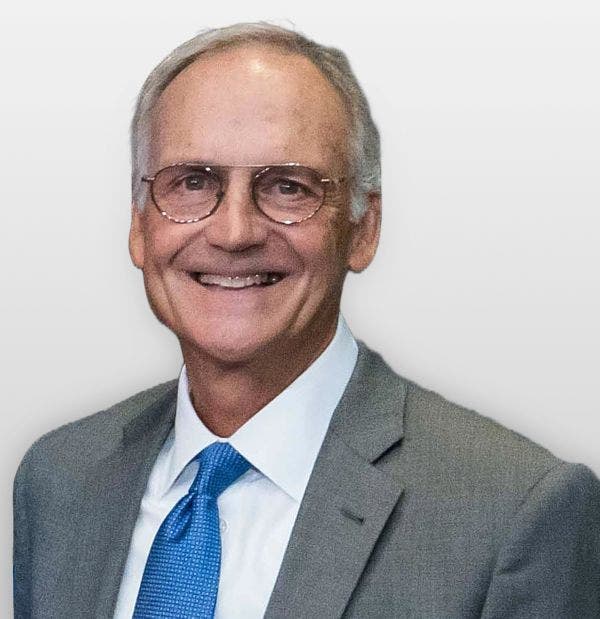
Arrow Electronics Interim CEO William “Bill” Austen said the end of the distribution agreement between Dell Technologies and his company’s Enterprise Computing Solutions distribution unit will not have a material impact on the 2026 or 2027 financial results of the $30.9 billion company.
“It’s insignificant for us,” said Austen (pictured) in an interview with CRN. “The profit contribution from that is immaterial for Arrow Inc.”
In fact, Austen said, the end of the ECS relationship with Dell has “no impact on our 2026 business, and it’s immaterial for 2027, and it will be replaced with new business that’s already in the pipeline.”
[Related: Dell Technologies Terminates Enterprise Computing Distribution Deal With Arrow: Sources]
Austen’s comments came after the company’s shares dropped precipitously after CRN reported on June 25 that Arrow had received notice that Dell was terminating its partnership with Arrow ECS.
At the time, Arrow refused to comment on the end of the 10-year relationship with Arrow ECS, which came just one year after the distributor was honored as Dell Technologies’ North America Distributor of the Year.
Dell also declined to comment.
Arrow’s shares dropped from $224.77 on June 24 to $206.41 on July 10, a loss of approximately $940 million in market capitalization.
Acknowledging the “stir” among the company’s investors in the wake of the end of the Dell-ECS relationship, Austen stressed that the change only impacted a relatively small part of Arrow’s revenue and that the two companies still have a strong relationship via the distributor’s OEM and components businesses.
“We still value Dell as a supplier and as a customer in both other parts of our business, like global components and our solutions business,” Austen said.
Dell made the decision to move on from Arrow ECS after a formal review of its North America distribution business that included detailed requests for proposal (RFPs) from its four North American distributors: Arrow, D&H Distributing, TD Synnex and Ingram Micro.
Anthony Tanoury, Dell Technologies’ senior director of channel sales distribution, told CRN in May at Dell Technologies World that “part of the RFP” is what kind of investment the distributors were making in the Dell go-to-market.
Tanoury said the RFP included nine criteria in “many different areas” and that the company met with each of the distributors. “We went through a thorough process,” he said.
Austen, for his part, said his company still values its Dell relationship.
“Our strategy in ECS was not in alignment with the RFP, so it was a conscious decision on our part,” he said. “The way that we responded to the RFP, we still value Dell.”
Arrow Focusing On Value-Added Infrastructure Business
Arrow’s strategy for its ECS business is focused on higher value-add solution offerings in cloud, hybrid cloud, AI, cybersecurity and services, not hardware, Austen said. Only 25 percent of Arrow ECS’ business comes from hardware, while 75 percent comes from software and services, he said.
“We are transacting ECS across our ArrowSphere [multi-cloud services] platform,” he said. “There are over 8,000 transacting partners in ArrowSphere today. We manage over half a billion subscriptions through that platform. The Dell business is not in our ECS strategy, but it’s in strategies in other parts of our business, and we still enjoy a great relationship with Dell in other parts of the business.”
Distribution sources told CRN the dissolution of the Dell-Arrow ECS relationship creates a $1.4 billion to $2 billion opportunity for Arrow’s rivals to chase.
Austen said he and his team have been working with investors and sell-side analysts to ensure they understand that the changed relationship with Dell does not have a major impact on Arrow’s business. He said the actual annual net revenue from Dell via Arrow ECS was $700 million.
For the year ended Dec. 31, 2025, Arrow Electronics reported gross profit of $3.46 billion on a 10 percent increase in sales to $30.9 billion.
Arrow Global Enterprise Computing Solutions, meanwhile, for the same period reported non-GAAP operating income of $430 million on an 18 percent increase in sales to $9.35 billion.
“We have a tremendous amount of tailwind with both ECS and our global components business today, with the way the business has been positioned, the strategy that’s being executed, the execution of the teams that are out there,” Austen said. “And if you look at the wave that we’re riding, not just AI, but aerospace and defense, industrial and the re-emergence of transportation, we are parked both in global components and ECS right in the center of all that, and we’re doing quite well.”
Eric Nowak, president of Arrow’s global ECS business, told CRN that ECS’ Dell business will be replaced by sales of products from other vendors, noting that Arrow ECS continues to add new vendors to its line card.
“So basically, the sum is zero as every year we have new vendors coming and leaving, and so we compensate with this,” Nowak said. “A lot of partners continue to do projects with us. If they want some storage, and we don’t have Dell, they will take something else. We have a lot of other storage vendors. And of course the resources that will not be [focused] on Dell anymore will be repurposed for something that is more in line with the strategy with our high growth potential. So all of this means that basically we have a plan to replace this business with other business or with new business.”
Dell, Arrow Strategies Are Diverging
The strategies of Dell and Arrow ECS are diverging, Nowak said.
“It was pretty clear that Dell wants their distributors to do the full range of products, including the PCs, laptops, small servers,” he said. “We don’t do that. We just can’t. It’s not our strategy. This is not our DNA. We never did that. And we’ll never do that. We say we are an infrastructure player. We’ll tell you 75 percent of our business is software and services and cloud, 25 percent is hardware. We are still growing the hardware business in dollars every year, but with storage, with networking, with security. Not PCs. Not laptops.”
Dell wanted Arrow ECS to focus on SMB, and that was not in line with the Arrow ECS strategy, Nowak said.
“We are a midmarket player,” he said. “It’s more complex solutions, with different kinds of partners, focusing on the midmarket [and] infrastructure, and so we said several times that, ‘No, we can’t do that,’ and so we consciously decided to answer [if Dell wanted to] continue to work with us, it will be on the infrastructure side only, not the rest.”
There is still value in Dell and Arrow working together in other ways, Austen said. “Our strategy is different than what they wanted,” he said. “We still continue to value what we do for them in other parts of our business, and they value us for what we do for them in the other parts of the business.”
That includes Dell and Arrow ECS working together in Europe, Nowak said. “It’s a different landscape in Europe,” he said. “They probably need people that are focusing on the infrastructure.”
Arrow ECS does not expect any of its channel partners to stop working with the distributor because of the change in the Dell relationship, Nowak said.
“Today there are zero partners that are just doing one line with us,” he said. “These guys will do a bit of Palo Alto [Networks], Dell, IBM, HPE. Most of them have commitments with us in terms of volumes. They cannot buy Dell from us next year. Well, they will buy something else that we have. We have a very large catalogue, and so they will pick and choose what makes sense. And we are focusing on, once again, infrastructure, software, cloud and so on. And what we do in terms of hybrid cloud is try to help all vendors and our partners to make the connection to the cloud and hybrid cloud. … So we do not expect to lose even one partner.”
The View From Raymond James And Bank Of America Securities
Financial services firm Raymond James said in a report that the agreement between Arrow ECS and Dell North America was likely ended because of the product mix.
“The agreement was primarily focused on laptops and peripherals, largely supporting Asia—a lower-margin business that is no longer strategic for Arrow. We suspect that Dell was seeking price concessions, which would have materially reduced the economics of the relationship,” according to the report.
Because of its other vendor relationships, Arrow is unlikely to lose the entirety of the opportunity represented by Dell, according to the report.
“Our worst-case scenario suggests an impact of less than two percent of FY27 operating income, but we think this scenario could prove aggressive. Assuming that ECS billings converts to 50 percent of sales (it was lower last year), and that [Arrow] is unable to redirect Dell-related demand to alternative suppliers, Dell business [will] likely generate depressed margins, potentially in the 2 [percent] to 3 percent range. Our base scenario assumes an annual operating income impact of $20 million [approximately] (1 percent of FY27 operating margin), but could be as low as $12 million,” the analyst firm wrote.
Another analyst firm, Bank of America Securities, also expects a minimal impact to Arrow’s financials.
“We would size the annual revenue impact to [Arrow] at $600 [million to $700 [million] and annual EPS [earnings per share] impact at [40 cents to 50 cents]. This represents about 2 [percent] of consensus EPS estimate of $21.60 for [Arrow] for 2027. Also, we would expect a gradual disengagement, likely over the remaining [second half] of 2026. So, the impact to 2026 earnings is even less,” Bank of America wrote.
Steven Burke contributed to this article.