CEO Paul Bay: Ingram Micro Wants To Be The Business Behind Its Partners’ Business
‘We’re going to continue to invest ahead of the curve. We appreciate what you’re doing. You don’t have to go it alone. We’re here for you. We want to be the business behind your business and help you continue to grow and become more profitable,’ says Paul Bay, Ingram Micro CEO.
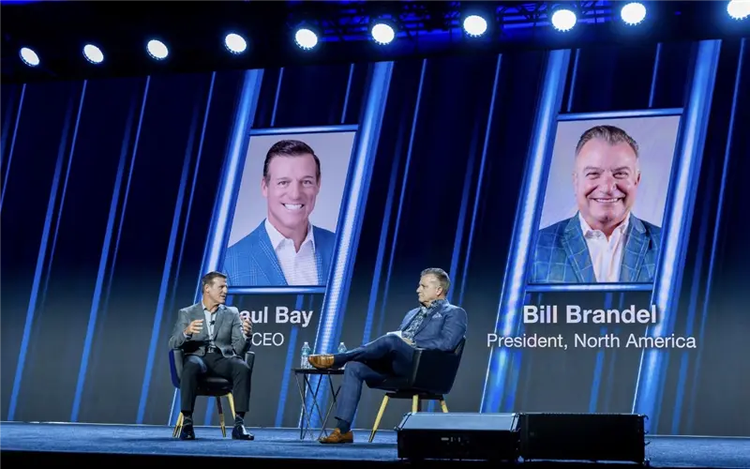
Ingram Micro is positioning itself as an extension of its partners’ business, investing in intelligence, automation, AI expertise and operational capabilities to help solution providers pursue growth while managing risk.
That was the message from CEO Paul Bay, who told partners at its One conference in Denver last week that they do not have to build every capability themselves as customer demands and technology markets become more complex.
“You don’t have to go it alone,” Bay said. “You don’t have to build every capability. Lean on us for what we’re building.”
The Irvine, Calif.-based distributor is continuing to invest on partners’ behalf, he said, while redeploying operating expenses to shift from a reactive model to a proactive one.
For partners, Bay emphasized services, operational excellence, AI, cybersecurity and cloud as areas for investment. He urged solution providers to build on their customer knowledge and turn that insight into repeatable intellectual property, while focusing on customers’ business problems rather than selling individual technologies. And as vendors recognize that their products are only part of a broader solution, Ingram Micro is working with them to bring together the products, services and transaction models needed to serve midmarket and SMB customers.
AI is also a major opportunity, but Bay cautioned treating it as a quick technology overlay or an efficiency tool. Ingram Micro’s own investment has moved from establishing a connected, automated platform and cleaning up global data to using that foundation to generate intelligence, identify demand and drive action.
The company is also investing in technical resources, including forward deployed engineers, and plans to become “customer zero” with major hyperscalers by using their technologies internally.
MSP partner Bill Blum said Ingram Micro’s renewed emphasis on partner relationships and investments in technology is “a positive shift” as the company heads into 2027.
“I am very, very happy that they’ve decided to work on personal relationships,” Blum, founder and CEO of Bound Brook, N.J.-based Alpine Business Systems, told CRN. “The lines of communication have opened up dramatically over the past three or four years, and even more so over the past six or eight months. It feels different. It feels more like a relationship.”
He also highlighted Ingram Micro’s Xvantage platform and its MCP server as important investments, saying the technology has helped his company work more efficiently and get things done faster.
“The Xvantage platform is fabulous. And the MCP server is just a game-changer for us in a lot of ways. We’re able to get things done so much faster,” he said.
Ultimately, Bay said success should be measured by whether Ingram Micro makes partners’ businesses simpler, safer and more profitable.
“When you win, we win,” he said.
Bay was joined on stage by Bill Brandel, Ingram Micro’s executive vice president, president, North America to discuss AI, future investments and how partners can further lean on Ingram Micro.
Brandel: During the last earnings call, you talked about Ingram Micro helping customers grow without taking unnecessary risk. What does that mean, particularly for partners in the distribution channel?
Bay: We had one of our best revenue growth performances, but more importantly, the North American business is back. Bill and the team in North America actually delivered the highest growth rates from a company perspective, and it’s been a few quarters since we’ve seen that.
It all comes down to something I’ve talked about on both the most recent earnings call and at Capital Markets Day: putting the customer in the middle. That’s how we build our strategy. One of the things we talk about is how we invest in that curve and how we make those investments on your behalf. We’re going to continue doing that. That’s our commitment.
We’re also making investments in enablement and operational excellence. And as Bill mentioned, we’re not necessarily adding a lot of operating expense. We’re redeploying that expense, moving from reactive to proactive, and that’s critical for us. If you’re looking to get into new markets or new technologies, continue to focus with us and we’ll help support that journey.
The other thing I get asked all the time is where we see growth. The good news is we’re seeing growth across all technology categories right now: server, storage, networking, cyber, PC, AI infrastructure and cloud. Cloud continues to perform very well, and we’re seeing nearly double-digit growth across the categories.
So where are the opportunities for all of you? You have to continue focusing on services. What services have you built? What competencies are you looking to develop? Operational excellence is another area. Lean on us for what we’ve gone through because we’re making significant investments to help you.
I’d also point to AI, cybersecurity and cloud. Those are real growth opportunities. With all the constraints in the market, the reason we’re seeing growth across so many areas is that your end users are on different journeys. Some are refreshing, some are building out new environments and others are looking at entirely new technologies.
My key point is, tell us what you need. We’re going through that process right now and we’re going to listen. That’s how we create our strategies and determine where we’re going to invest.
Brandel: AI creates an enormous opportunity, but it’s also a complicated technology. How do you turn AI from interesting technology into revenue?
Bay: First and foremost, I would tell you that the channel is even more critical when it comes to developing AI solutions. And for us, I think it’s important to understand the investment curve. There are really two phases.
The first phase was about automation and connectivity. We spent that first year getting the data clean on a global basis so we could ultimately create those signals. That has allowed us to get to the second phase, which is the intelligent operating model. That’s really about using that foundation to manage the business differently. How do we get to proactive demand for all of you? How do we create actions and deliver outcomes? Without that first phase, we wouldn’t be able to get to the second. We now feel really good about how we can help you become a better business partner.
We’re moving from being reactive to being proactive and creating actions and outcomes for you. And one of the key things I think we need to look at is this: AI is the capability. Intelligence and business advantage are your differentiators. Don’t think about AI simply as an efficiency tool. There’s still a huge need for security, governance and risk mitigation. Those all remain central to where we are.
And the last thing I’d say is that this isn’t a big-bang approach. It’s about practical applications, productivity, data and automation, ultimately getting to more demand generation and outcomes.
Brandel: After 47 years in business, what’s the simplest way to explain what you want customers to benefit from?
Bay: Simply put, grow with us, or lean on us to help you grow your business profitably at the lowest possible risk. That’s what we’re focused on. When you win, we win. How do we help you generate a better business that’s more profitable?
When you’re looking at AI, you can’t just build tools on top of what you’re already doing. It’s hard to monetize that. Sometimes it takes a journey-mapping exercise, looking at everything from an end-to-end perspective. I’d say embrace the technology. How do you free up your people so they can scale?
A good example for us is MCP, or Model Context Protocol, and the intelligence we have behind it. But there’s a difference. Everybody’s going to talk about MCP, and we’re going to have a little bit of word Bingo going on in the industry. Our differentiation is that it connects securely, it’s managed, and it gives your agents access to that data and intelligence.
Everybody is going to talk about MCP, whether it’s Ingram Micro or others. But there’s a differentiated experience we’re driving here. It’s about that secure connection and giving agents access to global intelligence and data.
At the end of the day, the real value is simple. Are we taking friction out of your business? Are we helping your teams actually serve your customers and your end customers better?
Brandel: As the roles in our industry continue to blur, where do you need partners to invest and add the most value?
Bay: First, your customer knowledge is your advantage. How do you turn that insight into repeatable intellectual property? And yes, the lines are blurring. I want to be clear about that because I’ve been talking about it for a long time. What that means is we’re trying to help you deliver outcomes. We’re here to enable your business, and we want to make sure we’re focused on that. We’re going to continue making those investments.
At the end of the day, you’re the trusted source for those end users and your businesses. So continue to focus on the business problems and the full solution, not just the technology needs. I think we’re getting better as an industry, but we’ve got to continue focusing on that. Ingram Micro can bring that entire ecosystem together for you and augment the areas where you may not have the expertise.
Another important development is that vendors understand now, more than ever, that they’re just part of the solution. I wouldn’t have said that on stage three or four months ago, or maybe even before COVID. They’re now recognizing that they’re part of the solution, not the entire solution. That’s critical.
I have conversations weekly, and certainly monthly, with the senior-most executives of our vendor partners about how we can work together to reach the midmarket and small and midsize businesses. That’s where you have tremendous value and the ability to scale. The SMB and midmarket opportunity is critical for all of us, and we want you to capitalize on it.
Brandel: Many partners want to expand into new markets and technology areas but don’t necessarily have the resources or expertise. How is Ingram helping them make those investments?
Bay: First and foremost, I think investments are all relative. I don’t care if you’re a company approaching $60 billion like Ingram Micro, or you’re a $1 million or $5 million solution provider. The investments are all relative to your business.
I mentioned we’re in the middle of budgeting right now and going through the process of where we’re going to place our bets. We’re going to invest in you. I’ll give you a couple of examples. We have great use cases around our Enable AI tool. One of the encouraging things is that we’ve gone through the initial phase of people understanding the training and ultimately getting to outcomes. We’re seeing more opportunities coming through the front door and progressing. I would say lean on us to support you. Look at those use cases as we help support your journey.
Another good example is the hyperscalers. We’re going to be customer zero with all the big hyperscalers. What that means is we’re using that technology ourselves. We have the right skill sets, we’re making the right investments and we have people using those technologies inside our company. We’re going to do that across the board.
The other thing that’s critical, and it’s not inexpensive because of the resources, skills and certifications involved, is our forward [deployed] engineer model. We’re in the process of co-investing with the hyperscalers to put those technical resources closer to your end users, on your behalf. That’s an investment we’re going to make this year. At the end of the day, use our scale as an extension of your business. Whether it’s cybersecurity, cloud, data center or AI, across the entire stack, we want to help you get there.
And as we’re looking at that forward [deployed] engineer model, look for us to reach out to a handful of partners to see if there’s an opportunity to work together as we build out those skill sets across the hyperscalers.
Brandel: When we come back together next year, what do you hope customers will say is fundamentally different about doing business with Ingram Micro?
Bay: First and foremost, foundation and trust. Relationships matter. That human aspect of it is important. We’re making these investments to free up time so we can do more with you. We want to spend more time with you and continue building the trust and relationships we have.
But I’d say there are really four simple things. If you come up to me next year, or throughout the year, I want to be able to ask you four questions. First, have we reduced the complexity and risk of your business? Second, are you using our intelligence to make doing business easier? Third, are you growing faster and, more importantly, are you making more money? And lastly, are we an invaluable extension of your company?
When you come up and say, ‘Paul, your team, the representative I talk to every day, is an invaluable piece of my company,’ that’s what I want to hear.
We’re going to continue to invest ahead of the curve. We appreciate what you’re doing. You don’t have to go it alone. We’re here for you. We want to be the business behind your business and help you continue to grow and become more profitable.