Halo CEO On Global Expansion, Hiring And Taking On The Competition: Our Mission Is ‘Better’ Value, ‘Higher Standards’
“People sometimes assume we’re doing something radically futuristic, but honestly, we’re just looking at what exists and asking, ‘Can we do this better, with more care and higher standards?’” says Halo founder and CEO Paul Hamilton.
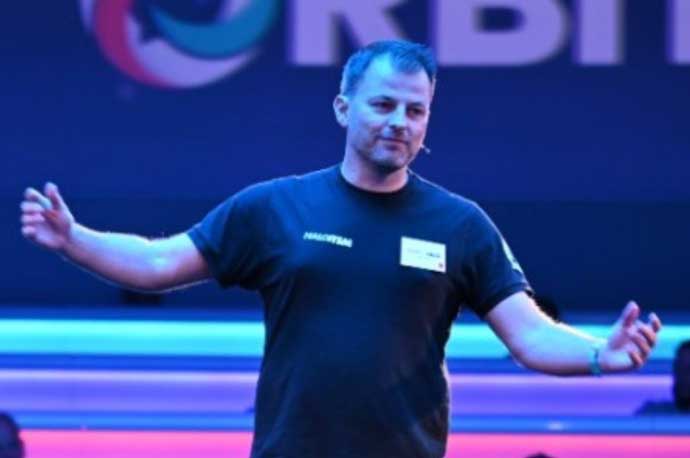
Halo’s Paul Hamilton is not short on ambition. From recently moving headquarters to a larger, more iconic space to hiring hundreds per year to taking on competitors, Hamilton’s vision is to stay lean, stay focused and deliver value for the partner.
“Obviously, the big driver is continued growth,” Hamilton, founder and CEO of Ipswich, U.K.-based PSA vendor Halo, told CRN in an interview. “The building we’re in today is about 15,000 square feet and we’ve got around 170 to 180 people working in it. We’re basically out of room already. We’re planning to recruit another 800 graduates in Suffolk by 2030, so we needed a building that could actually support that kind of growth. The property we’ve acquired is 220,000 square feet and gives us space not just for the next few years, but for decades.”
But it’s about more than square footage. The building, he said, represents what Halo is trying to achieve.
“It’s probably the most iconic office building in the U.K. outside of London,” he added. “It’s a Norman Foster design, and they just don’t build offices like that anymore. It’s a timeless building. It’s just had its 50th anniversary and when we talk about it internally, we’re talking about the next 50 years. That’s not something you hear often in software. Most software companies are thinking about the next quarter or the next exit. We’re committing to a building of this scale and saying, ‘This is where Halo grows for the long term.’”
Today, Halo employs about 250 people worldwide with teams in Florida, Seattle, Dubai and Melbourne, Australia. In the U.K. alone, the goal is to reach about 1,000 employees by 2030 with an additional 500 globally. The next region taking off for the vendor is Latin America, with customers now in Mexico and Brazil.
“Emerging markets really resonate with our value proposition,” he said.
Hamilton is taking on the competition as well, saying while older players in the space “all do similar things,” Halo is younger and more agile.
“The real difference isn’t just the technology,” he said. “It’s the business model, the relationships and how we operate.”
Looking ahead, product investment is focused on expanding practical AI capabilities rather than hype-driven features. Customers can expect “a lot more agentic AI use cases and big improvements in how customers build and manage agents,” alongside a major push into enterprise-grade configuration management.
“This is probably the last major functional gap between us and ServiceNow for tier-one enterprise,” he said. “By the end of 2026, we expect to be ahead.”
CRN spoke further with Hamilton about Halo’s pricing strategy, AI investment and why the company continues to reject private equity even after receiving offers, including one that valued 50 percent of the business at $1 billion.
How do you balance staying lean while expanding globally?
It’s quality over quantity, especially when it comes to partners. About 20 percent of our revenue now comes through MSP partners. Two years ago, it was probably 5 [percent] to 10 percent. People sometimes assume we’re doing something radically futuristic, but honestly, we’re just looking at what exists and asking, ‘Can we do this better, with more care and higher standards?’ In terms of pure functionality, platforms like ServiceNow, Kaseya or ConnectWise all do broadly similar things. Our tech stack is newer, seven or eight years old instead of 20, but the real difference isn’t just the technology. It’s the business model, the relationships and how we operate.
You’ve reduced prices as you scale, talk to me about that.
As we grow, our cost per customer goes down. Infrastructure costs drop as we spend more with AWS. Engineering costs don’t double as customers double; they stay relatively constant. Instead of taking that efficiency and increasing margins, we’ve chosen to keep margins stable and pass the savings on to customers.
We’ve literally sent invoices where customers got a nice surprise … their costs went down. We’ll do it again at $250 million in revenue, then at $500 million, $750 million and again at $1 billion. No SaaS company has ever done that before.
So where does Halo stand financially today?
At the end of 2025, we were at about $160 million in revenue. Last year we grew just under 60 percent, and the years before that averaged closer to 100 percent. The market’s tougher right now, but that actually creates more opportunities for us because customers are reassessing spend.
Are acquisitions part of the strategy?
No. We’re not acquiring anything. Our growth is completely organic.
What are MSPs asking for around AI?
There’s obviously a lot of noise around agentic AI. We’re cautious because we want to see real ROI before pushing hype. We do have agentic AI functionality live, and we were one of six vendors selected for Gartner’s Magic Quadrant for AI Applications in IT Services Management. But our industry has been automating for decades already; the gains aren’t as dramatic as in other sectors.
How do you decide what not to build?
Our road map is customer-driven. We work with MSPs of all sizes and we’ve structured the business so different teams focus on small, midmarket and enterprise customers. And each has its own road map and development resources.
We’ve never abandoned smaller MSPs, even as we’ve moved upmarket. The platform works for any size, it just needs configuration tuning and that’s what we help with.
What have you learned competing with older PSA vendors?
The lack of agility is honestly surprising, and development moves incredibly slow. But we don’t obsess over competitors. We focus on customers, and our partners are often the best filter for what makes sense and what doesn’t.
Over the years, you’ve been adamant about staying privately held. Why stay private when PE capital is flooding the market?
We get offers all the time. Last year, we were offered $1 billion for 50 percent of the business. But the moment you take that money, everything changes. Prices go up and culture changes. The thing that makes Halo special—the care, the speed and the relationships—that all gets diluted.
Private equity strategies don’t work in the long-term interest of customers. We think infinitely and we’re building for the next 50 years, not the next three. We’re a cash-rich business. We’ve got cash invested and if we wanted to deploy accelerators or even do an acquisition, we could. We do sometimes think about acquisitions when we lose a deal because a customer wants a single-vendor model. Some organizations see multiple vendors as a cybersecurity or compliance risk. But If we acquired vendors just to become single-vendor, we’d destroy our best-of-breed partnerships. That would ultimately hurt customers so we’re happy with the strategy we’re on.
Do you still plan to bring your Halo Orbit conference to the U.S. in 2026?
No announcements yet, but yes that’s still the plan so watch this space.
What should partners expect from Halo’s 2026 road map?
You’ll see a lot more agentic AI use cases and big improvements in how customers build and manage agents. The other major focus is configuration management for large enterprises. Historically, only one team could really manage config changes. We’re changing that so multiple teams can work independently, with their own testing and release tracks. This is probably the last major functional gap between us and ServiceNow for tier-one enterprise. ServiceNow’s been better here historically, but by the end of 2026, we expect to be ahead.
We want customers to demand more. Raise the standards. If someone uses our proposal to get 50 percent off from their existing vendor, we’re fine with that. It pushes the market toward better value. That’s our mission: better value, higher standards and doing things differently, even if it looks strange at first.