Infosys CEO: AI Driving Business Growth
‘We bring together a deep understanding of clients’ technology landscape, strong data engineering, and process reimagination capabilities to help them capture value at scale from AI. We aspire to make AI work for clients, delivering business outcomes for cost, revenue growth, and innovation,’ says Infosys CEO and Managing Director Salil Parekh.
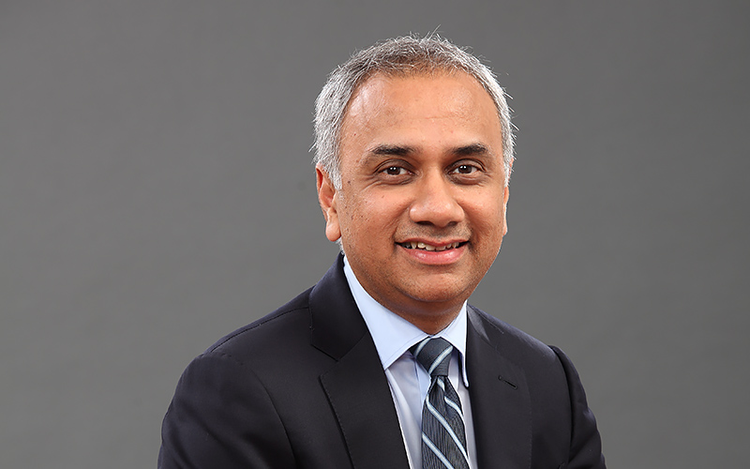
AI is quickly becoming a key focus in the growth of Infosys, the company’s CEO told press and analysts
Salil Parekh, CEO and managing director of Bengaluru, India-based digital services and consulting giant Infosys, also said that his company has deepened relationships with its largest global customers.
Parekh, during his prepared remarks during Infosys’ third fiscal quarter 2026 financial conference call, said Infosys has expanded its strategic partnerships with AI companies, including most recently with Cognition, the San Francisco-based developer of the Devin software agent.
[Related: Infosys Buying Texas, Australia Companies In IT Services Push]
“We will combine Cognition’s Devin software agent with Infosys’ knowledge of the client landscape and industry expertise,” he said. “We are already working with them across clients.”
The third quarter also saw Infosys, ranked No. 8 on CRN’s Solution Provider 500, increase the company’s Topaz AI capability with an agent services suite called Topaz Fabric, which Parekh said helps clients manage and implement AI agents across the enterprise.
“We had strong momentum in AI adoption across our client base,” he said. “Today, we work with 90 percent of our 200 largest clients to unlock value with AI. We’re currently working on 4,600 AI projects. Our teams have generated over 28 million lines of code using AI. We built over 500 agents. We are scaling our forward-deployed engineer team.”
Parekh said Infosys’ clients are seeing the solution provider as a trusted partner to drive value realization from AI investments.
“Some of the areas they focus on are fragmented data, legacy application landscape, and business workflows that are not conducive for AI,” he said. “We bring together a deep understanding of clients’ technology landscape, strong data engineering, and process reimagination capabilities to help them capture value at scale from AI. We aspire to make AI work for clients, delivering business outcomes for cost, revenue growth, and innovation.”
Infosys sees what Parekh said are six AI-led value pools that could unlock a significant incremental opportunity for the company:
- AI engineering services
- Data for AI
- Agents for operations
- AI software development and legacy modernization
- AI and physical devices
- AI services
“We believe we are uniquely positioned to capture market share across these value pools and emerge as the leading AI value creator for global enterprises,” he said.
Large deals with customers are helping lead Infosys’ growth, Parekh said. He said that, during the quarter, the company signed 26 large deals that were valued at a total of $4.8 billion, with 57 of that revenue being net new. He cited as an example a $1.6-billion deal with the U.K.’s National Health Service in the U.K. that expands Infosys’ work in the healthcare sector by helping NHS leverage AI to streamline operations and improve patient care for U.K. citizens.
During the conference call, when asked how he views the productization of Infosys’ AI initiatives relative to AI and agentification, Parekh said that agents are very much a big play thanks in large part to the company’s Infosys Topaz, the company’s AI-first technology for leverage generative AI.
“We are absolutely on the forefront of that,” he said. “What we have built within Topaz is Fabric, Topaz Fabric we called it, a set of purpose-built agents which work with many different native AI companies’ interfaces and can support a lot of different functions within clients, horizontal and vertical. That suite is going to be our agent suite. Then there are agents of the other companies which we will integrate, implement, expand, make it work because we know the tech landscape of a client and we know the industry depth.”
In terms of productization, Infosys has built four small language models in its product suite.
“We are going to do small language model work,” he said. “We will do other things. For example, there are a set of AI wrappers or orchestration modules that we can build which will enable clients to switch between foundation models, switch between agents, do a selection of agents. So that’s a different type of product platform, which is all in Topaz. So that is the way we are thinking about it today.”
Infosys By The Numbers
For its third fiscal quarter 2025, which ended December 31, Infosys reported revenue of $5.10 billion, up 1.7 percent over its third fiscal quarter 2024 revenue of $4.94 billion. That beat revenue expectations by $70 million, according to Seeking Alpha.
The company also reported net profit of $747 million or 18 cents per share, down from last year’s $804 million or 19 cents per share. On a non-GAAP basis, Infosys reported net profit of $855 million or 21 cents per share, up from last year’s $804 million or 19 cents per share.
Non-GAAP earnings beat analyst expectations by 1 cent per share, according to Seeking Alpha.
Looking ahead, Parekh said Infosys has increased its fiscal year 2026 guidance to reflect expected revenue growth of 3.0 percent to 3.5 percent compared to its previous forecast of 2.0 percent to 3.0 percent growth. The company also expects operating margin guidance for the financial year to remain unchanged at 20 percent to 22 percent.