Pax8 CEO Scott Chasin: ‘Businesses Will Increasingly Become Agent-Powered Organizations’
‘Today we’re seeing partners deploy AI and charge based on outcomes, cost savings or productivity improvements. There’s also an opportunity around managing and routing agent traffic to different models. Then there’s recurring revenue from managing agents and AI orchestration. Ultimately, I think the model becomes a blend of consumption fees, management fees and outcome-based pricing,’ says Pax8 CEO Scott Chasin.
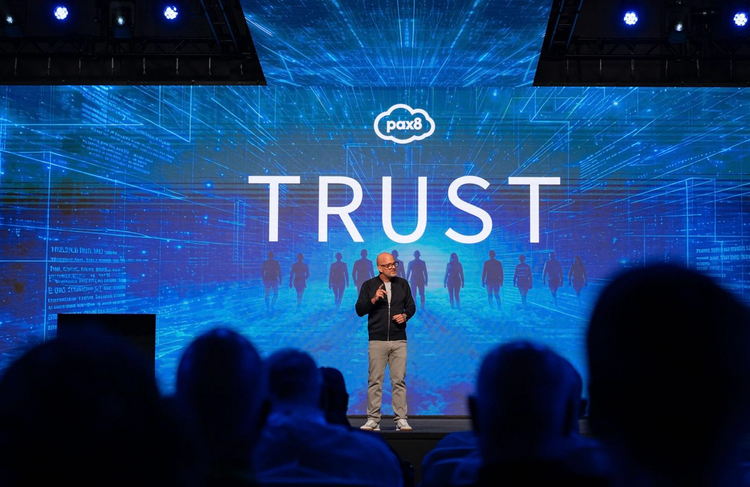
Chasin said that the industry is moving beyond generative AI as a tool for content creation and entering what he calls the era of “useful AI,” where agents take actions, automate workflows and operate as always-on digital employees.
“We’ve gone from instant access to knowledge, to reasoning and now we’re moving into taking action,” Chasin told CRN. “The usefulness of AI is the new exponential. We’re finally seeing agents that can use tools, perform work and actually do things. That’s changing everything.”
Rather than viewing AI as a replacement for workers, Chasin said MSPs should see it as a way to eliminate repetitive knowledge work while creating new service opportunities around governance, orchestration, security and cost optimization.
“Every employee is going to have an agent assigned to them,” he said. “Those agents will understand preferences, context, likes and dislikes. They’ll act as representatives inside a new agent workforce. Then those agents will interact with task-based agents that automate workflows and processes across the business.”
That shift creates a new recurring revenue opportunity for MSPs, he said.
“We see this as the first real rinse-and-repeat management opportunity on the path toward becoming a managed intelligence provider,” he said. “By the end of 2026, I believe we’re going to see the first real large-scale go-to-market motions around agentic deployments inside SMBs.”
CRN spoke further with Chasin about where MSPs should focus first, how partners can monetize AI management services and why AI governance and token optimization will become critical disciplines.
In your keynote, you mentioned that about 400 million SMBs will need help managing AI, but there are only about 90,000 qualified MSPs. Where do you see the biggest near-term opportunities for MSPs to capture that demand?
It’s agentic AI. When you think about the evolution of AI over the last couple of years, we’ve gone from instant access to knowledge, to reasoning capabilities that emerged last year, and now to taking action, using tools and actually doing things. The way I characterize it is that we’re moving into the era of useful AI. Software engineering is a great example. We’ve finally seen agents and frameworks that wrap around models, use tools and are now very capable at coding. That has changed everything.
We’re now at a point where anybody can build almost anything, and that’s just the beginning. The usefulness of AI is the next exponential curve. Businesses are looking at AI to transform operations process by process and workflow by workflow. The first step is automating knowledge-work drudgery. The second step is persistent, proactive AI. At the end of last year, we saw some of the first real examples of agents that could access email, calendars and contextual data. These agents are now being deployed everywhere.
For Main Street and small businesses, this is one of the first truly useful applications of AI. Think of it as a staff member that filters out the noise and brings you the signal. We’re moving from humans prompting AI to AI proactively helping humans. The vision is that every employee will have an always-on agent assigned to them, scoped to their identity and context. It will understand their preferences and interact with workflow agents that handle tasks and business processes. Businesses will increasingly become agent-powered organizations. For MSPs, this represents the first major rinse-and-repeat opportunity on their path to becoming managed intelligence providers.
You also talked about helping partners manage AI consumption as the next major commercial model. How do you see MSPs monetizing AI management in ways customers will understand and value?
First, it’s important to understand that intelligence is based on tokens, the currency of AI. Tokens represent the work AI performs, whether it’s reading, writing, reasoning or taking action. Cost optimization is critical. What’s unique right now is that frontier models are becoming incredibly sophisticated, but you don’t need a massive frontier model to summarize an email or manage a calendar. That’s where open-source models become a major opportunity.
We’re seeing open-source models perform extremely well on routine knowledge-work tasks. The opportunity for MSPs is understanding customer requirements and creating policies that determine when to use open-source models and when to route workloads to premium models for more complex tasks. The ability to orchestrate and route workloads across different models will become a very important management function for service providers. As businesses adopt agent-based architectures, every task, workflow and process will require orchestration, governance and security. Managing all of that becomes a significant opportunity.
Where do you think the revenue model ultimately lands? Is it optimization, governance or something else?
I think it’s a combination. Today we’re seeing partners deploy AI and charge based on outcomes, cost savings or productivity improvements. There’s also an opportunity around managing and routing agent traffic to different models. Then there’s recurring revenue from managing agents and AI orchestration. Ultimately, I think the model becomes a blend of consumption fees, management fees and outcome-based pricing.
You mentioned that Pax8’s Agent Gateway helps partners manage costs, credentials and governance. What specific MSP pain points are you trying to solve?
Every business is becoming a consumer of AI, not just through frontier models. There’s a significant opportunity to optimize how AI gets used. Agent Gateway allows all agent communications and token activity to flow through a centralized layer. That gives partners the ability to create optimization policies across all their customers.
The last thing you want is for a customer to adopt AI and then get surprised by a massive token bill. Policy management and orchestration solve that problem. Credential management is another major challenge. Every business is effectively becoming an API company. We’re already seeing examples where credentials are exposed through prompt injection attacks and other vulnerabilities. Securing those interactions is critical. This creates a huge opportunity for MSPs to package optimization, governance, security and orchestration into repeatable service offerings.
How do you see the MSP role evolving from selling software to orchestrating models, agents and AI budgets?
We believe management gets elevated as a new generation of AI-native partners is emerging. These businesses are starting with customer No. 1 and focusing entirely on delivering AI and agents to SMBs. They don’t have legacy infrastructure or legacy thinking.
That represents a massive opportunity, not only for those AI-native firms, but also for existing MSPs that evolve into managed intelligence providers. If every one of the world’s 400 million SMBs needs to become AI-enabled to remain competitive, somebody has to help rewire those businesses.
What’s the first capability MSPs should build internally to become trusted AI advisers for customers?
The first step is awareness and education. I’ve been sounding the agentic AI alarm bell for two years. MSPs need to understand the opportunity and understand the landscape. For some partners, that means completely rethinking their journey toward becoming a managed intelligence provider.
Many MSPs I talk to say they struggle with explaining AI and demonstrating ROI. So is this really a technology problem, or is it a mindset problem?
I think it’s largely a mindset challenge. One of the side effects of early AI adoption is what I call ‘knowledge pollution.’ We studied employees using AI and found email activity up 82 percent, document creation up 45 percent, and meeting invites increasing significantly.
We’re producing more content than ever before. At the same time, vendors, recruiters and businesses are increasingly using AI-powered outreach. Employees are being overwhelmed by both internal and external information. That’s where always-on agents become important. They act as filters and firewalls, surfacing the signal and eliminating the noise.
Knowledge pollution is real, and it’s one of the strongest arguments for deploying personal AI agents that work on behalf of employees. Every human will eventually have an agent, and that creates another major management opportunity for MSPs.
Why do you want to be the partner guiding MSPs through AI transformation?
It starts with trust. For years we’ve helped partners identify and deliver the best solutions for their customers. What we’re doing now is simply extending that responsibility into AI. We see a tremendous opportunity to help our partners succeed. More importantly, we’re advocating for an industry that serves the underserved.
Many large vendors focus on the biggest enterprise accounts. We focus on SMBs and the partners that support them. Our role is to help define what’s next, ensure the broader market understands what’s happening and position the channel for success as AI adoption accelerates.
If partners take one practical lesson from this event and implement it immediately, what should it be?
Education and action. We released a new SMB workforce report because partners need actionable guidance, not more noise. Last year, we introduced the Managed Intelligence Playbook. This year we’re focused on task-based agents, workflow transformation and the emerging concept of always-on agents.
Partners need to understand these opportunities and begin discussing them with customers now. The technology is moving quickly, the governance tools are improving, and the vendor ecosystem is maturing. The opportunity is here.
If a partner starts today with the Managed Intelligence Playbook, where would you like to see them one year from now?
I’d like to see them move beyond customer zero. Many partners are experimenting with AI internally, and that’s important. But the real opportunity starts when you move from customer one, to customer 20, to customer 50 and beyond. My message is simple: Don’t spend too much time on customer zero. Get in front of customers and explain the opportunity. Use AI to scale your own business.
I believe in human-centric AI. A year from now, I hope partners have moved far beyond internal experimentation and are actively helping dozens of customers transform their businesses.
As AI automates more work, do you believe human connection becomes even more important?
Absolutely. One of the greatest competitive advantages MSPs have is trust. They’ve spent years building relationships and becoming the technology advisers their customers rely on.
That trust becomes even more valuable in the age of AI. AI can automate tasks, workflows and processes. But it cannot replicate human warmth, empathy, judgment, creativity or intention. Look at a doctor. Only a small portion of their value comes from paperwork. The real value comes from the interaction, trust and expertise they provide to patients.
The same dynamic is playing out across every profession. As repetitive knowledge work becomes automated, people will spend more time exercising creativity, judgment and human connection. Those qualities remain uniquely human, and they will become even more important in an AI-powered world.
**(**Photo via Pax8)