TD Synnex CEO: BlueStar Acquisition, Kuka Robotics Pact Fuel New Physical AI Push
‘The OT/IT convergence is still in its infancy. But I think if we can streamline the go-to-market and logistics here, we're going to see a lot of players. This is the big theme. Nvidia, by the way, is pushing for it,’ says TD Synnex CEO Patrick Zammit.
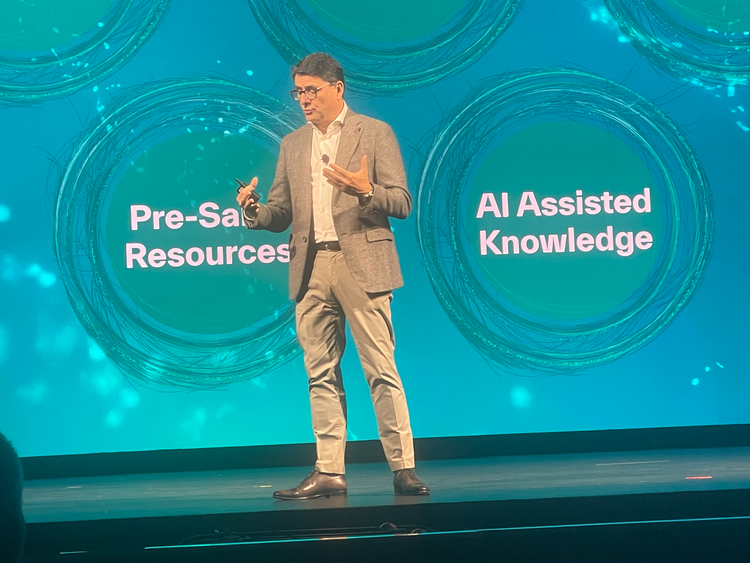
TD Synnex is sharpening its focus on physical AI with its planned acquisition of specialist distributor BlueStar and a new distribution agreement with industrial robotics manufacturer Kuka, moves that CEO Patrick Zammit (pictured) said will give the company new ways to capitalize on the convergence of operational technology and information technology.
BlueStar, which TD Synnex last week said it has agreed to acquire, brings the distributor a portfolio that includes barcode scanners, printers, and related products, along with specialized expertise in logistics and manufacturing, Zammit told CRN. He said the business will remain a specialist TD Synnex unit under its current management, providing access to its broader IT product portfolio and financial resources.
“We are adding now to our portfolio in North America, in Europe, and in Latin America a specialist which is going to not only enrich our portfolio but is also going to provide a platform to address the OT market,” he said. “And that's now a priority for us too because of physical AI and the potential of physical AI.”
[Related: TD Synnex CEO Sees Growth Opportunity As Vendors Favor Global, End-To-End Distributors]
Although Zammit said the transaction is not financially material, he called it strategically significant because TD Synnex expects accelerated growth in the market. The deal is expected to close by the first or second quarter of next year, pending European antitrust approval.
“We have an extensive IT portfolio, which will make a big difference for BlueStar in its go-to-market, and obviously we're going to provide them the financial means to grow,” he said. “So I think BlueStar is going to be even stronger in the market thanks to us.”
The distribution agreement with Kuka extends TD Synnex’s physical AI strategy into robotics, Zammit said. TD Synnex signed with Kuka in Europe and North America as the robot maker looks for a distribution partner to simplify a fragmented route to market and reach its long tail of resellers. Zammit said robotics offers great near-term physical AI potential while acknowledging that TD Synnex is still developing its value proposition and go-to-market model.
“We talked about the convergence of OT and IT,” he said. “We made an acquisition in the OT space. We signed up a robotic company, so you can see that physical AI is something which is very, very high on our radar. We are giving ourselves, I would say, the tools to be successful.”
Zammit also discussed how the BlueStar acquisition might impact the business of ScanSource which has long distributed technologies similar to those of BlueStar, as well as his company’s new move into helping channel partners tackle the fast-growing space technology industry.
There’s a lot going on with TD Synnex, physical AI, and space tech. To learn more, read CRN’s complete discussion with Zammit which has been lightly edited for clarity.
TD Synnex just unveiled plans to acquire BlueStar. Talk about the acquisition.
It's a big announcement. We have been investing in the space and developing a specialist value proposition and go-to-market plan for this space. And BlueStar is a distributor who specializes in the space.
Describe BlueStar from TD Synnex’s point of view. What is BlueStar?
It's a specialist distributor focused on markets such as logistics and manufacturing. It's at the junction between OT (operations technology) and IT (information technology), and it brings a portfolio of barcode scanners, printers, and other products which are adjacent to what we sell today. They are addressing a customer segment which is very interesting to us because we believe that customer segment is the one who will also consume a lot of physical AI.
There are lots of synergies with our IT solutions because OT and IT are converging. We are adding now to our portfolio in North America, in Europe, and in Latin America a specialist which is going to not only enrich our portfolio but is also going to provide a platform to address the OT market. And that's now a priority for us too because of physical AI and the potential of physical AI. Regarding the integration, it will remain a specialist business unit [of TD Synnex]. The current management will continue to lead that specialty business unit, and of course, we are going to create synergies with our other business units to deliver business outcomes to the market. So it's very interesting....
Some of its resellers are common with ours. Many of them are specialized.
Have you talked about financial details yet?
No. … It’s not material. Strategically [it’s significant.] Financially, it's not insignificant … but strategically it's significant because we expect accelerated growth in that space.
When is the acquisition going to close?
We need to wait for antitrust approvals from Europe. Let's say Q1, Q2 next year, latest, hopefully.
With the acquisition, does this put you in direct competition with ScanSource? The BlueStar line card is very similar to that of ScanSource. Will this impact ScanSource from a competitive view?
They are a very good competitor and now we have a very good value proposition. We have an extensive IT portfolio, which will make a big difference for BlueStar in its go-to-market, and obviously we're going to provide them the financial means to grow. So I think BlueStar is going to be even stronger in the market thanks to us. [And] we are going to add a lot of understanding of verticals, which we see have a high potential for the future, logistics and manufacturing in particular.
Does the acquisition impact any of TD Synnex’s other specialty areas or focuses?
Not at all. Our collection of specialists ensures that we make the right investments in all our specialties. At the same time, we continue to add new specialties without impacting our investments in the others. So, with this acquisition, we keep our focus, but of course we keep the focus on everything else.
TD Synnex also just signed a distribution agreement with Germany-based industrial robot maker Kuka. What’s happening there?
That was signed in Europe, and we just signed for North America. Again, very interesting. They have a go-to-market today that’s very fragmented, and they are looking for a partner who can rationalize their go-to-market, and that's what we want to work on. The CEO. It's Christoph Schell, ex-CRO from Intel, ex-CRO from HP.
Think about Kupa this way to put BlueStar in perspective: We talked about the convergence of OT and IT. We made an acquisition in the OT space. We signed up a robotics company, so you can see that physical AI is something which is very, very high on our radar. We are giving ourselves, I would say, the tools to be successful.
Where does Kuka fit in the robotics business? What is their specialty?
We're looking at robotics in general. Humanoid robotics is obviously something we're looking at, but traditional robotics probably has, in the short term, more potential, and we have to develop the value prop. So we are in the infancy of this business. Partnerships are going to help us develop the right value prop and go to market.
Robotics has not traditionally been a channel play.
They have their own resellers. Kuka sees the benefit of introducing a distributor between themselves and the long tail of resellers to rationalize the go-to-market, so we'll see.
OK, but is the traditional TD Synnex reseller a target for that type of business?
If we think about BlueStar, some resellers are common with TD Synnex because of their specialty. Now it's one group. I'm convinced that many IT resellers are going to be interested by this value proposition. The OT/IT convergence is still in its infancy. But I think if we can streamline the go-to-market and logistics here, we're going to see a lot of players. This is the big theme. Nvidia, by the way, is pushing for it.
So acquiring BlueStar and signing a distribution agreement with Kuka is all part of a push by TD Synnex to get involved in physical AI?
Exactly.
How important is being in the physical AI business for TD Synnex given that AI itself is still new?
AI is new, but the prospects are very attractive. It's very difficult for the moment to put a figure on it. What is important is to build the right model to play. For us, it’s an adjacency. It's not a diversification, it's an adjacency. Adjacencies normally are very powerful. We stay very close to our core business, but still, it's different product profiles, probably different end users, and so we are very excited to add that capability.
TD Synnex is also looking to make a channel play for the space tech industry. What is TD Synnex looking to do?
Look at what's happening in this area with companies like SpaceX and Blue Origin. There is also a lot to come from Europe, and probably a lot to come from India. This is going to be a strategic and fast-growing area, and it’s another specialty business for us. So how do we identify the right value prop, the right partners, the right go-to-market. That's what we are working on now, a dedicated team.
This is a North America initiative today, which we will scale globally if it's successful. There’s more to do.
All the presentations and a lot of discussions that have gone on at Inspire 2026 have all been around AI, whereas TD Synnex has a lot of solution providers who do a lot more than just AI, or maybe have never even touched AI. Do you see all TD Synnex’s solution providers ready to take AI to business customers?
It's a little bit like cloud 10 years ago, a lot of skepticism. And today who is not selling cloud? I think it's going to be the same with AI. At least three vendors presented on AI, and two of our presenters presented the AI stack. It's difficult today, even if you are super specialized, to not touch AI one way or another: infrastructure, data layer, infrastructure layer, you name it. AI PCs. We had AMD and Nvidia talking about AI at the edge. AI is going to redefine the role of the PC and the infrastructures. When we launched our Destination AI enablement program and we looked at the stack and the vendors, honestly, it was so broad-based.
So, yes, I think the reseller community is going to support AI and agentic AI. And the good thing with our approach is, if a reseller is very specialized, they will find a solution at TD Synnex. You want to sell the whole stack? We are the orchestrator. We are in a position to fine-tune our offering to the needs of the reseller. Security is another example.
There were relatively few presentations on security at Inspire 2026 this year.
The team had to pick the themes. It also depends a little bit on the profile of the vendors who came on stage. As far as I'm concerned, if you implement AI, security and governance are super important. We had an executive session with key partners and vendors [at Inspire], and it became a discussion in the room. It was very interesting. Risk was a big topic. With AI comes cybersecurity risk. Agentic attacks are easy and cheap with AI. That means that, on the other side, you have to use agentic AI to respond on time. We've done it, by the way, at TD Synnex. It’s already done. That's an opportunity. There’s a risk your data could leak out of your company. You have to manage that risk. You have the risk of an agent going after the wrong data or going where you don't want it to go. So there are huge opportunities from a security and data management standpoint.
What’s behind TD Synnex’s move to bring a FinOps (financial operations) service to its channel partners?
We developed FinOps for cloud. It took us a few years to do it. But FinOps for AI is already in place after about two years. It's impressive to see how fast the market is evolving and addressing it. I remember with cloud, SecOps [security operations] and FinOps took us some time. SecOps and FinOps are top of mind already after two years, along with governance. I think there's not enough communication on the governance side, but you need to have governance in place in your company. This is something we can help with.
It took us a little bit of time at TD Synnex as ‘customer zero’ to find the right balance between risk and innovation. We held the cursor a little bit too long on risk management and not enough on innovation. We’re now moving the cursor to the middle. It’s a big impact on how fast the team is innovating and adopting the tools.
And in parallel, we continue to strengthen our security. So, being customer zero in that space is super helpful to develop our enablement programs, Destination AI in particular.
TD Synnex’s Hyve business is doing well. Because TD Synnex provides components and systems for a lot of your branded vendors as well as through Hyve to hyperscalers, does providing scarce components to Hyve conflict with how you serve your other vendors?
It’s two separate divisions. The components Hyve needs are sourced on behalf of the hyperscalers, but everything has been negotiated by the hyperscalers. So we are not using distribution sourcing to support Hyve. We have their own sourcing, all negotiated by the hyperscalers, so there's no overlap. We don't compete with the OEMs because we don't have any products. I mean, we build to spec. We don't develop any products. We have no intent to develop our own products. No conflict of interest with the OEMs. The hyperscalers negotiate, and then we source the components. All the strategic components—memory, GPUs, you name it—they negotiate it. But then we source it for them. We finance it, if you will. That's our job.
Hyve is a contract manufacturer. We are not a Supermicro. Supermicro competes [with our branded vendors]. We build to spec. So yeah, it's clean. Hyve is like Jabil, Flex, Sanmina, Celestica.
How is competition in that space?
Very good competitors. Long history, but again, we grow faster than they do, so we're competing well, too. They are good competitors working on the value prop. Very interesting. We are watching, but we feel we have a lot of good differentiators. So we are competing well in this market.