TD Synnex CEO Patrick Zammit On The Memory Shortage, Price Increases And ‘Fighting For The Channel’
‘At the moment, our vendors are trying to figure out how to manage [the memory shortage]. It’s changing daily. There’s a shortage issue and a big price increase. I think price is an even bigger issue than the shortage,’ TD Synnex’s CEO tells CRN.
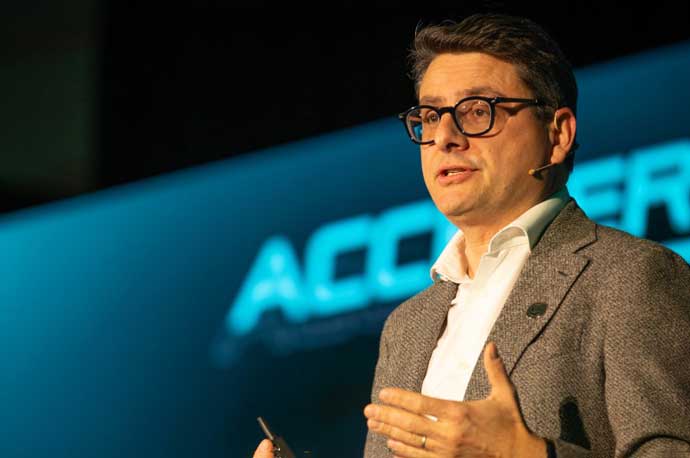
IT distribution is in a very solid position in 2026 despite shockwaves caused by the memory shortage and other factors, according to Patrick Zammit, CEO of TD Synnex.
Regarding the state of distribution today, Zammit told CRN during the recently concluded Global Technology Distribution Council Summit that the landscape is changing rapidly, driven in large part by the memory shortage.
“There’s a shortage issue and a big price increase,” he said. “I think price is an even bigger issue than the shortage. … We should expect further price increases throughout the year because all analysts and everybody are very clear that the price increases are not over. There’s more to come, driven by the memory price increase. We just need to be prepared for it.”
[Related: TD Synnex CEO: ‘Distribution Continues To Be A Good Story’]
Zammit said the impact from memory and other component shortages is tangible, with quote validities slashed from 30 days to 15 days. The question of whether backlogged orders will be repriced is also a major topic of debate.
“We are confronted with a series of requests from the vendors, and obviously we are fighting for the channel and telling them, ‘The past is the past. Don’t reprice the backlog,’” he said.
Zammit warned that further price hikes are likely throughout the year and that those hikes, driven by memory price surges, will push up average selling prices (ASPs) for hardware by 10 percent to 20 percent or more. That, he said, will have a big negative impact on sales volume of consumer PCs but little impact on B2B sales volume because of the ongoing PC and server refresh cycles.
“On paper, the increase in prices should have a negative effect on volumes,” he said. “On the other hand, you have good reasons to continue to refresh your hardware, your infrastructure, your PCs because of what I just mentioned, and it’s going to be interesting to see how that plays out. It’s a little bit too early to speak about it. I think what we are seeing at the moment is for sure some pull-ins and pull-forwards, which help. I don’t know the magnitude yet. We need to figure it out.”
Because of TD Synnex’s Hyve systems integration capabilities, the distributor has better visibility than most companies into component availability, Zammit said. He also noted that TD Synnex will start publicly highlighting Hyve’s financials starting this quarter, given how that business has grown.
Here is more of CRN’s conversation with Zammit.

How is the state of distribution today?
I think it’s solid. When you look at the latest [London, U.K.-based] Context data from Europe or IDC in North America, the market is doing pretty well. It’s encouraging. And when you look at what is driving it, it’s many technologies. Networking is doing well. Software continues to be strong. Cloud is strong. PCs in value terms continue to be good. And compute is also solid. So the growth in distribution has been fueled by many cylinders, and those cylinders continue to be solid.
How is the memory shortage impacting your hardware business?
At the moment, our vendors are trying to figure out how to manage it. It’s changing daily. There’s a shortage issue and a big price increase. I think price is an even bigger issue than the shortage. And so how will the OEMs handle it? Quote validities have been reduced dramatically from 30 [days] to 15 days. And the most contentious topic is, what is the backlog today? Is it going to be repriced or not? This is a big discussion point as we speak. We are confronted with a series of requests from the vendors, and obviously we are fighting for the channel and telling them, ‘The past is the past. Don't reprice the backlog.’ We understand the challenge for the future, but for the past, don’t do it. That’s probably the biggest challenge we have from a pricing standpoint in the short term. We should expect further price increases throughout the year because all analysts and everybody are very clear that the price increases are not over. There’s more to come, driven by the memory price increase. We just need to be prepared for it.
ASPs for all hardware are going to increase quite significantly, probably between 10 [percent and] 20 percent, maybe even more in some cases. So that’s a tailwind for the whole year. The big question is, what’s the impact on volume? On the consumer side, I’m negative. I think the consumer business will be badly impacted by the price increases because price elasticity is very high. So businesses serving consumers will suffer. It’s not our case. We are focused on B2B. We have a very small retail business. So we are not concerned about B2B volume. We should see some impact, but you still have a PC base to refresh to be Windows 11-compatible. You have a server base to refresh because the new generations are significantly more efficient. You have [endpoint security hardware] that requires upgrades. You have to upgrade your switches in the data center to support AI. You have to upgrade your storage systems to support AI.

What about the impact on volume?
On paper, the increase in prices should have a negative effect on volumes. On the other hand, you have good reasons to continue to refresh your hardware, your infrastructure, your PCs because of what I just mentioned, and it’s going to be interesting to see how that plays out. It’s a little bit too early to speak about it. I think what we are seeing at the moment is for sure some pull-ins and pull-forwards, which help. I don’t know the magnitude yet. We need to figure it out. I would say net in value, we probably have more tailwinds than headwinds.
You said that order validity is being cut back from 30 days to 15 days.
Sometimes it was 45 days. Now it’s down to 15 days. The reason is the volatility of component prices, especially memory. But there are others. Vendors want to commit to a price for a limited period of time. This is the new norm. It will have an impact on how channel partners will have to support a deal with the end users. We’ve put a model in place, but it’s rapidly going to be insufficient, and so we have to manage the end-user demand differently through the channel.
Has TD Synnex been able to build any inventory?
Yes, we already built inventory in October and November because we saw it coming. We have our Hyve [integration and deployment] business, which gives us advanced notice. Hyve is supporting hyperscalers. Hyperscalers are driving the demand. And so we had some visibility on it. We’ve been able to build inventory and give very good support to our customers. But obviously, that advantage will diminish over time. We’ve helped our partners navigate in the last months. But yes, the reality is the new constraints and the short validity of the orders. That’s something we have to continue to manage together with our partners.
That said, is TD Synnex pushing partners to change their business model at all, maybe to do less with hardware and more with software or services?
The question is, is this going to be a tailwind for cloud, public cloud, on-premises? The AI revolution is driving demand at the edge and for on-premises versus the cloud, but the whole situation may change again. If companies can’t get their hardware at the right price, they may be tempted then to move more workloads to the cloud. We will see. In both cases, because we are so well positioned in this hybrid cloud environment, we will be able to support our partners, but from a macro standpoint again, that could be one of the consequences. AI is a tailwind for hardware on-premises, and the memory shortage is becoming a tailwind for cloud. It’s going to be interesting to watch.
What do channel partners need to do to change their business model to meet these changes?
Partners have their end users. The end users have to drive the refresh of the infrastructure, and it’s going to be very financially driven. They’re going to calculate the cost and the return of doing it on-premises with the new pricing environment versus doing it on the cloud. And they’re going to support their end users. Basically, the economics are going to be even more important than before, and our partners know how to do it very well, so no concerns. Partners can support their end users, but that’s going to be a discussion. Now it’s true that public cloud is also exposed to the increase in component prices, so we should expect some increases in the cost of using the public cloud. So yes, it’s complex.

We talked about memory prices, but we’re also seeing shortages in SSDs and hard drives. Western Digital recently said its hard drive capacity is completely sold to the hyperscalers.
Yes, for 2027, and now they’re starting to get orders for 2028. Storage, whatever the technology, is under massive pressure. High-bandwidth memory, same thing. They are going to be primarily consumed by hyperscalers who are eating up a lot of capacity at companies like Samsung and SK hynix. This is having an impact on the overall capacity to produce memory, it’s clear. And it’s interesting that the hyperscalers have started to eat up a lot of capacity for compute, but obviously you need to upgrade the whole environment of compute, and everything is being impacted. I would say it’s not a big surprise. It was expected. It's just that companies have prioritized their investments. But yes, if you want to get the full benefit of your compute capacity, you need to upgrade all the equipment around it. And this is what is happening now.
Are all distributors being impacted the same? Is anybody better able to weather these changes?
It depends on your financial strengths whether you can build inventory or not. In our case, we have two advantages. We saw it coming because of our Hyve business, and we had the financial capacity to build inventory to support our partners a little bit better. That probably will continue to be an advantage for the coming quarters. I think it’s going to be easier for the larger distributors to support their customers and build the inventory where it makes sense and also work very closely with the vendors than for the smaller local distributors.
Do you see any consolidation in distribution because of this?
It could accelerate some of the consolidation, but the consolidation of the industry is a trend. When you have vendors rationalizing their go-to-market, as some of them have done, usually that impacts the smaller distributors. And if you don’t have critical mass, you lose your competitiveness. So I would say that there is an overall trend driven in part by vendors rationalizing their go-to-market. That situation will probably accelerate.
There is another dimension to take into account. We need to invest in digital platforms. Yes, it’s millions of dollars of investment. Again, you need to have a certain critical mass to be able to finance it. It’s the fate of distribution. You need to grow. You need to build critical mass in order to be able to finance the investments and support the channel.

What are some of your strategic priorities for 2026?
It continues to be strengthening our market position in the high-growth countries and where our share is low, especially in APJ or Latin America or Eastern Europe. We have many countries where we are missing some critical vendors. So we’re working to enrich and leverage our product portfolio in those countries and support our partners better.
Another priority is very clearly AI. We want to become AI-fluent. We have identified our use cases. We are going to leverage AI to increase both the customer experience and our processes internally. And the last point is being partner-first, continuing to roll out our PartnerFirst digital partner portal globally and become even more easy to deal with thanks to our very effective and effective digital platform, which provides our partners 24x7 access to the information they need to succeed.
Those are the priorities for me this year. And I would say we are progressing.
And speaking about AI, what is TD Synnex doing to help channel partners learn about AI and to be ready to bring it to their customers?
We are the first distributor to develop an enablement program called Destination AI. Lately, we’ve enhanced the program and identified three critical opportunities with AI for partners and their end users. The first is building an AI factory. The second is agentic AI. The third is security, which is very important. Those three activities are really critical because LLM is a very general concept, and it was relatively difficult for enterprises to identify use cases. Agentic AI is different. You can rapidly develop a use case. You can rapidly see the results for the company. So I think we have a fantastic opportunity to accelerate the adoption of the technology through the partners for the end users.
Security is going to be a big theme because while AI has a lot of advantages, it creates new risks, especially in security. That’s where we are positioning ourselves with a lot of enablement programs so that when our partners go to the end users, they cover all the aspects of AI, not only the use cases, but governance, security, making sure there is no data leakage, data management. All those aspects of AI are absolutely critical for successful implementation of end-user AI solutions. We are very actively promoting AI. We continue to add resources to support partners and their end users. We have labs where partners and their end users can test concepts. We’re helping our partners win at the end users. That makes us very unique in the market.
Anything else that you think we should know about TD Synnex?
For the first time, this Q1 we’re going to disclose the financials of Hyve. It’s because I’ve changed a little bit the way I’m managing the company, and now Hyve is really managed as a stand-alone division, and according to GAAP, you have to report the figures separately, and so that’s what we’re going to do.
Is this a precursor to a spinning off of Hyve?
Not at all. It’s a compliance reason. Today investors do not have clear visibility on the performance of Hyve. But the growth rates are incredible.