WWT ‘Visionary’ CEO, Touted By Michael Dell And HPE’s Neri, Explains His Successful Leadership Strategy
Tech titans Michael Dell and Antonio Neri call WWT CEO a “visionary” for his leadership strategy. WWT’s CEO Jim Kavanaugh explains to CRN his Integrated Management and Leadership curriculum that is core to his $20 billion company’s success and future.
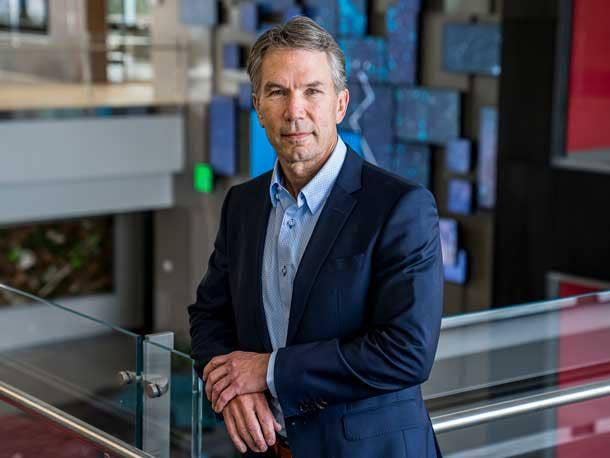
One of the most innovative and popular tech CEOs on the planet is World Wide Technology CEO Jim Kavanaugh, who crafted a unique leadership curriculum that’s been the key to WWT’s success for decades.
“Individuals at World Wide may be really, really good from a performance standpoint, but we are very disciplined about, ‘We’re either going to coach you up so your values get in-line with ours, or we’re going to coach you out,’” said Kavanaugh, the co-founder and longtime leader of $20 billion IT powerhouse WWT.
WWT’s Integrated Management and Leadership (IML) curriculum is a main reason why sales and WWT’s influence continues to skyrocket decade after decade, while at the same time, winning countless employee-workplace awards, such as being named to Fortune’s prestigious list of “Best Companies To Work For” for 14 years in a row.
Michael Dell: ‘Long-Term Success Is Rooted In Company Culture’
Dell Technologies founder and CEO Michael Dell touts Kavanaugh as “a true visionary” with a top-notch leadership strategy and philosophy that drives success.
“Jim has always understood that the key to long-term success is rooted in company culture,” Dell tells CRN. “I’ve spent a lot of time with the WWT team over the years, and I’ve seen Jim’s focus on his people, their development and company culture. I’ve also seen how that focus has transformed WWT into a machine of innovation and customer service.”
[Related: WWT CEO Jim Kavanaugh Honored With Best Of The Channel Lifetime Achievement Award]
HPE CEO Antonio Neri said Kavanaugh is a “visionary leader” who helps not only elevate WWT and its customers, but HPE as well.
“Jim’s people-first philosophy is at the heart of everything he does,” Neri tells CRN. “Both colleagues and customers frequently highlight Jim’s genuine care for people, as he leads with empathy, integrity, and a deep respect for those around him.”
WWT’s IML Curriculum Key To Success
The St. Louis-based company’s IML curriculum is so critical to WWT’s success and future that Kavanaugh spent millions this year on hosting a leadership conference in Las Vegas.
“It was not a sales kickoff. It was not a business development kickoff. It was around training and developing our managers and leaders around our values, our behaviors and our business concepts,” WWT’s CEO said.
More than 2,000 WWT employees attended the three-day event in Las Vegas aimed at reinforcing the company’s integrated management and leadership curriculum that focused on training, developing and mentoring managers and leaders. WWT’s cultural values steer employees toward great teamwork, kindness for each other, a passion for hard work and making sure they are engaged and excited about working at WWT.
“To stand the test of time in technology, a leader has to see what’s coming and fearlessly reinvent to stay ahead,” Michael Dell said. “Jim has always positioned WWT for success.”
In an interview with CRN, Kavanaugh takes a deep dive, explaining WWT’s IML curriculum, leadership strategy, and his major decisions over the past 35 years that has built WWT into one of the world’s leading tech companies.
What is the net gain of WWT’s IML curriculum? What does it achieve?
If you look at a lot of employee engagement surveys from other companies, and I’ll give you a broad base of the metrics, the results are: maybe 25 percent of your employees are engaged.
There’s a certain percentage, more like 50 percent, who are disengaged.
Then there’s another 25 percent that are actively disengaged, so who don’t like the company.
It should be disturbing as a leader with all the money you’re spending that so many employees are disengaged.
So it’s like, ‘What if you had 100 percent or 95 percent of your employees engaged and really excited about your business?’ Think about the productivity.
So that’s the mindset we look at. … I have personally, intimately been involved with building this out from day one with other executives within the organization.
Talk about WWT’s Integrated Management and Leadership. Why is it so important to WWT’s success?
So if you look at it at a very high level about why we think it’s so important, there’s two different areas of a company: one is the business, and the other is employees.
On the business side, it’s about, ‘How are you looking at your strategic plan? How are you looking at your business operations? What are your financial metrics?’ What are all of those things that you go in to measure the key performance indicators of your strategic plan, your vision, your mission and your business operations. Every company needs to do those. Some do them better than others, but it needs to be something done with clarity of: what are the expectations and outcomes?
On the other hand, you have the development of your employees.
Most companies spend 80 percent or 90 percent of their dollars around their people. You would think that it would only make sense to try to get the most out of your people that you can.
So spend the same amount of time equally that you spend on [the business side]—like your vision, mission, operational and financial focus—as you would spend on the employee development of getting the right people on board, developing them, training them, and making sure that they are performing.
What is your leadership strategy in terms of hiring and developing employees with the IML as a core metric?
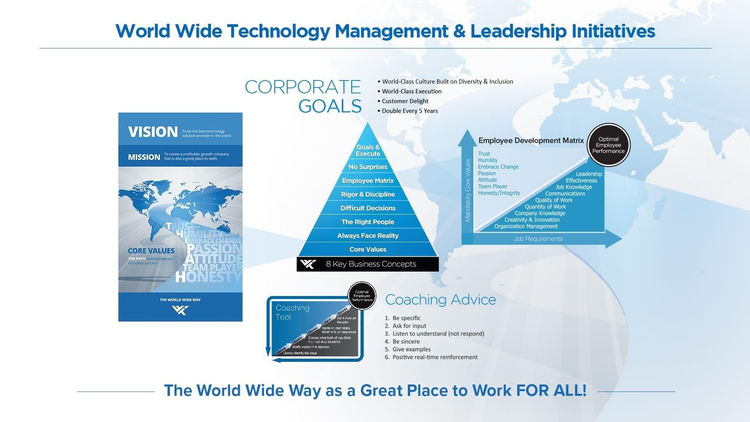
Part of our IML is around the importance of our values. When we go to hire our employees, part of the onboarding is to walk them through our values. We have an employee performance matrix: one axis is the values of our business, the other axis is your job.
We’re like, ‘We don’t want you just to be really good at your job. You’re a great developer or you’re great at sales. You hit your number, but you treat people like crap, and you’re not a team player.’
Individuals at World Wide may be really, really good from a performance standpoint, but we are very disciplined about, ‘We’re either going to coach you up so your values get in line with ours, or we’re going to coach you out.’
And when you coach out a top performer, like a top engineer, people listen and are like, ‘Wow, WWT takes this very seriously about being a team player.’
If people think because they’re smarter than somebody, or they’re performing better [that] they have the right to be disrespectful—no, that’s unacceptable.
The IML is something that we take very seriously and the feedback from our employees has been just off the charts.

WWT has stayed relevant for 35 years through decades of tech disruptions and market transformations. What are some of the major milestones or challenges you’ve faced?
Very early on, we had three owners of the business.
One was really not a fit for a number of different reasons, from just a values perspective and team orientation.
That individual had to be moved out.
That was a big moment very early in the first couple years of the business, that if we didn’t make that change—if I did not make that change—I don’t believe we would have continued to get to where we are today.
There are some things just structurally around businesses that can be significant inflection points and moments within the business about whether you’re going to go this way or this way. That was a big decision.
Another big moment was deciding to diversify, which is much easier said than done.
Eighty percent of our business was with the federal government early on. We intentionally diversified into the enterprise and commercial space. A lot of companies that try to do that don’t do it successfully, but we are able to do that successfully.
Another one is, about 10-plus years ago, I was thinking about skating to where the puck was going and we made a big investment in software development and building out a small, boutique data science practice that really played out well to position us to where generative AI has played out.

Talk about WWT’s core values of respect, determination, grid and teamwork. How has the culture you created made WWT stand the test of time?
It is not my job, I don’t believe, to tell people whether they should have a religion and believe in a certain religion.
There are hundreds of religions around. The world is a big place. It can be very complicated.
However, what I do believe as a CEO of a global company, is that I’m very clear around the values and the behaviors of the company.
And that’s how as individuals we treat each other with respect, how we expect to work as a team player, the level of effort that we expect, that we have the right attitude—that is very transferable.
So whether we have employees in St Louis, New York, California, Singapore, Australia, London—that expectation of how we treat each other, how we work together, is something that is very, very transferable, and people understand that. And then holding people accountable to that.
The values of World Wide are so important to be grounded.
I want people to have the drive, grit, the determination and the confidence to go after it and think big and bold but do it with a level of humility and appreciation.
And at the end of the day, just be a good person.
I mean, when you responded in a way that you’re not proud of, just take accountability for that. Nobody’s perfect.

What’s it like to be the leader of such a powerful company that’s influential on so many customers and people?
As a leader, more and more people are watching.
So you don’t want to lose your edge and that grit, that energy and the fight that got you to where you are—but people are watching.
So how you treat people, if it means something to you, is something that you need to think about.
As you build good habits and good behaviors, it’s important to hold yourself and think about those habits and behaviors you want to be proud of.
Over the years, I reflect back and I have such a huge level of appreciation and gratitude for the position that I’m in and where I am.
It’s important to understand, as you continue to grow, to not allow the success to go to your head. And to not think that you created or solved cancer [for example] by yourself. If you look at innovators, it’s like 99 percent of the time, it’s a team of people.
World Wide was not created by Jim Kavanaugh. World Wide was created by me and a lot of other great people.