Broadcom’s Hock Tan On VMware, VCF 9, AI Sales And CEO Future
Hock Tan explains his plans to remain Broadcom’s CEO for the next five years, VMware Cloud Foundation customer momentum, the ‘second phase’ of his plans for VMware and much more.
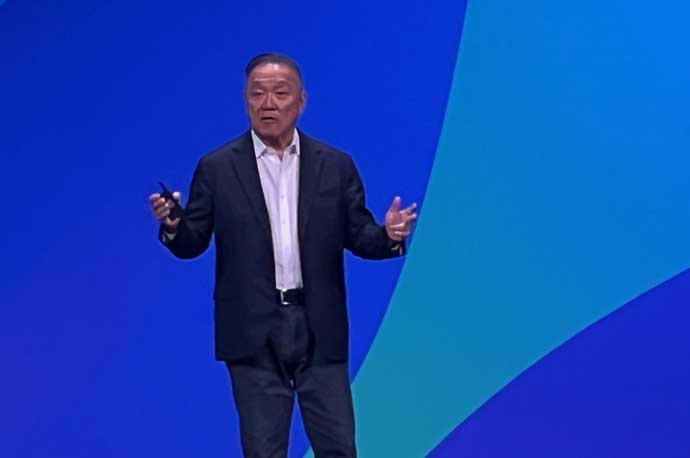
Broadcom CEO Hock Tan shed significant light on the company’s VMware business, its record $110 billion backlog and just how long he plans to stay the leader of Broadcom.
“The board and I have agreed that I will continue as the CEO of Broadcom through 2030, at least,” said Tan during his company’s recent third-quarter 2025 financial earnings report.
“These are exciting times for Broadcom,” he said. “I’m very enthusiastic to continue to drive value for our shareholders.”
Tan also revealed how many customers are adopting VMware’s private cloud platform, VMware Cloud Foundation, initiating the “second phase” of his VMware plans and seeking to win over public cloud customers.
“After two years of engineering development by over 5,000 developers, we delivered on our promise when we acquired VMware. We released VMware Cloud Foundation version 9.0,” he said. “This provides a real alternative to public cloud.”
CRN breaks down Tan’s boldest remarks on VMware’s market traction, AI revenue forecasts and “slow” demand for Broadcom’s non-AI semiconductor business.
Broadcom Third-Quarter 2025 Earning Results
Before jumping into Broadcom’s CEO biggest statements, here’s a quick look at Broadcom’s third-quarter earnings results.
Broadcom generated total revenue of $16 billion, up from $13 billion compared with third-quarter 2024.
The company’s Infrastructure Software segment—which includes VMware—generated $6.8 billion in revenue, up 17 percent year over year. Broadcom’s Semiconductor Solutions business generated about $9.2 billion in revenue, an increase of 26 percent year over year.
“In summary, continued strength in AI and VMware will drive our guidance for Q4 consolidated revenue to approximately $17.4 billion, up 24 percent year on year,” Tan said.
Click through to read Tan’s boldest statements.
‘Way Over 90 Percent’ Of vSphere Customers Have ‘Bought VCF’
Pretty much, virtually way over 90 percent of [our top 10,000 accounts] has bought VCF.
Now I’m careful about choice of words, because we have sold them on it and they bought licenses to deploy it, it doesn’t mean they are fully deployed.
Here comes the other part of our work, which is to take these 10,000 customers or a big chunk of them who have bought the vision of a private cloud on-prem, and working with them to enable them to deploy it and operate it successfully on their infrastructure and on-prem. That’s the hard work over the next two years that we see happening.
And as we do it, we see expansion across their IT footprint on VCF private cloud running on their data within their data center. That’s the key part of it. And we see that continuing.
That’s the second phase of my VMware story.
First phase is convincing people to convert from perpetual subscription and [in] so doing purchase VCF. Second phase now is make that purchase they made on VCF create the value they look for in private cloud on their premise, on their IT data center.
That is what’s happening. And that will sustain for quite a while because on top of that, we will start selling advanced services, security, disaster recovery, even AI, running AI workloads on it. All that is very exciting.
Seeing ‘Some’ Success With VCF Outside 10,000 Enterprises
Now beyond the largest 10,000 [customers], are we seeing a lot of success? We are seeing some.
But again, [there are] two reasons why we do not expect it to be necessarily successful.
One is the value, the TCO that comes from it, will be much less. But the more important thing is the skill sets that are needed—to not just deploy, that you can get services and ourselves to help them—but to keep operating.
It might not be something that they can take on. We shall see. This is an area we’re still learning.
VMware has 300,000 customers. We see the top 10,000 as being people where it makes a lot of sense, [that can] derive a lot of value in deploying private cloud using VCF.
We now are looking at whether the next 20,000 or 30,000 midsized companies see it the same way. Stay tuned.

$110 Billion Backlog, AI Semiconductor Forecast
With robust demand from AI, bookings were extremely strong. And our current consolidated backlog for the company hit a record of $110 billion.
Q3 semiconductor revenue was $9.2 billion as growth accelerated to 26 percent year on year.
And this accelerated growth was driven by AI semiconductor revenue of $5.2 billion, which was up 63 percent year on year and [extended] the trajectory of robust growth to 10 consecutive quarters.
We generally don’t break up backlog numbers [between AI and non-AI and software]. I’m just giving a total number to give you a sense of how strong the business is as a whole for the company.
It’s largely driven by AI in terms of growth. Software continued to add on a steady basis. And non-AI has grown double digits. Nothing compared to AI, which has grown very strongly. To give you a sense, perhaps fully 50 percent of it at least is semiconductors.
We continue to make steady progress in growing our AI revenue. For Q4 2025, we forecast AI semiconductor revenue to be approximately $6.2 billion, up 66 percent year on year.

‘Demand Continues To Be Slow’ For Non-AI Semiconductor Business
Turning to non-AI semiconductors, demand continues to be slow to recover, and Q3 revenue of $4 billion was flat sequentially.
While broadband showed strong sequential growth, enterprise networking and server storage were down sequentially. Wireless and industrial were flat quarter on quarter as we [expected].
In contrast, in Q4, driven by seasonality, we forecast non-AI semiconductor revenue to grow low double digits sequentially to approximately $4.6 billion. Broadband, server, storage and wireless are expected to improve, while enterprise networking remains down quarter on quarter.
The only consistent trend we’ve seen over the last three quarters that is moving up strongly is broadband. Nothing else. If you look at it from a cyclical point of view, it seems to be able to sustain an uptrend so far.
But as a whole, they are not getting worse. But they are not showing a V-shaped recovery as a whole that we would like to see and expect to see in cyclical semiconductor cycles.
The only thing that gives us some hope is broadband at this point and it is recovering very strongly.

VCF 9.0 ‘Provides A Real Alternative To Public Cloud;’ Infrastructure Software Segment
Here’s one I’m most excited about: After two years of engineering development by over 5,000 developers, we delivered on our promise when we acquired VMware.
We released VMware Cloud Foundation version 9.0, a fully integrated cloud platform, which can be deployed by enterprise customers on-prem or carried to the cloud. It enables enterprises to run any application workload, including AI workloads, on virtual machines and on modern containers.
This provides a real alternative to public cloud.
Q3 infrastructure software revenue of $6.8 billion was up 17 percent year on year—above our outlook of $6.7 billion as bookings continued to be strong during the quarter.
We booked, in fact, total contract value over $8.4 billion during Q3.
In Q4, we expect infrastructure software revenue to be approximately $6.7 billion, up 15 percent year on year.