Google CEO Explains 6 ‘Big’ AI And Gemini Launches At Google I/O Keynote
From Google’s new Gemini Omni and Gemini 3.5 Flash to its new Gemini Spark agent and Google Antigravity 2.0, Google CEO Sundar Pichai explains the significant innovation launched at Google I/O 2026 this week.
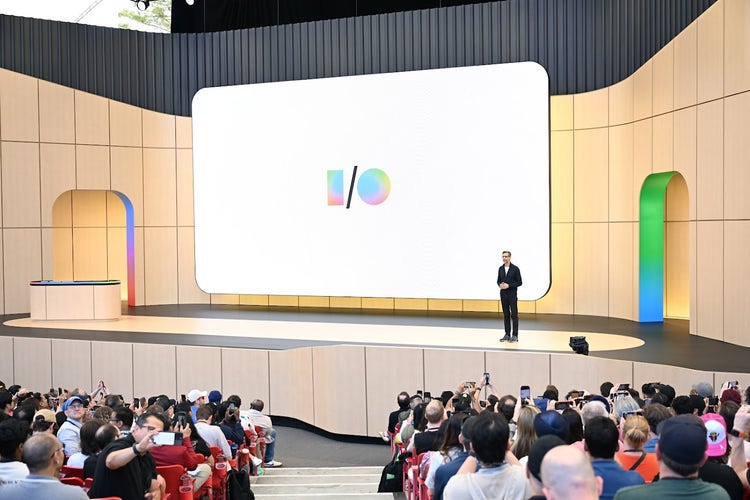
Sundar Pichai is bullish about Google I/O 2026 new product launches around agentic AI and Gemini as the CEO touted new innovation and billions in AI investments.
“In 2022, we were spending $31 billion annually in capex. This year, we expect that number to be about six times that, approximately $180 to $190 billion,” said Google’s CEO on stage in front of thousands of attendees this week at Google I/O in California.
“A key part of this investment is our custom silicon,” said Pichai. “As we look across the full stack of innovation, from the infrastructure behind TPU 8i to the frontier capabilities of Gemini 3.5 and Antigravity, it’s clear we’re firmly in our agentic Gemini era.”
From Google’s new Gemini Omni and Gemini 3.5 Flash to the new Gemini Spark agent and Google Antigravity 2.0, Google’s CEO weighed in on the new products launched at Google I/O 2026.
[Related: Google-Blackstone New AI TPU Company: 5 Huge Anthropic, Leadership And Google Cloud Things To Know]
Google Cloud Partner On New Innovation
Sanjay Singh, CEO of top-tier Google Cloud partner Onix, said the tech giant’s new innovation is unmatched in the AI era.
“Gemini is basically the front door now to everything that happens on the Google stack, which is amazing,” said Singh.
“The way Google’s integrated stack is coming together—from an agentic infrastructure, from a TPU perspective, from a model perspective—makes a lot of sense,” he said. “The way [Gemini] is now cutting across all products, data, Workspace, applications, agentic building, etc. is very useful for us and our customers.”
Singh highlighted Google Cloud’s backlog of roughly $462 billion as of second quarter 2026 as signs that the company is leading in the agentic era.
“The market demand is there because there’s a huge backlog already going into next year and they continue to grow at 40 percent-plus per year,” Singh. “They continue to put a lot of money into the channels and the programs. They will continue to win in the data and the AI space.”
Over the past 12 months, over 375 Google Cloud customers have each processed more than one trillion tokens, “representing incredible demand for AI from across industries,” Pichai said. “We have some big announcements today around that.”
Here’s six new Google products launched at Google I/O 2026 that every partner and customer need to know about, along with insight from Pichai during his keynote.
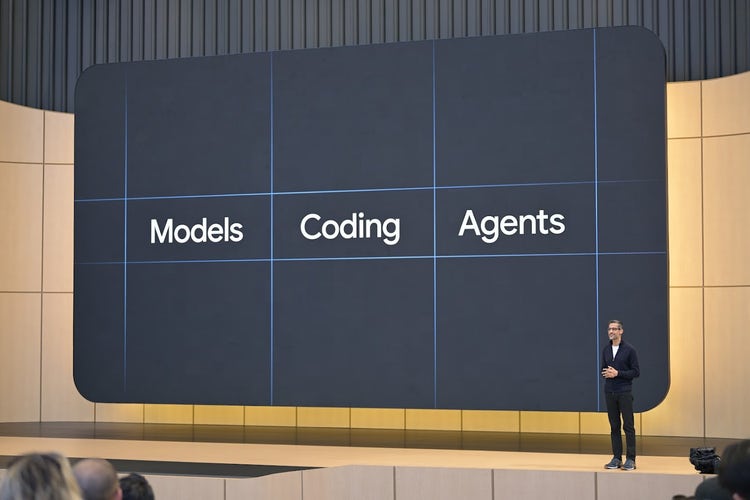
New Gemini 3.5 Is ‘In A League Of Its Own’
One of the biggest launches at Google I/O was Gemini 3.5 Flash, Google’s first model that combine frontier intelligence with action.
“When compared to [Gemini] 3.1 Pro, 3.5 Flash is better across almost all benchmarks. It’s made huge progress in coding,” Pichai said.
“Gemini 3.5 Flash is a very capable model, at the frontier and comparable to the best models, but it’s still very fast. Which is why when you look at the intelligence versus output speed, it’s in a league of its own,” Google’s CEO said. “When looking at output tokens per second, it is four times faster than other frontier models.”
Pichai said the new model has been a “game changer” for Google internally.
“We’ve been using 3.5 Flash with a reimagined version of our agent-first development platform Antigravity, and it’s dramatically accelerated how we build. In March we were processing half a trillion tokens a day internally across our AI developer tools, and we’ve been doubling every few weeks,” he said. “Now, we’re processing more than three trillion tokens a day. This scale created a powerful feedback loop helping us improve [Gemini] 3.5.”
Gemini 3.5 Flash is now available.
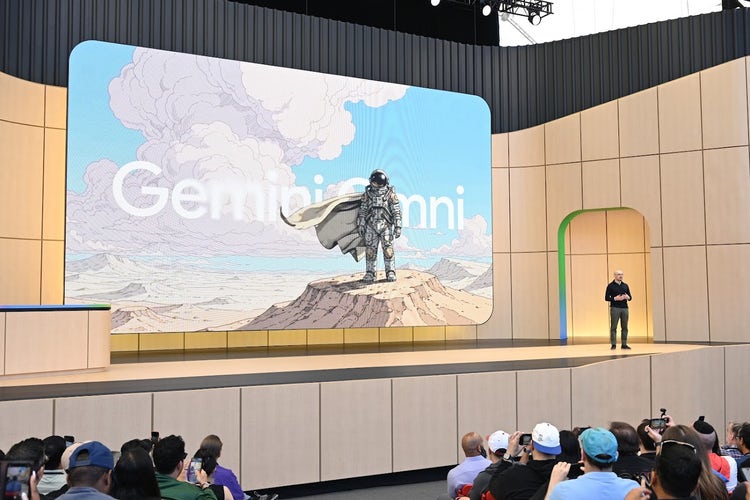
Google Gemini Omni And Omni Flash
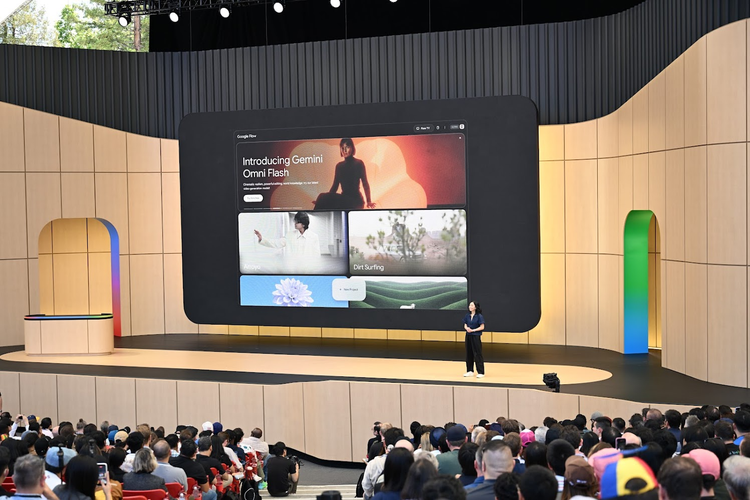
Google’s CEO touted the launch of its new Gemini Omni model that can create anything from any input, which “is a leap forward in world understanding,” multimodality and editing.
“This new model combines Gemini’s intelligence with our generative media models — a huge leap forward in world understanding,” he said. “We’re launching the first model in the Omni family: Gemini Omni Flash.”
He said Gemini Omni is capable of generating samples in any output modality from any input. “We’re starting with video outputs, and over time we’ll enable image and text,” he said.
In Google’s AI creative studio Flow, Gemini Omni allows user to blend real-world inspiration with generated content and iterate conversationally.
Gemini Omni Flash is available starting today.
“We’ll also be rolling it out to developers and enterprise customers via APIs in the coming weeks,” Pichai said.
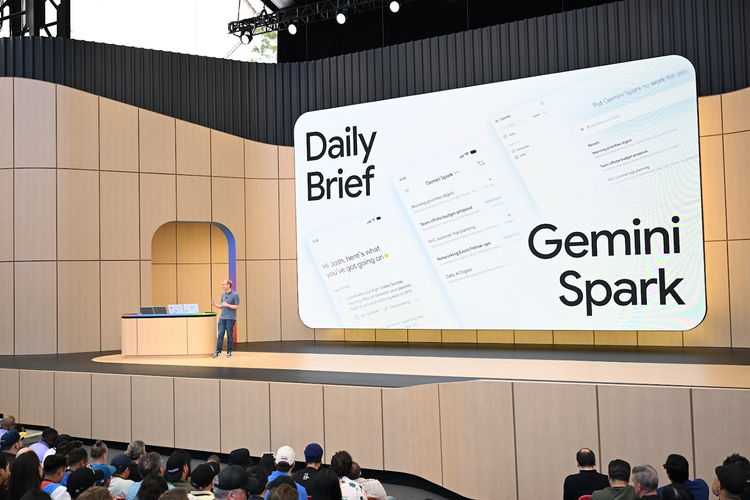
Gemini Spark Agent
Google’s new Spark agent is a personal AI agent in the Gemini app that helps users navigate their digital life and take action.
“It runs on dedicated virtual machines on Google Cloud. And it’s 24/7 so you don’t need to keep your laptop open,” said Google’s CEO.
Gemini Spark agent is powered by Gemini 3.5 and can integrate seamlessly with other Google tools as well as with third-party tools through model context protocol (MCP).
“And you can work with Spark however is most convenient—in the Gemini app or soon, through email and chat,” Pichai said.
Google is rolling out Gemini Spark to testers this week with the Beta coming to Google AI Ultra subscribers in the U.S. next week.
Google Antigravity 2.0
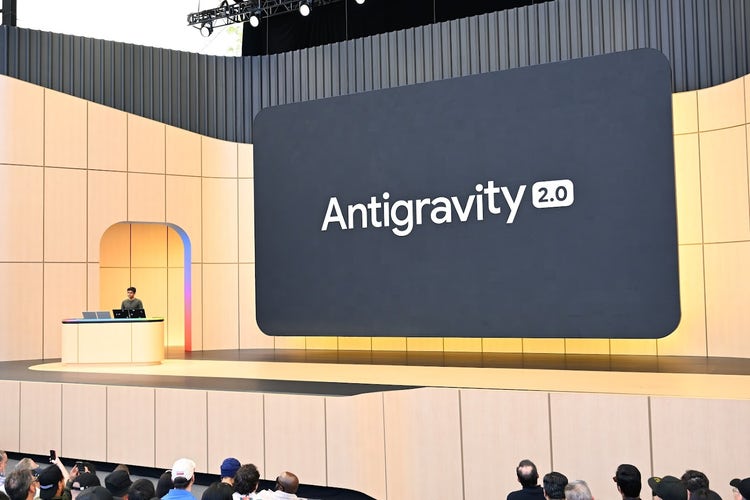
Google unveiled a new version of its agent-first developer platform Antigravity.
“Antigravity is expanding beyond the coding environment, turning it into a platform to develop and manage cohorts of autonomous AI agents,” said Google’s CEO.
“This includes Antigravity 2.0, a new standalone desktop application that acts as a central home for agent interaction, where anyone can orchestrate agents for all sorts of tasks,” he said. “And we developed an even more optimized version of Flash: not just 4x but 12x faster than other frontier models.”
Google’s new Gemini 3.5 Flash model is now available to developers in Antigravity 2.0.
Antigravity 2.0 acts as a central home for agent interaction, allowing users to orchestrate multiple agents to execute tasks in parallel.
Gemini for Science
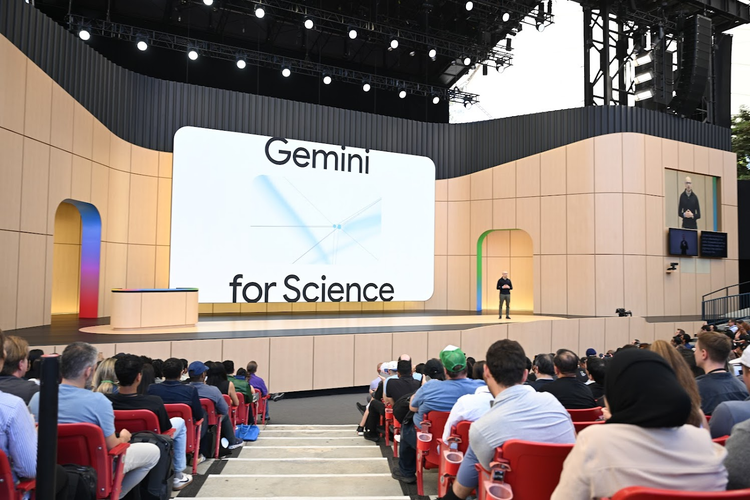
Gemini for Science is a collection of science tools and experiments designed to expand the scale and precision of scientific exploration.
Google’s CEO said Gemini for Science brings together a number of AI tools to help accelerate scientific research.
“Building on the deep reasoning and research capabilities of Gemini, as well as Deep Think and Deep Research, it includes new experiments on Labs as well as Science Skills to connect agentic platforms like Google Antigravity to over 30 major life science databases and tools,” Pichai said.
As part of Gemini for Science, Google also launched Science Skills, a specialized bundle that integrates insights from over 30 major life science databases and tools including UniProt, AlphaFold Database, AlphaGenome API and InterPro.
Using these skills on agentic platforms like Google Antigravity, allows researchers to perform complex and often manual workflows—like structural bioinformatics and genomic analyses—in minutes rather than hours, according to Pichai.
New Google TPU 8t And TPU 8i
“For the first time, we’ve taken a dual chip approach with specialized architectures for training and inference: TPU 8t and 8i,” said Google’s CEO during his keynote.
Google’s new TPU 8t is optimized for training, designed for high-throughput AI workloads. It uses new Inter-Chip Interconnect technology to scale up to 9,600 TPUs and 2 petabytes of shared memory in a single superpod.
“TPU 8t is optimized for large-scale pretraining, and it’s nearly three times the raw computing power of our previous generation,” said Pichai.
“We’ve taken a fundamentally different approach with our training infrastructure. … We can now seamlessly distribute training across multiple sites, scaling training across more than 1 million TPUs globally,” he said. “This gives us the ability to create the largest training cluster in the world. For model builders, this means training larger, more capable models in weeks rather than months.”
Looking at Google’s new TPU 8i, the TPU is optimized for inference and reinforcement learning. TPU 8i uses a new Boardfly topology technology to directly connect 1,152 TPUs in a single pod.
“TPU 8i is designed for inference. We have dramatically improved speed at every step. Because if we learned anything in 27 years of working on Search, it's that latency matters,” Google’s CEO said.