Nvidia GTC 2026: HPE Unveils Vera Rubin Systems, Expands Private Cloud AI Portfolio
HPE made a major push at Nvidia GTC 2026, introducing a set of new AI systems and services built around Nvidia’s Vera Rubin architecture.

HPE made a major push at Nvidia GTC 2026, rolling out a broad set of new AI systems and services built around Nvidia’s Vera Rubin architecture alongside expanded capabilities for its HPE Private Cloud AI cloud service—including a new air‑gapped configuration for sovereign and regulated environments.
Among the highlights are new HPE Cray Supercomputing systems based on Nvidia Vera CPUs, a rack‑scale Vera Rubin NVL72 system by HPE, a new Open Compute Project-inspired AI server, and expanded GPU scaling for HPE Private Cloud AI.
Among the new Vera Rubin-based offerings are a new HPE Cray Supercomputing GX240 compute blade for the Cray Supercomputing GX5000 based on the Nvidia Vera CPU.
The liquid-cooled HPE Cray Supercomputing GX240 starts with 16 Nvidia Vera CPUs but scales up to a mind-boggling 640 Nvidia Vera CPUs with 56,320 ARM cores per rack.
Designed for trillion-parameter AI models and beyond, the new Nvidia Vera Rubin NVL72 by HPE features support for 72 Nvidia Rubin GPUs, delivering up to a 10X reduction in inference token costs and a 4X reduction in the number of GPUs needed to train models compared with Nvidia Blackwell systems.
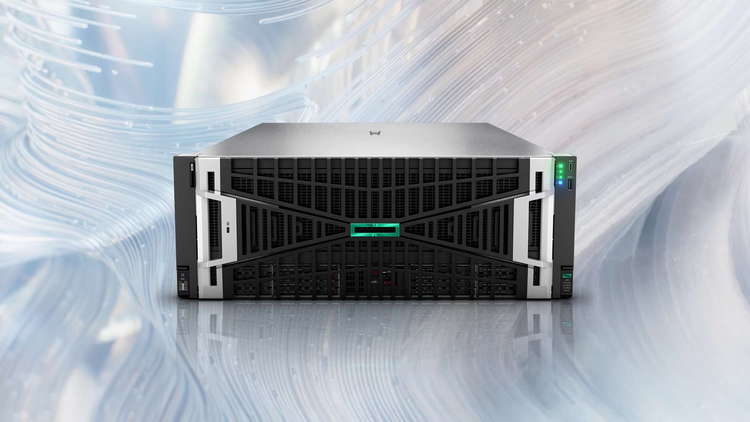
The new HPE Compute XD700—billed as an Open Compute Project-inspired AI server—is aimed at providing superior rack density and performance, supporting up to128 Rubin GPUs per rack, HPE said.
HPE is also launching an air-gapped configuration of its popular HPE Private Cloud AI turnkey cloud service for sovereign deployments.
The new air-gapped AI configuration ensures that data remains private and is not exposed to the internet, said Dale Brown, global head of growth AI Solutions for HPE.
“This is about sovereign, finance, defense, health care, regulated industries—more and more they are looking for solutions to have right-sized AI but actually be able to grow that in a completely private environment that is actually not connected to the public internet,” said Brown.
HPE is also expanding its Private Cloud AI turnkey cloud service aimed at enterprise customers to support up to 128 GPUs, up from 64 GPUs.
The support for additional CPUs allows enterprise customers to scale their enterprise solutions as they fine-tune their AI solutions.
The additional GPU support delivers the ability for enterprise customers to “grow their AI solutions as they see fit,” providing “headroom” for expanding AI solutions, said Brown.
Ultimately, the HPE-Nvidia partnership is all about “removing friction, repeatable patterns, speeding time to value with proven best tools and techniques between our companies,” he said. “We are super proud of how we have co-engineered these solutions consistently again and again.”
Here are the new HPE products and services unveiled at Nvidia GTC 2026.
HPE Cray Supercomputing GX240 Blade
One of the cornerstone announcements is the HPE Cray Supercomputing GX240 compute blade for the Cray Supercomputing GX5000 platform. HPE is positioning the GX240 as the industry’s first liquid‑cooled Nvidia Vera-based compute blade and the densest ARM‑based Vera system currently available.
The GX240 starts with 16 Nvidia Vera CPUs per blade and scales to 40 blades per rack, supporting up to 640 Nvidia Vera CPUs and 56,320 ARM cores per rack.
“We partnered with Nvidia to be the Vera Rubin and Vera Rubin solution provider,” said Chris Davidson, vice president of HPC (high-performance compute) and AI solutions for HPE.
The new GX240 is targeted at the most demanding AI solutions including the next wave of generative AI LLMs and inferencing and training at scale, said Davidson.
“What we are looking at is how do we keep up with that driving demand for organizations to develop, train and deploy,” said Davidson, speaking about HPE’s new unified AI and HPC architecture aimed at what he called delivering “groundbreaking outcomes for customers.”
Target customers include model builders powering LLM models, including facial and image recognition for faster airport security, intelligent mobile and digital features for local language, and even autonomous robots along with cloud service providers deploying large-scale AI infrastructure for enterprises and sovereign AI providers made up of government and public sector entities looking for compliance for a specific region or solution, said Davidson.
The Cray Supercomputing GX240 will provide customers with added performance and efficiencies needed for “researchers who are looking to increasingly combine their HPC and AI workloads in these workflow-type fashions whether this be space, weather or molecular dynamics,” said Davidson.
The GX240, HPE said, is also “perfect” for customers already adopting the HPE Cray Supercomputing exascale GX5000 platform and are interested in CPU partioning. “That is going to very exciting for what it enables as we move into the future of infrastructure,” Davidson said.
In addition, it is ideal for organizations looking for energy efficiency or ARM-based supercomputers, said HPE.

Nvidia Vera Rubin NVL72 By HPE
HPE is also rolling out the Nvidia Vera Rubin NVL72 rack‑scale system, designed for trillion‑parameter AI models and beyond.
The new Nvidia Vera Rubin NVL72 features support for 72 Nvidia Rubin GPUs, delivering up to a 10X reduction in inference token costs and a 4X reduction in the number of GPUs needed to train models compared with Nvidia Blackwell systems.
The fully integrated rack-scale system, which features a new unified HPC and AI GPU architecture, combines the Nvidia Vera CPUs, the Rubin GPUs, the networking and software with HPE services for deployment, said Davidson.
The extensive HPE services offered with the Nvidia Vera Rubin NVL72 include data center design, on-site expert support, customized services and sustainability services for the life of the system, said Davidson.
The system features direct liquid cooling and enhanced L11 integration, he said. “It goes beyond what our competitors are providing today. We allow customers to extract more value out of their infrastructure investments and enhanced ROI,” Davidson added.
HPE Compute XD700 Based On Nvidia HGX Rubin NVL8
HPE also introduced the HPE Compute XD700, billed as an Open Compute Project-inspired AI server.
The XD700 supports up to 128 Rubin GPUs per rack, delivering a two-times density increase compared with prior generations, according to HPE.
The two-times density increase from prior generations ensures more robust inferencing training, more inferencing and more performance “per dollar per watt,” said Davidson.
The system architecture is built on the Intel Xeon 6 processor and is optimized for both high-performance compute and AI workloads, he said.
The system is validated for scalable deployments that “speed time to value, leaning heavily on Nvidia’s reference architecture,” said Davidson. “It provides a proven configuration and form factor for from anywhere from two racks up to hundreds of racks, simplifying the deployment, reducing risk and maintaining uptime.”
HPE Unleashes HPE Private Cloud AI Air-Gapped Solution
HPE is launching a new air-gapped configuration of its popular Private Cloud AI turnkey cloud service targeted at sovereign deployments.
The new air-gapped AI configuration ensures that data remains private and is not exposed to the internet, said Dale Brown, global head of growth AI solutions for HPE.
“This is about sovereign, finance, defense, health care, regulated industries—more and more they are looking for solutions to have right-sized AI but actually be able to grow that in a completely private environment that is actually not connected to the public internet,” said Brown.
The Private Cloud AI air-gapped solution is ideal for sovereign AI solutions, said Brown.
“This solution provides even extra security about a private model bringing AI to the data but also controlling how the data is processed and where,” he said.
As for regulatory compliance, the Private Cloud AI air-gapped solution provides a level of “governorship over AI so that you can actually not only be within compliance, but you can actually prove that,” said Brown.
That compliance includes all the “constructs of administration, access and controls and how we actually build the system, said Brown.
The bottom line, he said, is that the Private Cloud AI air-gapped service allows partners and customers to understand “regulatory compliance from the ground up and the epicenter out.”
HPE has deployment services to ensure that customers get air-gapped solutions into production quickly to get “accelerated time to value,” said Brown.
HPE Teams With Nvidia On Sovereign Deployment Services
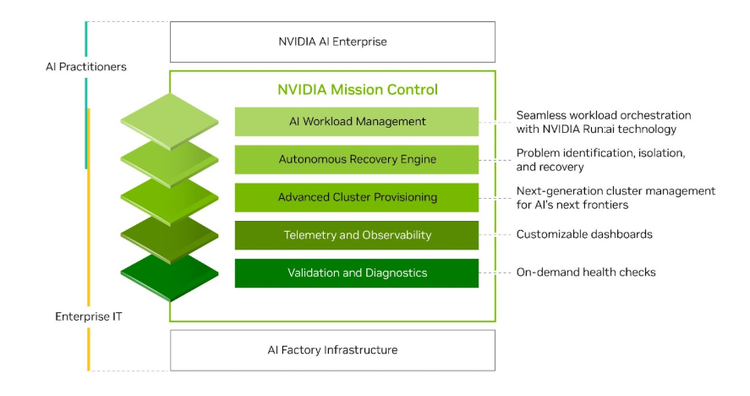
HPE is teaming with Nvidia to co-design large-scale sovereign AI factory deployments that are rapidly gaining momentum in the market.
The sovereign solutions support includes a full suite of the Nvidia Mission Control software including run.ai and Nvidia Dynamo.
HPE has enhanced the AI factory portfolio to support multi-tenancy with lightweight virtual machines with GPU pass-through and secure Kubernetes through Nvidia MIG (multi-instance GPU) capabilities, said Davidson.
“These solutions are built leveraging HPE services and expertise in data center design, liquid cooling, etc.,” he said. “This is about meeting the customer really anywhere along their AI journey.”
Further, HPE said, CrowdStrike is now delivering agentic security for HPE Private Cloud AI.

HPE Private Cloud AI Network Expansion Up To 128 GPUs
HPE is expanding its Private Cloud AI turnkey cloud service aimed at enterprise customers to support up to 128 GPUs, up from 64 GPUs.
The support for additional CPUs allows enterprise customers to scale their enterprise solutions as they expand their AI solutions.
The additional GPU support provides the ability for enterprise customers to “grow their AI solutions as they see fit,” providing ‘headroom” for expanding AI solutions, said Brown.
The HPE Private Cloud AI solution is offered in small, medium and large configurations, optimized for a specific enterprise footprint with the option to expand with prebuilt, fully integrated additional expansion racks.
“It gets implemented in the data center for the customer in a very cogent way and we are able to do that all the way up from their entry system, wherever that point of entry may be all the way up to 128 GPUs,” said Brown.
HPE has also expanded its support for the Nvidia agentic AI ecosystem with support for Nvidia AI-Q blueprint for AI Agents.
Nvidia AI-Q enables developers to build “fully customizable AI Agents that they own, inspect and control,” said HPE.
HPE is also now supporting Nvidia’s Omniverse blueprint for digital twin systems.
Nvidia AI-Q and Omniverse open the door to “two fantastic areas of growth and interest across many industries,” said Brown. “This is about how do we create a digital world and how do we have that be a tangible asset with all the metadata so that we know how it behaves, performs and we can actually engineer the way things work or we can actually deal with how we might maintain something remotely or how materials move in through a factory floor. The reality is that it is customizable and flexible with Omniverse inside of Private Cloud AI because we have already built the infrastructure for you.”
HPE Expands Nvidia ProLiant Compute At Edge, Adds Support For Blackwell RTX Pro 6000, RTX Pro 4500
HPE is stepping up its Nvidia edge computing game by adding Nvidia Blackwell RTX Pro 6000 and RTX Pro 4500 Blackwell accelerators to HPE ProLiant servers.
The RTX 6000 Pro provides 40 percent lower total cost of ownership for inference workloads compared with the prior H100 and H200 accelerators, said Brown.
The RTX 6000 and RTX Pro 4500 provide edge solution support for applications like AI-powered shopping with low latency, he said.
Brown stressed that HPE is co-designing these edge solutions with Nvidia. “These are multiple workload solutions where customers get access to the Nvidia toolsets and their ecosystems of IP beyond just the acceleration,” he said.
The HPE RTX Pro Blackwell use cases will power agentic AI robotic manufacturing applications at the edge, powering faster inventory turns and human safety of workers, said Brown.
The agentic AI support at the edge is resulting in dramatic gains in how business is done at manufacturing sites and warehouses, said Brown.
Another area for RTX Pro Blackwell is laboratory scenarios overcoming research bottlenecks and vision solutions, he said.
Those solutions need to be able to “transact lots of different types of data from different sources but at the edge again in a secure way,” said Brown.
HPE ProLiant Compute DL380a Gen12 servers and HPE Private Cloud AI systems based on the DL3802 are also being certified for Fortanix Confidential AI, a joint HPE-Nvidia solution built on Nvidia’s Blackwell Confidential Computing GPUs.