VMware’s New VCF 9.1 Cuts Customer Costs For Storage, AI And Security; Comdivision CEO Explains
With the launch of VMware Cloud Foundation 9.1, VMware is seeking to reduce customer costs around hardware, storage, Kubernetes and more with new technology and features inside the revamped private cloud platform.
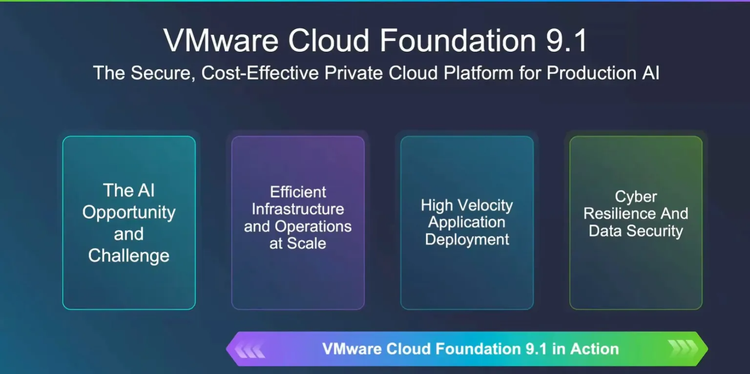
VMware’s new flagship private cloud platform, VMware Cloud Foundation 9.1, will help reduce a variety of costs for customers—from hardware and cybersecurity to Kubernetes operations—thanks to new innovation and features.
Comdivision CEO Yves Sandfort said VCF 9.1’s enhanced memory tiering, new global deduplication in vSAN and additional security features will undoubtedly drive more clients toward VCF.
“When we want to talk about whether something sells more or less, my perspective is always, ‘Does it have anything which customers need?” said Sandfort, who runs the VMware consulting partner standout. “When we look at the current market situation and VCF 9.1, I’d say yes, and there’s two main aspects.”
Sandfort said VCF 9.1 will help VMware customers reduce hardware costs, which is important in today’s market “due to current pricing for RAM and NVMe.”
[Related: Cloud Market Share Q1 2026: AWS, Microsoft, Google Battling In AI Era]
“So two new features that are very important for most customers are memory tiering and global vSAN and deduplication. This is going to help customers,” he said.
VCF 9.1 includes new Enhanced NVMe Memory Tiering that extends memory pools by intelligently tiering DRAM and NVMe.
Customers can see up to a 40 percent server cost reduction thanks to its memory tiering for clusters running a mix of AI and non-AI workloads, according to VMware.
In addition, a new multitenant infrastructure for AI isolation feature enables customers to run multiple AI projects and users on shared infrastructure with strict security boundaries, maximizing utilization of GPU and CPU resources.
“When we look at AI, we see the clear movement to enable AI, not only with the hard-to-get Nvidia GPUs but more and more features from a normal CPU perspective. That is going to help a lot of customers make it easier to adopt AI with VCF 9.1,” Sandfort said.
New Global vSAN Deduplication Tech For VCF 9.1
VMware launched new global deduplication capability for vSAN inside VCF 9.1, which is now generally available.
Sandfort said Comdivision customers will see big storage efficiency gains thanks to vSAN’s clusterwide deduplication feature.
VMware said customers can see up to 39 percent lower storage TCO through its enhanced compression and deduplication for AI data pipelines.
On the AI front, new AI observability and governance features provide metrics for time to first token, token throughput, and GPU utilization across multiple accelerator types, which Sandfort said enables customers to maximize infrastructure ROI through precise hardware utilization monitoring.
Overall, VCF 9.1 provides an AI- and Kubernetes-native private cloud platform with integrated security and mixed compute infrastructure support across AMD, Intel and Nvidia—seeking to help enterprises deploy inference and agentic AI applications with lower costs, enhanced security and more hardware flexibility.
New Security Technology And CrowdStrike Support
On the security front, Sandfort said he sees “massive security enhancements on the vDefend side, allowing people to not only use the already existing features, but now we will get virtual patching and other scenarios.”
VCF 9.1 includes virtualized load balancing and security with VMware Avi Load Balancer and VMware vDefend that eliminates hardware appliance requirements for AI inference endpoints and agentic applications—aiming to reduce capital expenses.
Other new cybersecurity technology inside VCF 9.1 includes new CrowdStrike Falcon Endpoint Security support for protecting AI models and training data, as well as zero-trust lateral security that extends distributed IDS/IPS protection to Kubernetes AI workloads that delivers 9 Tbps of threat inspection performance for distributed inference.
“All of this really allows customers with a larger VCF stack to not only save on additional security tools, which they no longer need, but also to ease operations,” Comdivision’s CEO said.
“In the end, this is going to be important because the operational overhead is going to be reduced,” he added.
VCF 9.1 Reduces Operational Overhead
The new VCF 9.1 private cloud platform is designed to run production AI at the lowest cost per workload under enterprise sovereignty, without compromising security or delivery speed.
It supports a mixed compute infrastructure across AMD, Intel and Nvidia, including multi-accelerator GPU options and high-speed networking capabilities for AI workloads.
With a unified Kubernetes and GPU platform, customer teams can deploy inference workloads, agentic AI applications and containerized services on a single infrastructure layer—without the overhead of managing separate stacks.
Sandfort said “the reduction in operational overhead” costs is very important to customers.
“VCF 9.1 is continuing the journey we had already with VCF 9.0, with a clear focus on reducing the manual overhead for the IT operations team,” he said.
“There are less steps for—not only implementation but more importantly for daily operations— and less complexity because you have one platform which allows you to run legacy virtual machines, Kubernetes workloads, but also other services in storage and networking to enhance your infrastructure,” Sandfort said.
VCF 9.1 delivers up to a 46 percent reduction in Kubernetes operational costs and 4X faster cluster upgrades, VMware said.
People Now See ‘The Value’ Of VCF; VMware Bookings Surpass $9.2 Billion
For Broadcom’s first-quarter 2026 quarterly earnings, the company reported that VMware sales increased 13 percent year over year, with total contract value booked exceeding $9.2 billion.
“What we currently see out there in the market is that, especially when it comes to medium-sized and large enterprises—but also an increasing amount of small businesses—people see the value of running and operating VCF or VVF [VMware vSphere Foundation],” said Sandfort.
“This is clearly different than what we had before because people are starting to understand that VCF or VVF can basically replace not only the hypervisor, but other silos they had before like storage, networking, security, etc.,” he said. “People are really seeing the benefits of having more eggs in one basket.”