AMD’s New Embedded CPUs Go After Intel On Performance, Energy Use And Size
With AMD marketing the chips for AI networking, storage and industrial edge use cases, the company claims that the new EPYC Embedded 2005 CPUs provide a balance of compute, energy efficiency and I/O capabilities that Intel can’t offer with a single product.
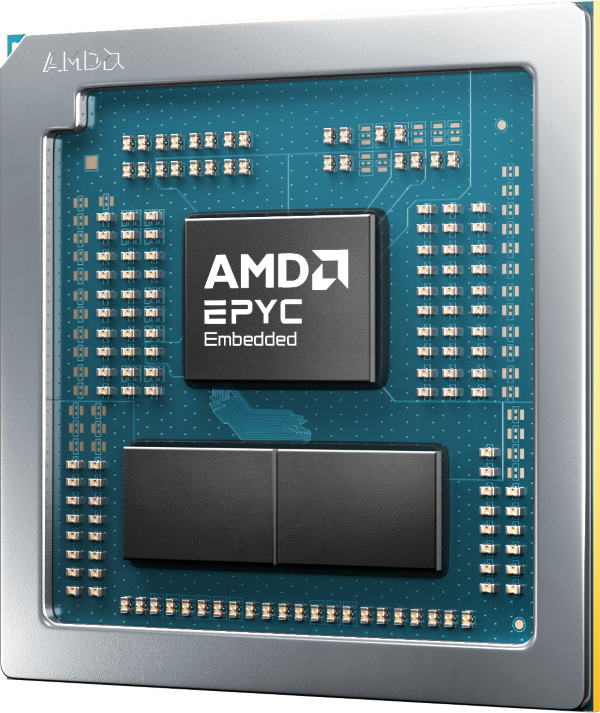
AMD said Tuesday that its new EPYC Embedded 2005 CPUs offer big advantages in performance, energy use, size and features compared to rival products from Intel.
Set to enter production in the first quarter of next year, the Embedded 2005 series processors pack up to 35 percent faster base CPU frequency using half the power of Intel’s Xeon 6503P-B and coming in a form factor that is 2.4 times smaller, AMD claimed.
[Related: Qualcomm To Bring Custom CPU Used For Snapdragon X Chips To Industrial PCs]
With AMD marketing the chips for AI networking, storage and industrial edge use cases that need to operate around the clock, the Santa Clara, Calif.-based company said that the Embedded 2005 series provide a balance of compute, energy efficiency and I/O capabilities that Intel can’t offer with a single product.
On one hand, there’s Intel’s Xeon D-2700 and D-2800 processors, which scale from four to 22 cores but use 65-135 watts and only support the last-generation PCIe Gen 4 for connectivity and DDR4 for memory.
Then there’s Intel’s Xeon 6500P-B chips, which scale from 12 to 20 cores and support the newer PCIe Gen 5 and DD5 standards but use 110-145 watts and, according to AMD, tacks on additional features that aren’t needed.
With the Embedded 2005 chips, AMD said its balanced approach is reflected in the processors scaling from eight to 16 cores and supporting PCIe Gen 5 and DDR5 while only using 45-75 watts for power consumption—without offering any unnecessary features.
Powered by the same Zen 5 architecture behind other recent AMD product lines, the Embedded 2005 series is a follow-up to the Zen-based EPYC Embedded 3000 series that debuted five years ago in 2020. The processors rely on TSMC’s 4-nanometer manufacturing node in contrast to the 14-nanometer process used for the previous lineup.
The combination of architectural and manufacturing improvements allows the Embedded 2005 series to deliver up to 3.46 faster single-threaded performance and 4.3 times faster multi-threaded performance per watt compared to the Embedded 3000 series, AMD said.
Like the predecessor, the Embedded 2005 chips come in a ball-grid array (BGA) form factor, measuring 40 millimeters long by 40 millimeters wide, for devices with constrained footprints, whether those are high-speed switches or storage systems.
Available in three models, the series features up to 16 cores, 32 threads, 64 MB of L3 shared cache, a base frequency of 3 GHz and a boost frequency of 4.5 GHz in a thermal package ranging from 45-75 watts.
All three variants come with 28 lanes of PCIe Gen 5 connectivity, four lanes for NVMe storage, two memory channels with support for DDR5-5600 or DDR5-3600, four USB 3.2 ports, one eSPI/SPI controller and one SPI controller as well as four I2C/I3C ports—the latter two of which are features important for embedded applications.
AMD is also touting their “enterprise-class” reliability, availability and serviceability (RAS) features for things like hardware fault protection, firmware fault recovery and secure boot.