AMD: ‘Significant Uptick’ In Dell PC Sales Helps Fuel Commercial Ryzen Sales
‘I think we're still quite under-represented in the enterprise portion of the business. That is where we have increased our go-to-market resources and focus,’ AMD CEO Lisa Su says of commercial PC momentum with Dell, Lenovo and HP Inc. on its latest earnings call.
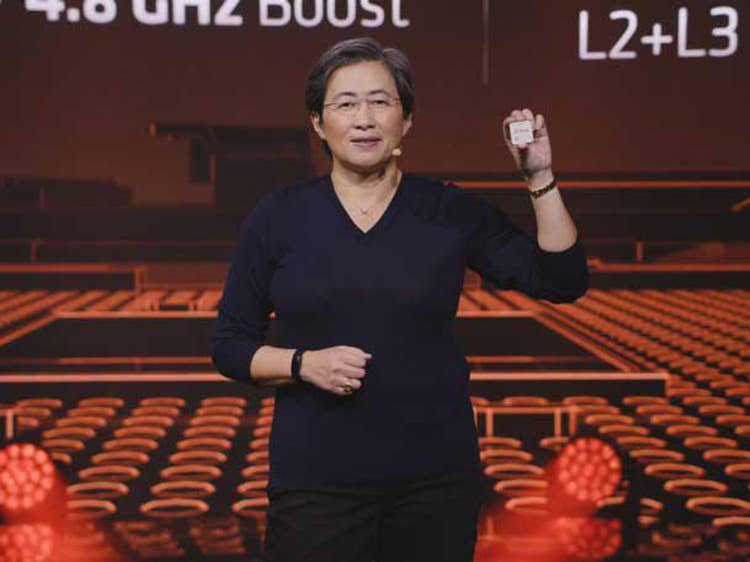
AMD Chair and CEO Lisa Su said Tuesday that a “significant uptick” in sales of Dell Technologies PCs using its Ryzen processors helped fuel a 25 percent year-over-year increase in client chip sales to OEMs for commercial purposes.
Su (pictured) made the disclosure in the company’s second-quarter earnings call, seven months after AMD announced its first commercial PC deal for Ryzen with Dell, which had long relied on Intel CPUs for the device segment that is critical to PC market growth.
[Related: AMD Exec: Dell Commercial PC Deal To Cover Broad Customer Base]
The CEO said the Santa Clara, Calif.-based company also saw “strong sell-through” for AMD commercial notebooks with Lenovo and HP Inc., adding that Dell continues to “ramp availability” of its AMD commercial portfolio.
Citing new enterprise deals with Fortune 2,000 customers in the pharmaceutical, tech, automotive, financial services, aerospace and health-care sectors, Su said the company expects to “continue growing our commercial client share based on the strength of our product portfolio and expanded breadth of OEM offerings.”
“I think we're still quite under-represented in the enterprise portion of the business. That is where we have increased our go-to-market resources and focus. And we're seeing nice traction there, especially with the portfolios that we have from HP and Lenovo in enterprise PCs, and now we're adding Dell,” she said on call.
The commercial PC growth helped fuel record sales for AMD’s Ryzen processors, which, along with record EPYC server chip revenue, allowed it to grow second-quarter revenue 32 percent year over year and 3 percent sequentially to nearly $7.7 billion.
This represented a new overall revenue record for the company, and it was higher than what Wall Street analysts were expecting.
U.S. Export Curbs Hurt Instinct Sales, Broader Profitability
By contrast, AMD’s earnings per share were 48 cents on a non-GAAP basis, down 40 percent year over year and in line with Wall Street’s expectations.
The decline was mainly driven by $800 million in inventory and other charges the company recorded for the period due to new U.S. export control restrictions on a version of its Instinct MI300 data center GPUs that had been tweaked for the Chinese market.
AMD said the $800 million in charges reduced the company’s earnings per share by roughly 43 cents, and they also dragged down its non-GAAP gross margin by approximately 11 percent. This resulted in a non-GAAP gross margin of 43 percent, down 11 points from the previous quarter and down 10 points from the same period last year.
On the earnings call, Su said the U.S. export restrictions “effectively eliminated” sales of its tailor-made Instinct MI308 GPUs and resulted in the company’s data center AI revenue declining year over year in the second quarter.
However, Su said, AMD was informed earlier in the quarter by the U.S. Department of Commerce that “it is moving forward with the review of our license applications to export MI308 to China.”
As a result, AMD expects MI308 shipments to resume “as licenses are approved, subject to end customer demand and supply chain readiness,” according to Su.
While AMD said it didn’t include MI308 revenue in its third-quarter guidance—which estimates total revenue to grow by roughly 28 percent year over year to approximately $8.7 billion—the company expects Instinct revenue to grow year over year in the period despite that.
Su Touts Progress For MI350, MI400 GPUs
Outside China, Su said AMD made “solid progress” with its Instinct MI300 and MI325 GPUs that came out over the past two years, citing “new wins and expanding adoption with tier-one customers, next-generation AI cloud providers and end users.”
“Today, seven of the top 10 model builders and AI companies use Instinct, underscoring the performance and [total cost of ownership] advantages of our data center AI solutions,” she said.
Regarding the MI350 GPUs the company announced at its Advancing AI event in June, Su said it began volume production of the chips “ahead of schedule” that month, with an expectation for a “steep production ramp in the second half of the year to support large-scale production deployments with multiple customers.”
As for its next-generation MI400 GPUs that AMD claims will fuel the “highest-performance AI system in the world when it launches” next year for rack-scale AI platforms, Su said “development is progressing well” and cited “significant interest in large-scale deployments from multiple high-profile customers.”
While Su didn’t name any of these high-profile customers on the call, she called OpenAI a “very early design partner” for the MI450 GPU at June’s Advancing AI event, where OpenAI founder and CEO Sam Altman joined her on stage to express his excitement.
“Looking ahead we see a clear path to scaling our AI business to tens of billions of dollars in annual revenue,” she said on Tuesday’s earnings call.
EPYC Sets ‘Records For Both Cloud And Enterprise CPU Sales’
Su said a significant ramp of the company’s fifth-generation EPYC processors combined with “sustained demand” for earlier generations allowed its data center business to “set records for both cloud and enterprise CPU sales” in the second quarter.
As a result, AMD’s data center revenue grew 14 percent year over year to $3.2 billion for the period, with Su saying that the company grew its year-over-year share in the market against Intel for a 33rd consecutive quarter.
With more than 100 new AMD-powered cloud instances coming online in the period, Su said, “there are now nearly 1,200 EPYC cloud instances available globally as providers continue expanding both the breadth and regional availability of their AMD offerings.”
“This continued expansion is accelerating enterprise adoption of EPYC in the cloud, with deployments growing significantly from the prior quarter as we closed large wins with dozens of large aerospace, streaming, financial services, retail and energy companies,” she said.
Su also touted significant growth in EPYC enterprise deployments on-premises, with the company notching new deals with large customers in technology, automotive, manufacturing, financial services and public sector industries.
This growth was supported too by Hewlett Packard Enterprise, Dell, Lenovo and Supermicro launching 28 new server platforms using its fifth-generation EPYC chips, according to the CEO.
“Looking ahead, we remain bullish on our server CPU business driven by durable tailwinds including growing demand for cloud and on-prem compute, sustained share gains and the growing investments in general-purpose infrastructure required to enable AI,” she said.
AMD’s stock price was down more than 4 percent in after-hours trading.