Trump: Intel To Give US 10 Percent Stake In Chipmaker
‘He walked in wanting to keep his job, and he ended up giving [a] $10 billion [stake] to the United States,’ President Trump said on Friday of his meeting with Intel CEO Lip-Bu Tan after he called for the semiconductor leader to resign more than two weeks ago.
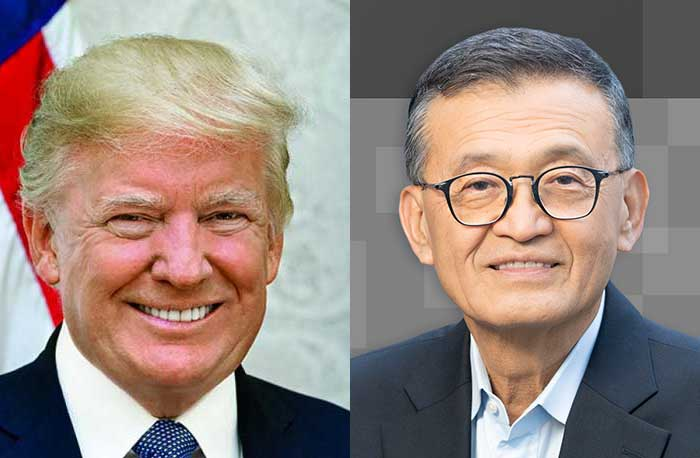
President Trump on Friday said that Intel has agreed to give the U.S. government a 10 percent stake valued at roughly $10 billion in the troubled semiconductor giant.
“I said, ‘I think you should pass 10 percent of your company.’ And they said, ‘Yes, that’s about $10 billion,’” Trump said in an Oval Office gathering with reporters before saying that Intel CEO Lip-Bu Tan agreed to the president’s request.
[Related: Exclusive: Intel Boosting Partner Incentives With ‘Simplified’ Alliance Program]
“He agreed, and they’ve agreed to do it, and I think it’s a great deal for them,” Trump said.
Later in the day, Commerce Secretary Howard Lutnick said, “The United States of America now owns 10 [percent] of Intel, one of our great American technology companies.”
“This historic agreement strengthens U.S. leadership in semiconductors, which will both grow our economy and help secure America’s technological edge,” he wrote on X. “Thanks to Intel CEO Lip-Bu Tan for striking a deal that’s fair to Intel and fair to the American People.”
Intel’s stock price was up more than 5 percent on Friday.
An Intel spokesperson declined to comment on Trump’s announcement.
Additional details about the agreement between the U.S. government and Intel were not available as of press time. However, media reports and remarks by Lutnick earlier in the week suggested how it could come together.
Lutnick told CNBC on Tuesday that the Santa Clara, Calif.-based chipmaker “should” give the U.S. government an “equity stake” for the U.S. CHIPS and Science Act funding that was awarded to Intel under the Biden administration.
Citing a White House official and other anonymous sources, Bloomberg reported Monday that the Trump administration is in talks to gain an approximately 10 percent stake in Intel as part of a potential investment that “would involve converting some or all of the company’s grants from the U.S. CHIPS and Science Act into equity.”
Intel was approved for a total of $10.86 billion in grants from the U.S. CHIPS and Science Act after the company finalized agreements with the Biden-led White House last year. These grants consisted of $7.86 billion to support Intel’s build-out of U.S. chip manufacturing and advanced packaging plants and up to $3 billion for a Pentagon-connected Secure Enclave program that is meant to help the U.S. military improve its capabilities and secure a domestic supply chain.
So far, Intel has received $2.2 billion of the $7.86 billion award, the company said in its quarterly filing with the U.S. Securities and Exchange Commission in late July.
Trump On How The Intel Deal Was Reached
The president said the agreement was reached after Trump demanded that Tan resign for being allegedly “totally conflicted” on Aug. 7 and then met with Tan at the White House four days later to discuss Trump’s concerns.
“He walked in wanting to keep his job, and he ended up giving [a] $10 billion [stake] to the United States. So we picked up $10 billion. And we do a lot of deals like that. I’ll do more of them,” Trump said on Friday.
Trump said the source of his issues with Tan was a letter sent by Sen. Tom Cotton earlier in the month to Intel Chairman Frank Yeary. The letter raised concerns about “Intel’s operations and its potential impact on U.S. national security” in connection to Tan’s alleged investments in Chinese firms and a late July guilty plea by the previous company Tan led, Cadence Design Systems, for selling software to a Chinese university on the U.S. Entity List.
In a letter Tan sent to Intel employees Aug. 8 after Trump’s call for him to resign, the CEO defended his integrity as a tech executive and investor and said the chipmaker was “engaging” with the Trump administration to address concerns it has.
Trump called Cotton’s letter a “pretty nasty story” on Friday and said he warmed up to Tan after meeting with the Intel CEO on Aug. 11.
“We talked for a while. I liked him a lot. I thought he was very good. I thought he was somewhat a victim, but nobody’s a total victim, I guess,” he said.
The president then said, “And I said, ‘You know what? I think the United States should be given 10 percent of Intel.’ And he said, ‘I would consider that.’ I said, ‘Well, I’d like you to do that because Intel has been left behind compared to Jensen.’”
Trump was referring to Nvidia, whose CEO and founder, Jensen Huang, had lobbied the White House to let the company sell its H20 GPU to Chinese companies earlier this year. The U.S. government eventually granted it an export license for Nvidia to sell the chip into China in exchange for giving the U.S. a 15 percent cut of its Chinese sales revenue.
Nvidia told some suppliers this week to halt production of the H20, according to a Thursday report by The Information.
Nvidia did not respond to a request for comment by press time.