6 Solution Provider Execs On The Impact Of Rising Memory Prices
CRN asked solution providers how rising memory prices are impacting profitability and the sales cycle in the wake of tough new measures impacting price quotes from top hardware OEMs. Here’s what they had to say.
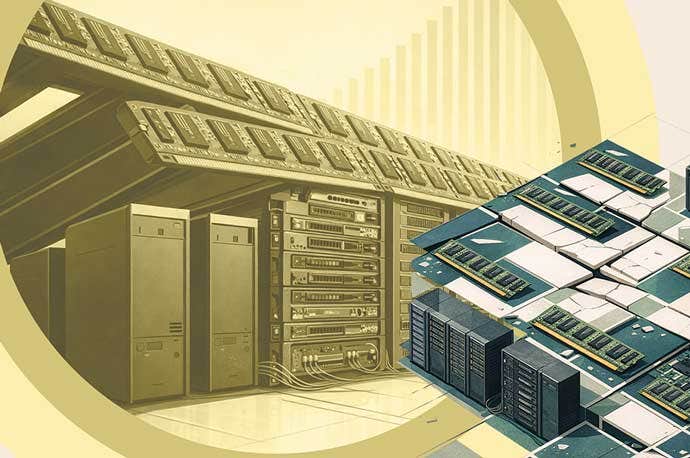
Solution providers told CRN they are grappling with order cancellations and working proactively with customers to guide them through the memory price increases and supply shortages of DRAM and NAND.
Major OEMs have raised prices and moved to implement tough new quoting validity measures and new contract terms and conditions that are impacting solution providers as well as their customers.
HPE raised prices in November, December and January.
HPE also shortened “the quote validity windows to 14 days (excluding public sector, B2B, OEM),” down from 30 days, and has “updated the contract terms and conditions for server and GreenLake orders to allow for price adjustments until the date of shipment.”
Dell Technologies Vice Chairman and COO Jeff Clarke said in a call with analysts that the company changed server pricing in December and PC prices in January.
“We made list price changes across the board. We changed, in our vernacular, our internal mechanisms around Smart Price and margin floors all changed instantaneously,” said Clarke. “We’re moving to discount off list price. We’re compressing discounting. Our quotes are valid for the shortest period of time they’ve ever been and we’re reducing promotions and all sorts of special pricing going forward.”
Lenovo, meanwhile, said it was making pricing changes to certain commercial client device products in early March.
Lenovo also said price quotes for servers and storage have been limited to 14 days for Lenovo’s internal bidding platform and 30 days for the external bidding platform.
Here is how solution provider executives responded when asked by CRN how rising memory prices are impacting profitability and the sales cycle in the wake of new measures impacting price quotes from top hardware OEMs.

Stefan Hellersperk
President, Lead Technician
ACS Computer Services
Morehead City, N.C.
We still custom-build desktops, but the memory that used to be $60 or $70, now it’s $140. And [indications are] it’s going to go higher. [It’s impacting] profitability for sure. I recently ordered laptops for a municipality, and a week later Dell canceled it. So I went to redo it. Well, the pricing now is way [higher]. I’ve already told the customer that it’s [a certain] price. So what do I do? I ate that. I’m the guy that’s going to stand behind what I say.
Now I’m [telling customers], ‘I’m going to give you this price but if something happens on the distribution side, there’s a chance that I might have to go back and get reapproval for a different price because memory and hard drive pricing is just in this big flux now.’ It used to be good for a week. Now you don’t have that window. I’ve never been in that kind of situation. So it puts me in a real bad spot because there’s only so many times you can take that hit.

Billy Sherlock
President
Affordable Computer Solutions
Largo, Fla.
It is costing the end user. We have a storefront, so we get a lot of people that walk in. Just last week, we had a gaming build. I bought two 32-GB sticks of RAM. It was $680. Normally it’s like half that. So we pass [the cost] along. So what we’ve seen is people are trimming down on the amount of RAM that they’re putting in. Video card prices aren’t so bad now, but the RAM and even SSD hard drives are through the roof. We buy stock and we hold it in. And we were selling SSD hard drives cheaper than you can buy them online now. And I’m [saying], we’ve got to raise the prices now. We’ve got to replenish it. So for us, we just stopped holding stock because of the fluctuation.
Bob Coppedge
Owner
Simplex IT
Stow, Ohio
One thing we always have to remember is that we operate in the supply chain. Our role is to help our clients and partners acquire the products and resources they need to run their businesses at the best possible price and with reliable availability. That also means helping guide them through periods of scarcity or rising costs.
As long as we communicate clearly and set expectations ahead of time that these challenges can happen, we can help our partners navigate both the risks and the opportunities that come with them. Rising costs may create pressure for everyone, but if we stay transparent and proactive, we can also identify areas where there are advantages or signs of improvement ahead.
Ultimately, it’s a partnership. Our job is to help our partners manage uncertainty while positioning them to take advantage of opportunities when they appear.

Paul Vedder
Co-Founder, Chief Experience Officer
VXIT
West Palm Beach, Fla.
All it’s really doing is adding complexity to the deal, but we are not going to lose margin on that. Unfortunately we’re just the messenger, and we’re not going to be [held responsible] because of external forces that we cannot control. So what we are trying to do is plan better for our clients, but the reality is that things are more expensive and it is what it is.
Mark Grundy
President
CorKat Data Solutions
Loveland, Colo.
We’re probably a little bit unique because we have a channel side business as well that does private data center services. So for us, we’re looking at a hardware refresh that we’ll have to re-evaluate because of the cost. It’s just part of the math problem, I guess.
Almost all of our customers, 95 [percent] or 96 percent, are fully hosted. They don’t need servers because we have a private data center. Their stuff all lives in our data center, so for us, it’s less of an issue. Other than, you know, endpoint.
Most of our clients use VDI [virtual desktop infrastructure], so the device becomes less relevant. And instead of having do a hardware refresh every three to four years, we can run it much longer because all there really is is a keyboard and mouse connected to the internet. The PC is just what you plug them into. The processing power becomes less relevant. We were good during COVID because everybody else had to figure out how to support customers at home, and we didn’t.
Manuel Villa
Founder, President
VIA Technology
San Antonio
We’re telling our salespeople that every proposal we have out there we need to close them right away or else we are going to have to reprice them. We have no control over memory prices.
It’s pretty bad. Companies are shifting their strategies. It is affecting everybody. We see it across the board. Every single technology is being affected by this.
It’s going to affect us because when we give a price, we honor it. We are locked into certain contracts.