AMD Refreshes Ryzen AI Chips, Goes After Nvidia’s DGX Spark
In addition to announcing Ryzen AI 400 chips that AMD says can outperform Intel’s latest for laptops and small form factor PCs, the company says its beefier Ryzen AI Max processors can best the chip inside Nvidia’s DGX Spark mini PC when it comes to performance per dollar.
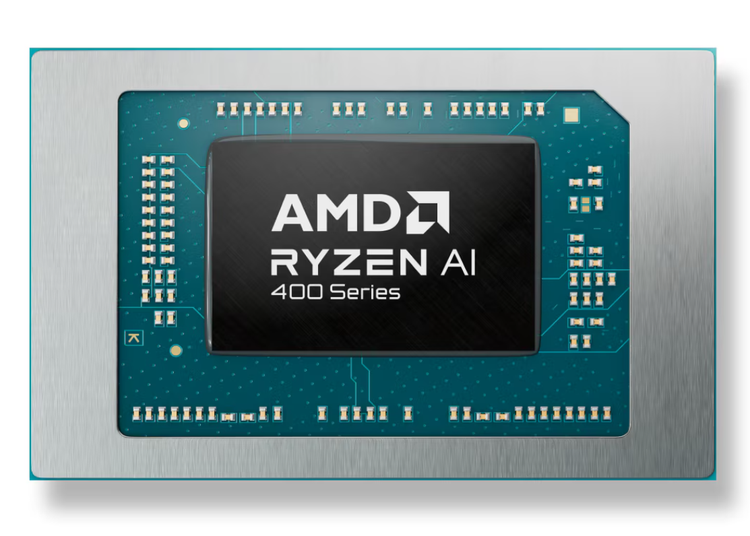
AMD used CES 2026 to announce a new line-up of Ryzen AI processors to go up against Intel’s latest in thin-and-light laptops—and show how it’s fighting Nvidia in a new arena.
The Santa Clara, Calif.-based chip designer revealed that its Ryzen AI 400 series will push the maximum CPU frequency to 5.2GHz and NPU performance to 60 trillion operations per second (TOPS) for laptops compatible with Microsoft’s Copilot+ PC program. In contrast, the Ryzen AI 300 chips maxed out at 5.1GHz and 55 TOPS, respectively.
[Related: Qualcomm: Snapdragon X2 Plus PC Chips Bring Big Speed Boosts For ‘Modern Professionals’]
The company also teased that it plans to release socketed Ryzen AI 400 models for desktop PCs, which would mark a first for AMD’s AI PC chip brand.
The Ryzen AI 400 processors are expected to debut in laptops and other small form factor devices from Dell Technologies, HP Inc., Lenovo and other OEMs by March.
AMD is pitching the new wave of Ryzen AI chips for those who want devices with the best CPU, GPU and NPU performance in combination with multi-day battery life and “leading AI performance and experiences.”
The Ryzen AI 400 processors also boost graphics frequency to as much as 3.1 GHz and memory speed to a maximum 8,533 megatransfers per second (MT/s), up from the 2.9 GHz graphics frequency and 8,000 MT/s memory speed of the previous generation.
The specs that aren’t changing from the Ryzen AI 300 series are the maximum 16 cores and 32 threads based on AMD’s Zen 5 architecture as well as the maximum 16 GPU cores based on the RDNA 3.5 architecture.
Compared to Intel’s 30-watt, 8-Core Ultra 9 288V, AMD claimed that its 28-watt, 16-core Ryzen AI 9 HX 470 is 30 percent faster for multitasking, 70 percent faster for content creation, 10 percent faster for gaming and 70 percent faster on the Cinebench 2024 nT bench while running on the laptop’s battery in balanced power mode.
“With the Ryzen AI 400 series processors, we’re leading across every use case, no matter what you use your PC for,” said Rahul Tikoo, senior vice president and general manager of AMD’s client business unit, in a briefing with journalists.
AMD Expands Ryzen AI Max Lineup, Makes New Claims Against Nvidia
AMD also expanded its lineup of Ryzen AI Max processors that debuted a year ago and came out with new claims about how they compare to the chips inside Nvidia’s DGX Spark mini workstation and Apple’s M5-based MacBook Pro.
These chips are larger and more powerful than the standard Ryzen AI processors, mainly thanks to the maximum of 40 GPU cores based on the RDNA 3.5 architecture, which helps make the integrated GPU capable of performing up to 60 teraflops. The top chip maxes out to 16 Zen 5 cores, 32 threads and a 5.1 GHz boost frequency. All others reach 5.0GHz, and the NPU performance is 50 TOPS for every model.
A key feature of the Ryzen AI Max series is how the processors can allocate up to 128 GB of system memory for the large, integrated GPU, which can make them a good fit for running large AI models and other heavy workloads.
“When we designed the Ryzen AI Max processors, this was the ultimate processor that we could design for content creators and gamers and bringing it into a common design point. But we also created a brand-new category of PCs for AI developers that wanted [a] large amount of performance,” Tikoo said.
With the expanded lineup, AMD has added 8- and 12-core models that reach 40 GPU cores and 60 teraflops, going beyond the 32 GPU cores and 40 teraflops in the existing 8- and 12-core products that came out last year.
In new claims, AMD compared the HP Z2 Mini G1a mini workstation, powered by its flagship Ryzen AI Max+ 395 Pro and equipped with 128 GB of system memory to Nvidia’s DGX Spark, powered by the GB10 system-on-chip with the same amount of memory. Nvidia released DGX Spark last year as a new class of workstation PC for AI developers.
The company said the HP device provides 50 percent more tokens per second per dollar for OpenAI’s 20-billion-parameter GPT-OSS large language model and 70 percent more tokens per second per dollar for the 120-billion-parameter version of the same model.
“If you compare the Ryzen AI Max platform to the latest Nvidia DGX Spark, you’ll notice you’ll get fantastic AI performance at a much better price point than the DGX Spark in what’s shown here in the latest GPT-OSS models,” Tikoo said.
AMD also noted that in contrast to DGX Spark, which runs on a customized version of the Linux-based Ubuntu operating system, Ryzen AI Max systems run on both Windows and Linux operating systems, supporting thousands of Windows applications.
Taking aim at Apple, the company said the Asus ROG Flow Z13 laptop, powered by the same Ryzen AI Max+ 395 Pro, can outperform a MacBook Pro based on Apple’s latest M5 system-on-chip by 40 percent in AI inference, 80 percent in multitasking, 80 percent in content creation and 60 percent in gaming, based on benchmarks it ran internally.
While the positioning of the Ryzen AI Max series against chips inside the DGX Spark and M5-based MacBook Pro shows the opportunity AMD sees in powering performant PCs in small form factors, Tikoo indicated that the processors won’t see the same broad adoption that the company expects for its standard Ryzen AI chips.
“We are certainly seeing a lot of interest in the Ryzen AI Max chips across content creation and across AI development. But the Ryzen AI Max chips are not for the vast majority of use cases, which are everyday use cases, whether you’re an office worker, whether you’re a road warrior, whether you are a consumer [or] gamer,” he said.