Intel’s Supply Issues Helped AMD Grab Record-High CPU Market Share: Researcher
Facing unexpectedly high demand for server CPUs, Intel has prioritized production of such products over client CPUs, particularly low-end models, due to supply constraints. CPU-tracking firm Mercury Research says this helped AMD gain market share in the fourth quarter.
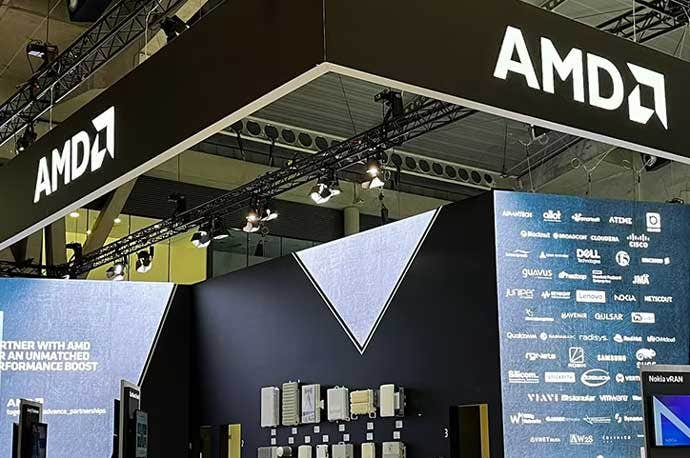
Intel’s decision to prioritize server CPU production in the face of supply constraints helped AMD achieve an all-time high in overall market share by ceding ground in the PC space, according to CPU-tracking firm Mercury Research.
Dean McCarron, president of Mercury Research, made the connection between Intel’s supply issues and AMD’s market gains in his Thursday commentary for his firm’s x86 CPU market- share report covering the fourth quarter of last year.
[Related: AMD CEO Expects Server CPU Supply Ramp To Help Boost Revenue]
The supply constraints contributed to AMD’s overall CPU share, minus IoT and semi-custom products, reaching a record high of 29.2 percent against Intel’s 70.8 percent share in the fourth quarter, according to Mercury. This represented a 3.6-point sequential increase and a 4.5-point increase from the same period in the previous year for AMD.
Intel also lost market share to AMD in server CPUs despite both companies shipping a higher number of products than usual for the quarter.
“AMD saw far stronger than median seasonal growth across all segments in the quarter,” except for semi-custom products for game consoles, McCarron wrote in an email.
“In contrast, Intel’s desktop and mobile shipments were weaker than seasonal due to supply constraints. And while Intel’s server CPU growth slightly offset the downturn in client, it was not enough to impact overall share change,” he added.
In a separate email, an AMD spokesperson said its revenue share of the x86 CPU market share against Intel grew across the board, hitting 41.3 percent in servers, 42.6 percent in desktops and 24.9 percent in mobile PCs. The company calculated its revenue share based on Mercury’s market-share report, which tracks CPU shipments.
Facing unexpectedly high demand for server CPUs, Intel has in recent months prioritized production of such products over client CPUs, particularly low-end models, due to supply constraints. Even with this reallocation, Intel CFO David Zinsner said last month in the company’s earnings call that its server CPU revenue for the fourth quarter “would have been meaningfully higher if we had more supply.”
“We’re absolutely constrained. What we’re doing within client, we’re focusing on the mid- and high end and not as focused on the low end. And then, to the extent we have excess, we’re pushing all of that into the data center space to meet that customer demand. I think you’ll see some share adjustments based on that,” he said on the call.
How Intel’s Supply Issues Impacted PC Market Share
This capacity reallocation, according to McCarron, “hit the company’s mobile client CPU shipments the hardest, resulting in Intel experiencing significant sequential and on-year declines in shipments, far below seasonal norms in what is typically an up quarter.”
“In contrast, mobile client CPUs was AMD's strongest segment in the quarter. This resulted in a large increase in AMD's share of the mobile CPU market, which set a new record high in the quarter,” the researcher wrote.
As a result, AMD’s share in the mobile CPU segment grew 4.1 points sequentially and 2.2 points year over year to 26 percent against Intel’s 74 percent, according to Mercury.
Intel also suffered from supply constraints in the desktop CPU segment. AMD’s share in this area grew 2.7 points sequentially and 9.5 points year over year to a record high of 36.4 percent against its rival’s 63.6 percent, the firm said.
Desktop processors grew at below-normal seasonal rates in the quarter, with AMD's above-seasonal results offset by Intel's weaker (but mildly positive) growth due to supply constraints,” McCarron wrote in his email.
Whereas AMD’s high-end Ryzen 9000 “Granite Ridge” processors were AMD’s primary growth driver for the segment in previous quarters, the company’s shipments this quarter “were broadly higher across all product lines, including older CPUs and AMD’s [Ryzen 8000G] ‘Phoenix Point’ APU products,” according to the researcher.
Despite Server CPU Priority, Intel Still Loses Share To AMD
Even with Intel prioritizing production capacity for server CPUs and shipping nearly double its seasonal average, it wasn’t enough to outpace AMD’s growth in the segment for the fourth quarter, McCarron said. That’s because AMD’s server CPU shipments “grew at more than triple the average,” he added.
As a result, AMD’s server CPU share grew 1.1 points sequentially and 3.1 points year over year to 28.8 percent against Intel’s 71.2 percent, according to Mercury. This marked another record high for AMD, said McCarron.
The researcher pointed out that the company’s fifth-generation EPYC “Turin” processors accounted for more than 50 percent of server revenue for the first time. Meanwhile, Intel’s fifth-generation Xeon “Emerald Rapids” chips surpassed the previous generation, code-named “Sapphire Rapids,” to “become Intel’s best-selling server core,” he added.
When including semi-custom and IoT products in the overall CPU market numbers, AMD still managed to grow share by 0.4 points sequentially and 5.7 points year over year to 31.3 percent against Intel’s 68.7 percent. The main factor that slowed sequential growth for AMD was a decline in system-on-chip shipments for game consoles.
Both Intel and AMD have vowed to increase production capacity this year, with the former expecting improvements every quarter.