Snowflake Is Unlocking AI’s Future—And For Partners, There’s No Time Like The Present
As Snowflake CEO Sridhar Ramaswamy brings his technical prowess and eye for innovation to bear, partners tell CRN that 2026 will be a year of massive growth and acceleration for their AI business.
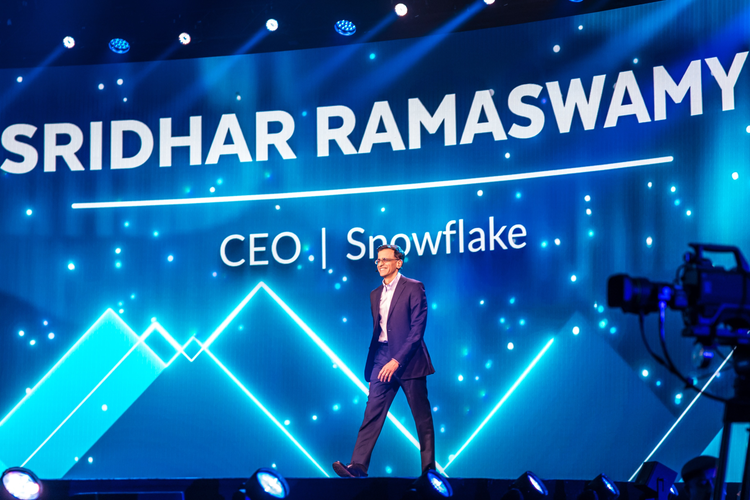
“[I was] completely unprepared for the question,” Ramaswamy told CRN in a recent interview. But in that moment, he seized the opportunity to showcase one of his company’s latest GenAI products—the Snowflake Intelligence agentic AI conversational platform for interacting with structured and unstructured data.
His query to Snowflake Intelligence produced a robust list of Snowflake aerospace customers. “No problem,” Ramaswamy said.
The experience wasn’t only a great example of the platform’s benefits, but an indication of how far the cloud-native data platform company has come in its 14 years, evolving beyond data warehousing, embracing the AI revolution and even moving into new markets like application building through offerings like Streamlit and Snowpark. On the horizon is its entrance into the observability space through its recent acquisition of Observe.
“There’s lots more to come,” he said. “There’s a lot of both anticipation and realization that big changes are afoot.”
Ramaswamy—named CEO two years ago after previously serving as Snowflake’s senior vice president of AI—said he wants to take the company’s channel partners along for the ride. The Bozeman, Mont.-based vendor’s partner ecosystem has exploded to more than 14,200 global partners, up 22 percent year over year and 24 times the 600 partners Snowflake had in 2022.
“Our partners have always played a key role in helping realize the value of Snowflake, hence the growth,” he said. “This is going to be a really interesting year, not only because our partners can help customers get more value from their data using AI and agents, but they can dramatically change the process by which they do their work as well.”
Just as Snowflake’s business is evolving for the AI era, solution providers are re-evaluating what it means to be an effective partner as customers look to adopt more AI tools and AI agents.
Solution providers who work with Snowflake told CRN that 2026 is shaping up to be the year many AI pilots move into production and clients seek a return on their investment.
Jim Martindale, CEO of Tampa, Fla.-based Snowflake partner BlueCloud—No. 484 on CRN’s 2025 Solution Provider 500—said that what makes Snowflake a powerful partner is its track record for innovating on technology that solves “huge pain and constraint for basically every organization” while maintaining vendor agnosticism for clients afraid of lock-in with any particular hyperscaler.
“It’s a pretty impressive story, to be honest,” said Martindale, whose company was named Snowflake’s 2025 Americas Data Cloud Services Innovation Partner of the Year.
Also impressive is the role Ramaswamy has played in bringing technical prowess and an eye for innovation as the company’s top executive, said Joe Berg, general manager and global leader for data and AI at Seattle-based Snowflake partner Slalom, No. 31 on CRN’s 2025 Solution Provider 500.

‘[Snowflake CEO Sridhar Ramaswamy] has been the right leader at the right time for that organization. He is exactly what they needed for their competitive moment, especially in the era of AI.’
—Joe Berg, GM, Global Leader, Data, AI, Slalom
Holding a doctorate in computer science from Brown University, Ramaswamy has brought a greater level of engineering expertise to the top job and has greatly accelerated Snowflake’s product release cadence.
“He’s been the right leader at the right time for that organization,” said Berg, whose company was named Snowflake’s 2025 Global Data Cloud Services AI Partner of the Year. “[He] is exactly what they needed for their competitive moment, especially in the era of AI.”
Partner Program Bonanza
Snowflake’s partner base includes close to 11,000 global services partners, up 26 percent year over year. It also includes 9,900-plus global data cloud product (DCP) partners, up 25 percent year on year. Members of the Snowflake ecosystem can be both DCP partners and global services partners.
While Ramaswamy is proud of the program’s swelling partner ranks, he also points to the growing engagement of partners through global partner certifications and accreditations. The ecosystem now boasts 27,068 global partner certifications, up 24 percent year over year, and 14,210 global partner accreditations, up 4 percent year over year.




Solution providers identified certifications and accreditations as an important differentiator in the fast-growing partner program to help separate experts from newcomers.
Ramaswamy wants to see more partners making billions of dollars off Snowflake every year, the CEO said while seated at cafe-style tables at a Snowflake office in Menlo Park, Calif.—an office, incidentally, that is part of a 773,000-square-foot campus Snowflake took over from Facebook parent Meta. The space leans into the winter theme, with a white-and-blue aesthetic, a stuffed polar bear to greet guests as they exit the elevator and a row of snowboards adorning a wall.
If typical services and consumption revenue ratios hover from 5-to-1 to 10-to-1, Snowflake partners driving $1 billion of new Snowflake revenue can see $5 billion to $10 billion of additional opportunity, Ramaswamy said.

‘It is a time of big change for Snowflake and partners. AI brings us closer to helping our customers realize value. And both partners and Snowflake need to seize this opportunity together.’
—Sridhar Ramaswamy, CEO, Snowflake
“It is a time of big change for Snowflake and partners,” he said. “AI brings us closer to helping our customers realize value. And both partners and Snowflake need to seize this opportunity together.”
To help partners capitalize, Snowflake named Amy Kodl as its senior vice president of channels and alliances in December. Snowflake did not make Kodl, the company’s fourth channel leader in three years, available for an interview for this article, saying she was still settling into her role.
Ramaswamy has tasked Kodl with building strong relationships so that Snowflake and its partners tackle potential sales together right from the start.
“Every use case that we win, every customer that we win, typically has a partner. I want that to be a robust, tied-at-the-hip conversation from the very beginning,” Ramaswamy said. “The more Amy and team bring partners along the entire selling journey [the better,] so that by the time we win a use case, there’s a partner that’s going and implementing it—sometimes it might be an internal services partner, it doesn’t matter—I think the more we are holistic in our thinking about how do we compress time to value with partners, the better we are going to be.”
Snowflake solution providers praised Kodl, who joined Snowflake in 2023 after 13 years with Salesforce, for her partnership prowess.
“She really just brings, not just the knowledge around it, but she’s great at building the relationships that matter in partnership,” Slalom’s Berg said.
Parth Patwari, who leads AI and data practices across all industries in the U.S. for Deloitte, Snowflake’s 2025 Public Sector Data Cloud Services Partner of the Year, told CRN that he and Kodl “have an extremely good working relationship” and called himself “a big fan of hers.”
“Our goal is to keep scaling up all things Snowflake,” he said.
BlueCloud’s Martindale said Kodl works well with solution providers and described Snowflake as “very partner-friendly.” BlueCloud employees speak to a Snowflake partner team and account executives daily. Multiple Snowflake leaders even appeared at a BlueCloud sales kickoff event in November.
“It’s been a huge part of BlueCloud’s success,” he said. “It’s a big part of our story. And we are really grateful for it.”
Partner Opportunities Ahead
Solution providers point to plenty of fresh powder under Snowflake’s skis for growth acceleration.
In Snowflake’s most recent quarterly earnings report—delivered in December for its third fiscal quarter, ended Oct. 31—the company revealed that it reached a $100 million AI revenue run rate, with more than 7,300 accounts using Snowflake AI capabilities every week. About 1,200 customers used agentic AI capabilities.
For Santa Clara, Calif.-based DoiT, No. 36 on CRN’s 2025 Solution Provider 500, the opportunity with Snowflake was so attractive, DoiT bought its way deeper into the technology.
In January, the solution provider acquired Snowflake optimization tool developer Select to further boost its capabilities in financial operations (FinOps) at the data layer with DoiT’s 4,000 customers worldwide, Steve Mills, the company’s COO, told CRN.
Snowflake’s technology should also help DoiT deliver greater data lake optimization automation capabilities to clients, DoiT Chief Product Officer John Purcell said. The company plans to explore ways to extend its abilities in not only Snowflake, but Google BigQuery and Databricks as well.
DoiT was already familiar with Snowflake Intelligence before the Select purchase and even bought a vendor booth at Snowflake’s annual Summit event in June, long before the acquisition. DoiT saw buying Select as a leap forward in its Snowflake practice, Purcell said.
Snowflake has “been around for a while, but their growth has been just outrageous as a third-party software company that’s attaching to a cloud environment,” he said.
Snowflake’s secret to success has been exploiting gaps within the data, data storage and database offerings of the cloud providers, Purcell explained. DoiT and other partners growing FinOps practices within Snowflake customers should result in more confident spending and budget building around Snowflake due to more predictable costs.

‘Everybody wants to know what your AI story is—models this and inference that and agentic this. That’s all great, and we have plenty to invest and deliver there. But the datasets underneath it is what unlocks all of this.’
—John Purcell, Chief Product Officer, DoiT
The consumption pricing model used by Snowflake and other cloud vendors is less predictable than classic software licenses. For publicly traded Snowflake and Wall Street analysts, this has also made predicting consumption revenue patterns more volatile quarter to quarter.
“Everybody wants to know what your AI story is—models this and inference that and agentic this,” Purcell said. “That’s all great, and we have plenty to invest and deliver there. But the datasets underneath it is what unlocks all of this.”
The power of AI coding tools persuaded Eduardo Ramos to evolve beyond custom software and build his own company focused on providing Snowflake solutions in the U.S., Caribbean and Latin America.
“I found that the GenAI world was catching up with our business model,” said Ramos, founder and CEO of Austin, Texas based Viewnear, of his prior role. “Writing code, it’s a commodity. It was a commodity back then. Now it’s a cheap commodity.”
Viewnear, which has 25 employees, is helping customers ingest data and augment it through Snowflake’s AI capabilities to reduce financial transaction reviews and other business processes from weeks to minutes, as an example. He is forecasting more than double his signed business for the year from 2025 to 2026 and has a 90 percent weighted pipeline.
The company’s customers range from finance to education to manufacturing, although it doesn’t specialize in verticals, Ramos said. He’s now exploring opportunities in generative user interfaces, where interfaces are created or modified in real time by AI models.
Ramos and his team show customers how to interact with data through Snowflake’s natural language interface and conduct predictive analytics.
“Our North Star is being recognized as the No. 1 boutique partner for Snowflake,” he said.
In one of the more extreme examples of the opportunity for Snowflake partners, one client has enlisted BlueCloud to take 800 legacy data warehouses down to a much simpler architecture through Snowflake, said CEO Martindale.
Data warehouses can build up over time from acquisitions and even rogue business units, Martindale said. BlueCloud is also busy helping customers with semantic modeling, governance frameworks and consolidating data onto Snowflake as their single source of truth. Customers want to increase their capacity for AI use while lowering consumption costs and even building predictability in those costs.
While Snowflake offers some tools for consumption cost prediction and BlueCloud has created its own ways to monitor, enterprise software budgeting is expected to grow only more complicated in the AI era as more vendors roll out tiered pricing and charge more for more power-intensive requests of AI tools.

‘If we can save an organization money real quickly getting to the platform, that helps Snowflake. It helps us. Then we can get into the art of the possible once we get them onto these platforms. And in some cases, use those savings to invest in other projects and programs.’
—Jim Martindale, CEO, BlueCloud
“It’s still a touch of witchcraft, and CFOs don’t love witchcraft,” Martindale said. “[But] the consumption model is great. It drives a lot of savings for organizations today compared to legacy systems. I’m a huge fan of it.”
Snowflake has won out against native data platform tools within the hyperscalers to reduce reliance on any one vendor and as a way to prevent data lock-in, Martindale said. BlueCloud has also aided customers in leaving open-source data storage framework Hadoop and other technologies for Snowflake.
“If we can save an organization money real quickly getting to the platform, that helps Snowflake. It helps us,” he said. “Then we can get into the art of the possible once we get them onto these platforms. And in some cases, use those savings to invest in other projects and programs.”
BlueCloud is looking to introduce industry-specific Snowflake packages in areas including automotive and life sciences, Martindale said. Industry points of view, industry accelerators, industry-based tools and industry value-add statements are part of the solution provider’s road map and can help speed up customer adoption. It’s also working in lockstep with Snowflake on the go-to-market.
“That’s super exciting for us,” he said. “It’s a frothy market.”
Alejandro Laplana, co-founder and CEO of Austin, Texas-based solution provider Shokworks, which has been a Snowflake partner for about two years, said the vendor’s tools have been key for data cleansing work with his midmarket customers across oil and gas, biotechnology, life sciences, wealth technology and other verticals.
His company is at work creating digital twins of customer businesses and leveraging data and AI for automating workflows and predictive maintenance. Now, he wants to partner with MSPs to grow the distribution of his company’s consulting capabilities.

‘We do see the potential for transformation through the data layer, through the application layer, to be really spectacular.’
—Alejandro Laplana, Co-Founder, CEO, Shokworks
“We do see the potential for transformation through the data layer, through the application layer, to be really spectacular,” he said.
Deloitte’s Patwari said that the consulting giant’s Data Assist platform for data ingestion and identification and pipeline and architecture building combined with Snowflake products allows clients in banking, financial services and other domains to bring their own data to learn more about their systems and even build marketing campaigns and other use cases.
“The opportunity cost, the time that you will save to build those things out, that’s massive,” he said. “And that’s what we capitalize on.”
He sees AI products getting even more domain-specific over the next three to five years and getting powerful enough for customers to build their own software platforms, if they want, on top of data housed in Snowflake, with the power of Deloitte’s tens of thousands of engineers to aid clients in scaling.
“That is no longer just a pipe dream,” he said. “It can be a reality very quickly.”
For Slalom’s Berg and his team, every industry the solution provider serves—including financial services, health care, public sector and media—is looking to modernize cloud workloads with pure-play vendors like Snowflake that specialize in trusted, secure management platforms that handle structured and unstructured data.
Slalom is also advising customers on building versus buying AI architecture components, where to create agents and who receives access, and how to stitch everything together. “‘Governance’ has never been such a sexy word in my world [until] AI,” Berg said. “That’s really been a key component of it.”
The AI era will unlock exponential scaling, with projects that once yielded 30 percent margin seeing double and triple the profit, Berg said. That has many solution providers looking at how to deliver through outcome-based models.
“To me, not a lot of partners can do that because they have to think about the revenue they drive instead of the value they create for their customers. But that’s what I challenge,” he said. “Nobody’s got it all solved from a customer perspective or from a technology perspective, so that makes it good for us on the services side.”
Snowflake’s growing adoption has also been captured in research by investment firms.
CIOs surveyed by Morgan Stanley named Snowflake among the companies they expect to receive share of incremental GenAI spending in 2026 and over the next three years, joining Microsoft, Salesforce and Palo Alto Networks, the investment firm said in a January report. CIOs said they are more likely to now use Snowflake and other third-party cloud data warehouses over that time and that they are increasingly adopting cloud data lakehouse and data lake environments companies including Snowflake to support data science, machine learning, AI and other innovative technologies.
CIOs explicitly named Snowflake and Microsoft Fabric among the data offerings they choose for GenAI and agentic application development.
Expectations for spending on Snowflake accelerated 320 basis points to 7.3 percent growth in 2026, the largest magnitude of acceleration across all vendors, the report said. Snowflake’s expansion from data warehousing, machine learning and app development helped increase customer spending on its products.
As Snowflake enters the observability market with its Observe acquisition, the vendor could also get into other data-intensive markets including customer data platform (CDP), and security information and event management (SIEM), investment firm KeyBanc said in a report in January. These would all open new markets for Snowflake solution providers as well.
Preparing For The Next Level
As Kodl comes in to take Snowflake’s partner strategy to the next level, solution providers said they’d like to see more co-marketing and enablement. Offering more sandboxes for partners to demonstrate and train teams on the latest Snowflake products and bringing in partners as early as possible in client engagements would go a long way, as would more tooling for monitoring and modeling product consumption for customer finance teams.
Some solution providers called on Snowflake to look into building specific partner programs, incentives and communities for particular partner personas, better rewarding transformation, advisory and consulting practices in one example. Solution providers also asked for more resources for small partners and the partners that serve small businesses, with time to share with Snowflake leadership their particular experiences with AI in the field to help with downstream AI adoption.
Asked about the ecosystem’s rapid growth, multiple solution providers expressed confidence in continuing to differentiate themselves from the pack, acknowledging that more competition in the field is healthy.
“We have to bring [Snowflake] value,” BlueCloud’s Martindale said. “We have to bring them new points of view. We have to bring them opportunities. We have to bring them use cases. We have to bring them our employees that are advanced from a certification perspective in their platforms. And if we do those things, then we’ll be the preferential partner. That’s the truth.”
Looking ahead, Snowflake’s Ramaswamy says much more innovation will unfold in AI. He’s excited for more AI agents to take their work completing tasks down from tens of seconds to one. He sees agentic systems becoming more commonplace for gathering data and more one-stop-shop applications where users can read and write data back to different source systems. He foresees open models catching up to closed ones and further democratizing AI.
What’s key for the channel to remember is that AI must tie back to saving employers and employees time, eliminating manual tasks and bringing them more information in context in an instant, he said.
“All of us should start with value,” he said. “I’m not in the business of selling AI. I’m in the business of creating value.”