Fermi America Files For IPO With Big Nuclear-Powered Data Center Ambitions, Risks
After opening in January, would-be data center builder Fermi America has aggressive plans to build four nuclear reactors near Amarillo, Texas by 2038, but has not yet signed a lease for the land, or one tenant for the massive buildout.
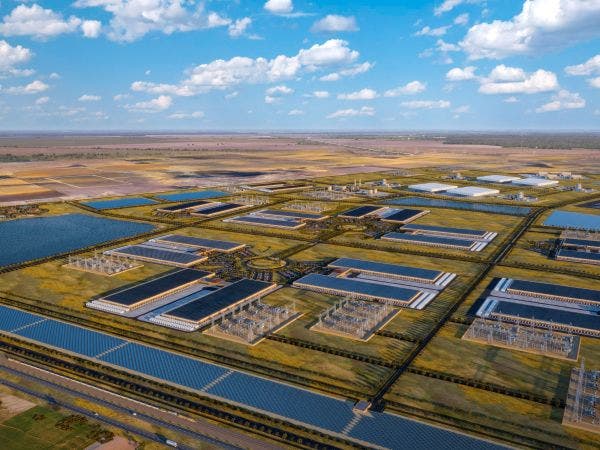
Data center builder Fermi America plans to construct four nuclear reactors along the plains outside of Amarillo, Texas, home to the largest natural gas fields in America and next door to where the U.S. builds nuclear weapons, though the company acknowledges that its management team has “limited experience” in the nuclear sector, and the CEO is currently fighting accusations of fraud.
The details were disclosed in Fermi America’s application for an initial public offering filed Monday with the U.S. Securities and Exchange Commission. CRN has reached out to Fermi America for comment.
The company, focused on landing AI hyperscale tenants, hopes to list on the Nasdaq under the ticker symbol “FRMI.”
The building of the “first-of-its-kind" energy campus called “Project Matador” expects to produce 11 gigawatts of behind-the-meter power for AI infrastructure through the use of four, full-scale Westinghouse nuclear reactors, along with 4.5 gigawatts of gas-fired power, solar PV arrays, and battery energy storage systems.
The 5,263-acre site is owned by the Texas Tech University System and sits beside the Panhandle-Hugoton Gas Field, which is one of the largest known natural gas fields in the U.S., the filing states. Project Matador also abuts Pantex, where the U.S. Department of Energy has built and now disassembles nuclear weapons and stores plutonium, according to the Pantex website.
“Project Matador, is among the largest hybrid infrastructure developments in the United States, that will combine hyperscale data centers and vertically integrated energy assets on a single site,” the filing states. “Project Matador is designed to host power generation, transmission, compute workloads, and chip manufacturing equipment all within the same perimeter.”
In order to hold on to the lease of that property and begin building, Fermi said it must show the lease holder, Texas Tech University, that it has secured “fully and unconditional funding for Phase 1.” If it can’t do that by Dec. 31, it risks losing the lease.
The project is currently in “Phase 0” and development through “Phase 1” is expected to cost at least $2 billion with a target to finish that by December 2026. To win that money and lock up its lease of the land, the company has embarked on the IPO, the filing states. The full build-out across all phases of Project Matador is expected to see a pricetag between $70 billion to $90 billion.
Fermi recently won $100 million in Series C preferred equity funding along with a $250 million loan from the Macquarie Group. The company has also raised $246 million in debt financing since May.
It has applied for a 10-year property tax abatement from Carson County, Texas. The Carson County Commissioners Court may review the request in the third quarter 2025, the filing states.
The company has generated no revenue to date, and expects financial losses to continue “for the foreseeable future” as it builds out its power footprint, Fermi America stated in the filing. It hopes to see tenant revenue begin in 2027, but it does not expect to see fully operating and capital requirements until phase four of Project Matador when it has successfully deployed up to six nuclear reactors on two nuclear islands in 2038.
Fermi plans to deliver a full 1 gigawatt of capacity by the end of 2026, with 46 percent coming from natural gas, 46 percent coming from mobile generators, and 8 percent purchased from the grid.
In May, it began the purchase of turbine and power equipment from Seimens. This includes “a combined cycle gas power plant rated at 487 MW.” Fermi said the equipment has been fully fabricated and is ready for shipment, but it remains warehoused at Siemens staging facilities in Germany, Sweden, Vietnam and China pending final delivery and assembly. Fermi still owes Seimens $134 million plus shipping costs, which are expected to total between $10 million and $12 million.
Once those are delivered, Fermi hopes to have that plant in operation by April 2026.
Fermi America’s CEO and cofounder is Toby Neugebauer, who co-founded Quantum Energy Partners in 1998, which was a private equity firm focused on energy investments. He also founded Windrock Capital, which was acquired by Macquarie. In 2022, he operated GloriFi, a bank that has declared bankruptcy. Fermi’s other co-founder is former Texas Gov. Rick Perry. Perry served as U.S. energy secretary from March 2017 to December 2019.
Nuclear Ambitions
As a “core component” of Project Matador’s power platform, Fermi plans to build four AP1000 pressurized water reactors developed by Westinghouse to provide 4 gigawatts of power to the site, with the first one beginning construction on Dec. 31, 2026, for a 2032 commission and then another in 2034, 2035 and 2036. Additionally ,the company is drafting plans to build another 2 gigawatts of nuclear power from small modular reactors.
However, the engineering, construction, and licensing of nuclear reactors is a complex and highly regulated undertaking, Fermi stated in its filing.
“Our management team has limited experience in the nuclear energy sector, which may hinder our ability to effectively navigate the complex technical, regulatory, and operational challenges associated with Westinghouse Reactor and SMR (small modular reactor) projects,” Fermi America wrote. “This lack of experience could lead to delays, misjudgments, or failure to anticipate critical risks, further increasing project costs and timelines.”
In August, the company hired Mesut Uzman as chief nuclear officer.
Uzman previously worked in the United Arab Emirates, China and Bulgaria and led the successful development of the 5.6-gigawatt Barakah nuclear project in the UAE, which recently celebrated its first year of operation and is comprised of four APR-1400 nuclear reactors. He played key roles in the construction and commissioning of 12 nuclear units in China, including four Westinghouse reactors, the company said.
Fermi also hired Mesut Uzman’s wife, Sezin Uzman, who has been named vice president of nuclear supply chain and compliance. She previously worked on the Barakah Nuclear Energy Plant, where she oversaw regulatory coordination.
Fermi’s power plans include two gigawatts of small modular nuclear reactors, called SMRs, which are in the early stages of development and deployment globally. Fermi wrote and the technology is still under evaluation.
“The limited availability of commercially viable SMRs poses additional risks. The technology is still emerging, with few operational SMRs globally, and the supply chain for specialized components is underdeveloped,” the company warned.
‘Risk Of An Accidental Explosion’ And Access To Thousands Of Nuclear Professionals
In the SEC filing’s risk section, Fermi said also of concern is Project Matador’s proximity to Pantex, a high security U.S. Department of Energy facility for nuclear weapon assembly and disassembly that is also on the national priorities list as a superfund site. The last nuclear weapon assembled there was in 1991, according to Pantex’ website.
This cuts both ways, Fermi said as it offers “normalization of nuclear activity” as well as logistical resource and infrastructure benefits, but comes with the potential danger of an “accidental explosion” or “catastrophic incident” at either facility.
“In addition, there is a risk of an accidental explosion or other catastrophic incident. Such an incident at the Pantex Plant or on the Project Matador Site could materially and adversely affect Project Matador, including causing significant construction delays, significant disruption of operations and damage to infrastructure and equipment,” the company disclosed.
On the other hand, Fermi said Pantex – the nation’s primary nuclear weapons center – is home to 4,600 “skilled nuclear professionals,” which the company highlighted as a resource for labor at its own facility.
“Our proximity to the Pantex Plant offers us the opportunity to access a highly experienced workforce steeped in nuclear safety culture and expertise,” the company stated. “We believe this proximity to critical United States nuclear and security infrastructure will be highly attractive to our prospective tenants.”
Fermi: Project Matador’s Timeline Is ‘Aggressive’
Nuclear power development in the U.S. has “slowed dramatically,” Fermi said with the most recently certified nuclear plant in Georgia taking 15 years to complete.
Yet Fermi plans to build and switch on the nation’s second largest nuclear generation complex comprised of four traditional nuclear reactors and two small modular reactors — 6 gigawatts of nuclear power — by 2038, 13 years from now.
Fermi is relying on the Trump administration’s push to hurry sign-offs for nuclear power projects. The administration has shortened the approval time for new nuclear reactor license applications to no more than 18 months. The goal is to have three new nuclear plants reach “criticality” by July 2026.
Fermi’s combined licenses application for 4 gigawatts of nuclear power has undergone a preliminary review and has been accepted for processing by the U.S. Nuclear Regulatory Commission.
Fermi is holding to a five-year construction cycle for each nuclear plant, basing that on projects that were completed in China and the UAE, it stated in the filing.
However, Fermi acknowledged there are risks to betting that looser regulations will remain in place.
“There can be no guarantee that this executive order will be effective in doing so or that a future Presidential administration will not reverse this executive order,” Fermi stated. “Indeed, certain recent nuclear power plant projects have taken more than ten years from commencement to completion and the timeline in our model to make the Westinghouse Reactors operational is aggressive,” the company stated.
CEO Buffeted By Fraud Accusations, Lawsuits
Fermi America’s President and CEO Neugebauer was previously the founder and CEO of GloriFi, a short-lived bank that marketed itself as catering to politically conservative causes. In July 2022, that business sought $1.7 billion in funding via a special purpose acquisition company (SPAC) merger with DHC Acquisitions. But it later declared bankruptcy.
In January 2023, Animo Service, an affiliate of GloriFi filed for bankruptcy and the trustee filed adversary proceedings against Neugebauer accusing him of a series of fraudulent transfers and breaches of fiduciary duty.
In February 2023, GloriFi’s bankruptcy trustee did the same, and also filed adversarial proceedings against Neugebauer “alleging a series of fraudulent transfers and breaches of fiduciary duties.”
Then in March of 2023, GloriFi investors filed a lawsuit against Neugebauer alleging “fraudulent inducement, negligent misrepresentations, breach of fiduciary duty, unjust enrichment and exemplary damages.”
Neugebauer contests the allegations and has filed his own federal lawsuits against GloriFi investors in Georgia and Delaware under the Racketeer Influenced and Corrupt Organizations Act.
In it he takes aim at high-profile conservative power brokers and campaign donors who invested in GloriFi, including Citadel CEO Ken Griffin, Peter Theil’s Founder’s Fund, and entrepreneur Vivek Ramaswamy. He accuses the group of attempting to wrest away control of the business and oust him as CEO. His suit is on hold while Texas courts wade through the allegations in GloriFi’s bankruptcy proceedings.
In response to an email from CRN, a Citadel spokesperson provided a news story in which a spokesman for Griffin called Neugebauer’s claims “fabricated nonsense.” A LinkedIn message to Founders Fund’s chief communication officer was not immediately returned. And a representative for Ramaswamy could not be located.
In the risk disclosures, Fermi said these legal matters could be a distraction to Neugebauer as he leads Fermi.
“Although Mr. Neugebauer continues to vigorously contest the allegations against him, assert his rights, and pursue causes of action, the Animo/GloriFi Proceedings may attract negative press coverage and other forms of attention to the Company, and at times could divert Mr. Neugebauer’s attention from the day-to-day operations of the Company,” the company warned. “We cannot predict the outcome of the Animo/GloriFi Proceedings or the impact they may have on the Company or its financial condition.”