Microsoft Unveils ‘World’s Most Powerful AI Datacenter,’ President Brad Smith Says
Inside 1.2 million square feet of floor space, Microsoft has joined thousands of interconnected Nvidia GB200s in a computing cluster capable of processing 865,000 tokens per second
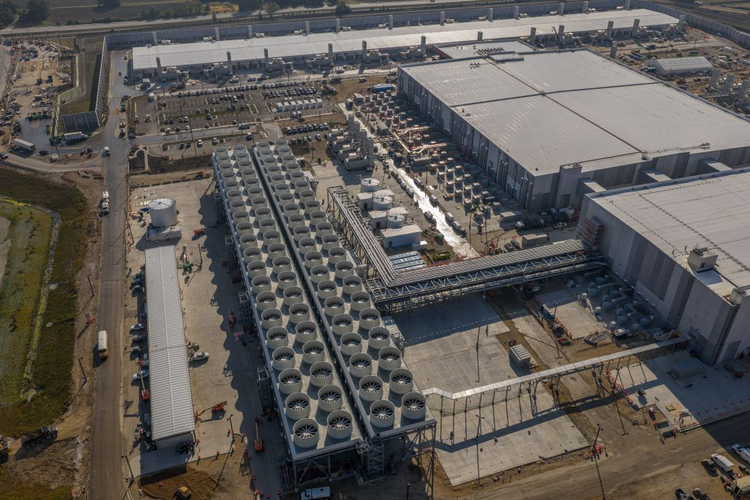
Microsoft said the most powerful AI data center in the world – with 337.6 megawatts of capacity – will soon be online in the fields of Racine County, Wisconsin.
The facility, dubbed Fairwater, was announced in 2023 and heralded a massive win for locals after Apple supplier Foxconn had abandoned plans for a manufacturing facility at the site. Microsoft has spent the last three years, and $3.3 billion, to bring the facility online and said on Thursday it is nearly completed and will be ready to open in in early 2026.
“In the heart of the American Midwest, a modern marvel is rising,” Microsoft’s vice chairman and president, Brad Smith, stated in a blog post Thursday. “We’re in the final phases of building Fairwater, the world’s most powerful AI datacenter in Mount Pleasant, Wisconsin — part of a region forged by generations of hard work and ingenuity.”
Scott Guthrie, executive vice president of cloud and AI for Microsoft, stated that what makes this facility so powerful is that it is running thousands of interconnected Nvidia GB200s in a computing cluster capable of processing 865,000 tokens per second, “the highest throughput of any cloud platform available today.”
“Each rack packs 72 NVIDIA Blackwell GPUs, tied together in a single NVLink domain that delivers 1.8 terabytes of GPU-to-GPU bandwidth and gives every GPU access to 14 terabytes of pooled memory,” Guthrie wrote. “Rather than behaving like dozens of separate chips, the rack operates as a single, giant accelerator, capable of processing an astonishing 865,000 tokens per second, the highest throughput of any cloud platform available today.”
Guthrie called out some of the statistics involved in building the data center including 1.2 million square feet of floor space, 26.5 million pounds of structural steel, 120 miles of medium voltage underground piping, and 72.6 miles of mechanical piping.
The Wisconsin data center is one of several that Microsoft is building including in Narvik, Norway, and Loughton, U.K. The Norway and UK AI datacenters will use similar designs to Fairwater and incorporate Nvidia’s newer AI chip design, the GB300, which offers even more pooled memory per rack, he wrote.
According to documents filed with Racine County, the Wisconsin data center is built on a 200-acre greenfield site inside a larger 315-acre plot of land.
It’s comprised of four buildings including a 545,620-square-foot, two-story conventional steel-framed structure with 194.4 megawatts of data halls. Another building will house 43.2 megawatts of data halls inside 293,420 square feet, and a third 263,170-square-foot building will contain the central utility plant, a structure that hosts a chiller room, pump room and other infrastructure. The fourth building is reserved for administration, the documents stated.
Smith said the current facility will soon house “hundreds of thousands” of Nvidia GPUs connected “by enough fiber to wrap around the planet four times over.” The horsepower is needed to handle training for “frontier AI models” and once it is operational, is expected to deliver “ten times the performance of today’s fastest supercomputers.”
“This is where the next generation of AI will be trained, setting the stage for breakthroughs that will shape the future. New discoveries in medicine, science, and other critical fields will start right here, with the models we train in Wisconsin,” said Smith, who added that he used to deliver newspapers by bicycle in Mount Pleasant, the town where the facility is located.
The buildout of the data center employed 3,000 construction workers during peak activity and it will require a full-time workforce of 500 to keep it running.
To offset the electricity used, Smith said Microsoft will match every kilowatt-hour it consumes from a fossil fuel source with carbon-free energy that it will return to the grid. As part of this project, Microsoft teamed with National Grid to build a new 250-megawatt solar project in Portage County that is under construction to support this commitment.
Microsoft is also planning a second data center “of similar size and scale nearby,” Smith wrote in his blog.
“We’re committing an additional $4 billion to be spent in the next three years to build our second datacenter of similar size and scale — bringing our total investment in Wisconsin to more than $7 billion,” said Smith.