Dell Supercomputing 2026 AI Innovation: Direct Liquid-Cooled Storage, Dell AI Data Platform Advances, OpenAI Codex Integration
Dell Technologies has is aiming to make agentic AI solutions faster for partners to deploy at a lower cost with a number of new products, including the world’s first direct liquid-cooled storage for rack-scale AI.

Dell Technologies has taken a “big step forward” in its drive to make agentic AI solutions faster for partners to deploy at a lower cost with a number of breakthroughs, including the world’s first direct liquid-cooled storage for rack-scale AI, said Dell Infrastructure Solutions Group Senior Vice President of Product Marketing Varun Chhabra (pictured).
Among the other Dell breakthroughs unleashed at the Supercomputing 2026 (SC26) show in Chicago this week are Dell AI Data Platform advances, including a new Agentic Data Gateway that promises a 76 percent reduction in total token consumption and integration with the popular OpenAI Codex software engineering coding platform.
The advances help partners make the “leap” from infrastructure providers to strategic AI solution providers, said Chhabra.
“This is all about helping partners prove value to customers, taking AI workloads to production faster than ever before with better ROI than ever on AI workflows,” said Chhabra in an interview with CRN. “This is all in the service of helping partners be seen more as strategic consultants and trusted advisers for helping customers think through their AI workflows.”
The opportunity for partners is to reinvent their business model to help customers across the entire AI life-cycle journey, said Chhabra. “It’s not just about resale,” he said.
Success in bringing business-outcome-driven AI solutions to customers starts well before infrastructure deployment with consulting aimed at bringing key company stakeholders together to align on an AI solutions strategy, said Chhabra.
Chhabra said organizational alignment and data preparation are key to success. “You need to look at what’s the right data and are you legally allowed to use the data,” he said. “You need to look at governance concerns. There is a massive opportunity for partners to really step in in a more strategic and advisory role than ever before.”
Here’s a look at the biggest innovation breakthroughs from Dell Technologies at SC2026 and the key to partner AI success with the new offerings.
‘Changing The Game’ With First-Ever Direct Liquid-Cooled Storage For AI
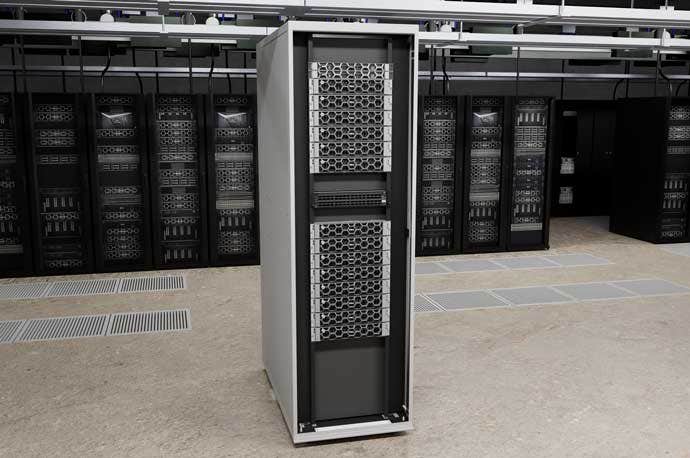
Dell is “changing” the AI game with the “world’s first direct liquid-cooled storage” for rack-scale AI with file object, block and parallel file storage in one platform, said Chhabra.
“Everybody talks about liquid-cooled compute, but we’re actually changing the game with liquid-cooled storage,” said Chhabra. “We already have liquid-cooled compute and liquid-cooled networking. Now we’re going to have liquid-cooled storage.”
The liquid-cooled storage opens the door for Dell to provide 67 percent greater drive density per rack unit.
Dell is currently working with Nvidia to certify the liquid-cooled storage.
Dell said the ability to share storage, compute and networking on the same liquid-cooled infrastructure is key to simplifying rack design, deployment and expansion in AI environments.
“This is a really, really big game-changer for partners working with customers on large-scale deployments,” said Chhabra. “Being able to do liquid-cooled storage along with liquid-cooled compute and networking is a massive, massive breakthrough.”
With data center space at a premium given the AI buildout, the liquid-cooled storage allows customers another “dimension” to maximize data center space and be more efficient, said Chhabra.
“Liquid cooling is uniformly the most efficient way to actually build out your racks because you can squeeze a lot more infrastructure in there,” he said. “That means per rack you have a lot more storage, compute and networking capacity. The biggest advantage is efficiency with data center space, efficiency with cost, cooling and power.”
Dell AI Data Platform Advances: Agentic Data Gateway Reduces Token Consumption By 67 Percent
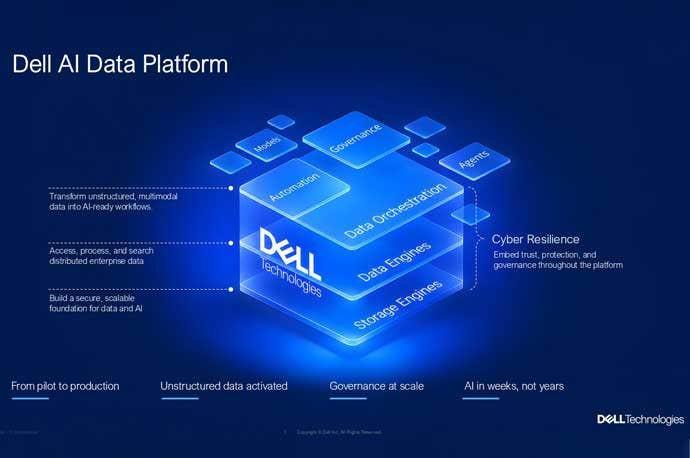
The new Dell AI Data Platform Agentic Data Gateway provides a single point of entry to secure and govern internal and external agents with identity, permissions, routing, observability and governance.
“What we’re finding with the Agentic Data Gateway is that it can reduce token consumption by 76 percent,” said Chhabra. “Think about the costs customers are seeing with token generation today. This is massive, massive savings.”
Dell has also found that the Agentic Data Gateway increases answer accuracy from 60 percent to 94 percent with governed context, said Chhabra. That’s a “huge unlock” that ultimately means more confidence in agentic AI business results.
The Agentic Data Gateway essentially provides a “governed path for enterprise data” with context, said Chhabra. “If you don’t have context around the data, the ability or effectiveness of the AI workload is limited,” he said. “The goal is to provide that governed pathway for what data and context agents have access to. You have to set up the plumbing so teams don’t have to rewire things every single time.”
Dell AI Data Platform Director of Product Management Vrashank Jain said in a press conference that the Agentic Data Gateway is the “perfect solution” for any customer looking for data sovereignty.
The Agentic Data Gateway provides a “singular place to govern” AI agents, enabling AI agent solutions to move from pilot to production faster, said Jain.
“Authorization, quotas, failing over, logging and cost tracking are now handled centrally rather than hand-wiring this to every single agentic application that users are building,” he said.
“These are the kinds of things that security officers and data stewards have long been asking for,” he said.
Dell AI Data Platform Is Critical To Helping Customers Reduce Token Costs
A deep understanding of the Dell AI Data Platform is critical to reducing token costs by helping customers train AI models and making them run more efficiently, said Chhabra.
“The AI Data Platform is a huge opportunity for partners,” said Chhabra. “There are many announcements underneath it, but the key is getting in there, understanding what the AI Data Platform enables and how customers can use it to train their models and make their models run better.”
Dell has found that using the AI Data Platform is critical in reducing token costs by reducing the reliance solely on LLMs, said Chhabra.
“The more you are having the LLMs recompute things they have done in the past, the more inefficient you are with your costs,” he said. “But if you have a strong data foundation in place that the AI Data Platform provides, it actually helps the models have memory so they don’t have to recompute things again and again. That means there are less token costs and you can spend your tokens on things that have truly not been created before.”
Dell AI Integration With OpenAI’s Codex Coding Platform
The Dell AI Data Platform integration and reference architecture with OpenAI’s popular Codex coding platform opens the door for partners to run Codex solutions on-premises in a hybrid solution.
“This is truly a hybrid solution,” said Chhabra. “It allows customers that are using OpenAI to actually keep some of their data on- premises when it comes to coding assistants.”
Chhabra called code assistants the “No. 1 use case” for AI for enterprise companies. “There is a lot of value here for partners to go drive value for customers,” he said.
Dell unveiled the Codex integration and reference architecture at Dell Technologies World earlier this year. Now it is available, said Chhabra.
Chhabra said hybrid cloud support for AI solutions is critical. “The work we are doing with OpenAI is a great example of that multi-cloud, hybrid reality customers find themselves in with AI,” he said. “This is an opportunity to prove value to customers in that hybrid AI world.”
New AI Agentic Infrastructure Management With Dell OpenManage Rack Scale, Dell Fabric Manager
Dell’s new OpenManage Rack Scale’s new agentic infrastructure platform is a major step forward for AI infrastructure management, said Chhabra.
Dell OpenManage Rack Scale, which provides infrastructure at a scale of up to 100,000 devices or 12 times more than the previous generation, opens the door for partners to monitor and manage at a rack-scale level with “AI learning” that provides faster root cause analysis, said Chhabra.
Dell’s new Fabric Manager, meanwhile, a new life-cycle management and observability platform across multi-network environments, helps partners manage networks at scale, said Chhabra.
Dell has also added new SONiC open-source network operating system support for the Dell Z9964F-ON high-end Ethernet switch and for the Nvidia SN4700 high-performance 400-Gigabit Ethernet data center switch and the Nvidia SN5600D, a high-performance 800-Gigabit Ethernet switch.
“The latest version of SONiC gives organizations silicon flexibility, multi-vendor interoperability and one consistent operating model across AI,” said Chhabra.

A Call To Action For Partners: Adopt Dell AI Data Platform With ISV Solution Blueprints
The call to action for partners in the wake of the Dell AI innovation offensive is to adopt the Dell AI Data Platform with ISV solution blueprints, said Chhabra.
“The AI Data Platform and getting under the hood of that and then learning more about what we are doing with our AI blueprints with our ISV partners are the two biggest calls to action for partners I would highlight,” said Chhabra.
Among the ISV reference architectures and validated solutions through the Dell AI Ecosystem program besides OpenAI are F5 and JFrog security software; DataRobot agentic AI platform; Dynatrace full-stack observability; Ipsotek computer vision; Teradata and Iternal Technologies data solutions; and ClearML and Klique AI governance and orchestration solutions.
“Our goal is to provide helpful partnerships and validated stacks across use cases,” said Chhabra.
MSPs taking AI managed services to their customers can reduce their own costs by taking advantage of the Dell AI automation platform blueprints—essentially “instruction sets for automating deployment,” said Chhabra.
“This is an opportunity for partners to actually reduce costs and deliver value to customers faster than they have ever done before,” he said.