Partners: Dell Supply Chain Superiority Is Driving Sales Growth Versus Competitors
As supply chain disruptions and memory shortages pressure IT buying decisions, Dell Technologies partners say the company’s unmatched supply chain strength is driving sales growth and competitive wins.
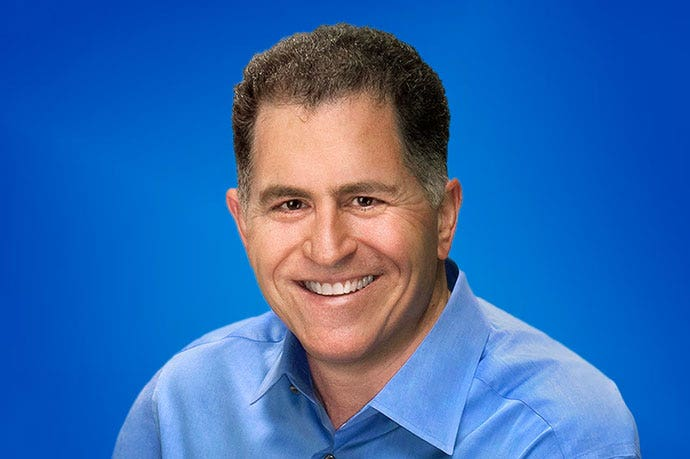
When several top World Wide Technology customers were concerned about getting orders filled in the midst of the current memory shortage and supply chain crisis, Dell Technologies founder, Chairman and CEO Michael Dell (pictured) stepped in to personally guarantee availability, bringing those sales “opportunities” over the goal line.
“Michael was able to come in and reassure the client on supply and availability and that we collectively would be able to meet their demand,” said Bob Olwig, executive vice president of global partner alliances for WWT, the $20 billion global solution provider behemoth that counts Dell as one of its top partners. “I think that’s pretty powerful. We don’t take that for granted—the relationship that we have with Michael Dell and other executives like Pete Trizzino, who heads up global sales. We feel like we are in a very humbling position with Dell right now, but it has been built up over 25 years of partnership.”
As Dell hosts thousands of partners this week at its Dell Technologies World Conference in Las Vegas, Olwig is one of many top channel executives saying that Dell Technologies’ much-heralded supply chain prowess is paying off. They say Dell’s ability to work hand in hand with them on price, supply and availability is a big differentiator in the current supply chain crisis.
When Michael Dell founded the company that bears his name 42 years ago in a dorm room at the University of Texas at Austin, he made its supply chain superiority a hallmark of the company from its early days. That supply chain prowess has become a big factor, with the company leveraging its $113.5 billion size and carefully nurtured legacy partnerships with memory and component suppliers to grow the business amid the current memory shortages.
Olwig, a 30-year WWT veteran who has been an executive sponsor of the Dell relationship for 25 years, said Dell “clearly” has a supply chain advantage that gives it a competitive advantage.
“We’re seeing great momentum with them right now, not the least of which is the AI-driven growth that we are sharing in terms of not only large hyperscalers and neoclouds, but we are also starting to see some traction with the enterprise accounts we are working on,” he said. “Dell is in a great position. Their stock is at all-time highs. It’s just a lot of fun working with them right now.”
With the memory shortage and supply chain crisis “top of mind” for every one of WWT’s enterprise accounts, the tight partnership with Dell is paying off in “more strategic” conversations with customers, said Olwig. “Nobody likes to be in this situation, it is disruptive for everyone, but Dell is a steady hand in all of this,” he said. “They have a great reputation in terms of delivering. I think they are bringing a competitive advantage in the market with their supply chain, and it is really coming through. We’re having very strategic customer conversations with Dell and with our enterprise customers together as we try to understand their spend and the time frame in which they need to acquire equipment and get it deployed.”
Olwig said there simply is no one that can match the Dell supply chain. “Dell has always touted that, and it has always been brought to bear through the years,” he said. “There is no one positioned like they are in terms of storage, compute, AI and client. They are unmatched in the industry as it relates to that amount of business and strength that they have. That just bolsters their supply chain advantage for sure.”
Even amid the current memory shortage, Dell reported record sales of $33.4 billion in its fourth fiscal quarter ended Jan. 30, up 39 percent compared with the same period a year ago.
Dell Technologies Vice Chairman and COO Jeff Clarke told analysts during the last Dell quarterly earnings call that the company’s supply chain prowess is poised to drive share gains in PCs, servers and storage despite astronomical memory prices increases.
“If you look at the last industrywide shortage [during the COVID-19 pandemic], Dell excelled and took share across the board, most notably in its PC business,” said Clarke. “Our long-term relationships, supply agreements with our partners we believe position us to take share in all of our businesses and in particular PCs.”
Furthermore, Clarke added: “We think there is a structural share opportunity for us certainly over the next couple of years as our supply chain team has positioned us quite well. I believe we can do that in servers. I believe we can do that in storage as well.”
Dell Chief Partner Officer Denise Millard said that the company is seeing scenarios where partner opportunities are moving from an incumbent competitor in an account to Dell because the “partner was sensitive in terms of timing, delivery or just wanting to make sure they had a little more control over when that outcome was going to get delivered.” She sees that “upside” continuing in the current quarter.
Dell partners, for their part, said they are seeing the Dell supply chain advantages paying off in sales growth for them.
Stephen Ayoub, executive vice chairman of Ahead, the $4 billion-plus solution provider powerhouse, No. 27 on the 2025 CRN Solution Provider 500, said Dell’s supply chain superiority resulted in a 63 percent increase in Ahead Dell server sales in the first quarter, up from the same period one year ago.
“We’ve been taking share from Dell competition in the marketplace,” said Ayoub. “A lot of that has to do with their availability of products and also their ability to keep pricing somewhat stable. We’ve seen our clients ordering a lot of inventory ahead with us managing deployment over six to 12 months by bringing inventory in, building it in our facility and shipping it to their locations throughout the country and the world.”
Ayoub, who referred to Dell’s supply chain capabilities as one of the company’s “superpowers,” said Ahead has seen “consistency” of pricing from Dell even amid the supply chain crisis. “There has been some instances where the price has increased, but it hasn’t been nearly as dramatic as the competition,” he said.
Holland Barry, field CTO for DXC, the $12.64 billion systems integration behemoth, No. 14 on the 2025 CRN Solution Provider 500, said Dell’s supply chain prowess is also paying off for DXC and its customers.
“We’ve had some situations where we had customers in a spot with another supplier, one of Dell’s competitors, and we’ve been able to come in and leverage those [Dell] supply chain dynamics to produce a very delightful outcome for customers,” said Barry.
Furthermore, Barry said, DXC has been able to get some flexibility on just how long a Dell price quote is guaranteed. “We can maybe extend that a little bit to match what the customer’s needs are,” he said. “Those are the kind of outcomes we have been able to produce for our customers.”
In contrast, some Dell competitors are drawing a hard line in the sand, refusing to extend price quotes, said Barry. “You can’t wait five minutes, and you certainly can’t even wait 24 hours—the story is a little bit different with Dell,” he said. “That feeling from the customer’s perspective that they can digest this information, make a decision, and maybe get some other stakeholders involved, especially in a large purchase, is a huge differentiator in the sales cycle process.”
Barry said the DXC-Dell relationship is so “broad and global” that it provides a “unique advantage” as it relates to the time frames for getting certain products. “That message is resonating really well [with customers],” he said. “We’ve leveraged that [Dell] relationship with certain RFPs [requests for proposal] and even last-minute orders [where customers] say, ‘Oh gosh, I can’t get this anywhere else.’ From a supply chain perspective, Dell is in a super strategic position.”
Jason Kranitz, president at Integrated Media Technologies (IMT), No. 200 on the 2025 CRN Solution Provider 500, said Dell is “far and away” the one vendor that is making lead times and supply chain less of an issue for customers. “Dell is a tremendous partner for us, and their supply chain advantages really do help,” he said.
Kranitz said he sees IMT’s Dell business growing 50 percent this year as a result of Dell’s supply chain superiority combined with the AI boom and the explosion of unstructured data. “AI and unstructured data is absolutely on fire,” he said. “Dell has supply chain. Other vendors are struggling. We expect that is going to have a significant impact on IMT’s business this year.”
Olwig, for his part, credits Michael Dell and Clarke for bringing a level of “rigor and discipline” that is being brought to bear in the Dell supply chain. “That level of consistency, the predictability, the trust that has been built, we don’t take that for granted,” he said. “We bring that to bear when we are serving our joint customers together.”
Olwig said even with the supply chain crisis, WWT is off to its “fastest start” ever in its 35-year history thanks in part to the partnership with Dell.
As for Michael Dell’s involvement, Olwig said it is not a “one-off” situation but rather part and parcel of the Dell channel sales go-to-market model, said Olwig. “Michael is very engaged, especially in their largest enterprise customers,” he said. “We share in serving those customers together. He makes his presence and reassurances known in some of these larger opportunities.”