Celona Modernizes Channel Program To ‘Co-Invest’ In Partners Capturing Private 5G Opportunities: Exclusive
“In order for us to continue to scale, we have to untap the potential of our partners and really enable them in a way like we’ve never done before,” Andy Hawk, Celona’s senior director of channel sales, tells CRN.

Private wireless provider Celona has made significant channel program changes that aim to better support MSPs building sustainable, repeatable private 5G practices.
The newly revamped Celona Frequency Program replaces the previous “vanilla” structure with the inclusion of a new tiered system for incentivizing early-stage partners around private 5G and rewarding partners that upskill and form longer-term commitments with the company, Andy Hawk, Celona’s senior director, channel sales, North America, told CRN.
“We wanted to create a program that was a little more progressive, that co-invested as our partners invested in the partner program to bring more value across the entire ecosystem,” Hawk (pictured above) said. “In order for us to continue to scale, we have to untap the potential of our partners and really enable them in a way like we’ve never done before. It’s the only way we’re going to grow globally.”
The private 5G upstart in 2022 launched its first solution provider partner program called the Fanatics channel program, which gave resellers, MSPs and systems integrators a formal way to interact with and register private 5G and LTE deals with Celona. The company then revealed the Celona Frequency Program in late 2024.
The company, which goes to market entirely through the channel, has more than 200 partners today, Celona executives told CRN.
The aim of the restructured program was to give partners a familiar structure similar to some of the most successful partner programs available today that partners could feel good about investing in because the value to them would continue to increase, Hawk said.
“We wanted to make sure that we supported the partners from end to end, regardless of where they fit, and give every partner the opportunity to upskill and to build that foundation of knowledge … and that comes through online certifications and through onsite training. Then, we also wanted to give them the opportunity to differentiate themselves through specialization badges,” he said.
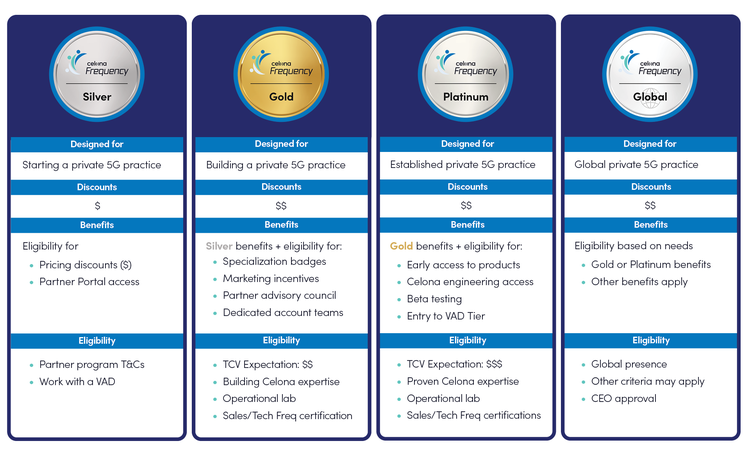
The newly revamped Frequency program includes four tiers: Silver, Gold, Platinum and Global. The first level, Silver, has been designed for partners starting a private 5G practice. The next tier is Gold, which provides eligibility for specialization badges, dedicated account teams, and the partner advisory council to partners building a private 5G practice. These partners must also have an operational lab and sales and tech certifications.
Most of Celona’s current partner base fits into the Gold tier as of now, Hawk said.
“In the front end of the partner journey, you have partners that come into the program. They really don’t have a private cellular practice, they really don’t have the tools for success, and they’re typically in a big hurry to sell a Celona solution. So, we’ve built a tier for them that officially enables them to work with a partner that already has all those skill sets, has the certifications and has the ability and experience to work in a distributor model. Then, those partners, as they move through the process, the value continues to grow,” he said.
The Platinum tier, for those that have an established private 5G practice, includes Gold benefits, plus early access to products, beta testing, and Celona engineering access. The final level, Global, includes all the same benefits as the Platinum level, but is designed for partners that have an established global private 5G practice and a global presence. Partners at this level must receive approval from Celona’s CEO Rajeev Shah.
Celona is also introducing two new specialization badges: Security and Managed Services. These have been designed for Celona’s security specialists and MSP specialists, respectively. Both are available for partners at the Gold tier or higher, the company said.
“Ultimately, this gives our partners opportunity to differentiate themselves, both internally as they evangelize their capabilities to our sales and engineering and operations teams, but also externally to the partner community and to the customer community,” Hawk said.
LRC Wireless, a telecommunications solution provider based in Lake Charles, Louisiana, has been on the cutting edge of connectivity and private cellular technology since its early days stemming back to the 1940s. Celona’s offerings, said the company’s president Perry Vincent, are a “true answer to a lot of problems.”
LRC has been partnering with Celona for private LTE, which the company sees as a next-generation connectivity offering for mission-critical applications. “When it comes out, we need to know about it,’ Vincent said.
LRC will be joining Celona’s new partner program at the Gold tier, aiming for Platinum, Vincent said.
“Private LTE is here to stay and you have to do it right,” he said. “Celona’s partner program is going to be a real way to give [partners] that participate in it the quality of service and support they need to make the [offering] stand for itself,” he said.
The Private 5G Opportunity
Celona’s Frequency Program has to evolve as demand for private wireless and 5G soars, Hawk said.
StepCG, a Celona partner that falls within the Platinum tier of the new program, prides itself on its engineering services chops. The company has a great deal of experience in private cellular, neutral host networks, and security integration, said Ed Walton, CEO of the Covington, Ky.-based MSP.
StepCG will be pursuing both the new Security and Managed Services specialization badges and as a Platinum tier partner, is acting as a value-added distributor (VAD) to Silver-level Celona partners. That’s because despite the significant opportunity around private 5G, there exists a “steep learning curve and significant investment” for some channel partners, Walton said.
“We’ll act as a services partner because many [partners] have not done a deployment, but may have a customer relationship and we can offer our services. They can bring us in, and that VAD construct allows us to say: ‘Here’s a menu of services that we know are needed in each deal, and you as a partner, you may not have that technical bench and you may want to focus on resale, but we can provide that for you, and we can even do it on your paper,’” he said.